
Science is the way of sceptics; belief is the way of everyone else.
Being an atheist in any time is a difficult thing, though hardly as much now as it was, say, in the 17th, 18th or 19th centuries (a period known as the Dark Ages).
 I am an atheist, proudly, in that I don’t believe in theology. I don’t believe there is a God, of any colour, and I don’t believe in any of the dogmatic practises that follow from such belief.
I don’t decry your belief in such, should you hold it, though I question the depth of your knowledge on the subject, and on several other subjects for that matter. And while I hold a level of distain for certain “inalienable rights” held by many western governments and societies, such as the right to religious expression, I, unlike my counterparts in theological circles, and apparently unlike some of my contemporaries, do not subscribe to an “us vs. them” mentality.
I believe in the Scientific Method; though the word “believe” in that statement is somewhat misleading. The Scientific Method does not require belief in its power or in its efficacy to proceed, unlike religion. Though, the inaccuracy of that statement is less about the semantics of opposition than it is about a misunderstanding or a misidentification rather, of one or the other. Some would juxtapose the two, the institution of science with that of religion, as a feature of some greater intra-secular battle, but in reality, science is not an institution. It is not a structure or a lobby group, or even a community as such…it is, as the name suggests, a method, a way of doing things, of looking at nature and the problems she[1] presents, so as to afford the best chance of finding a solution. It just so happens that the solutions traditionally offered by the Church (the institution of religion) are and have been wholly inadequate to address the real world problems faced by humanity, save for the typical wish-thinking of prayer and faith.
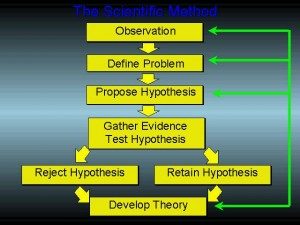
 Again though, the Scientific Method is not an institution, it is a method, and is clearly spelled out for all to see. Question, predict, experiment, observe and conclude. More specifically, the Scientific Method is quite simply a way of collecting data, or information, through observation and experimentation, with care taken to eliminate any and all biases from the process. I dare suggest, with a great deal of common sense backing me up, that our entire world, the world of the 21st century, is based upon and entirely dependent on the fruits of that particular method.
Every technology we enjoy is the product of some application of the scientific method; from indoor plumbing (on the scale enjoyed in western society) to cellular telephones and the internet, and everything in between. Even art, and music and literature are the result of an application of the scientific method, in practise if not in origin. But there are rules to the endeavour.
One cannot simply declare that a certain finding is true, or that another is false. Logic and reason must prevail, and indeed, only in those cases where they both have done so, has there been any success. It has been said that good science is good observation, by who is unavailable to me, though I’m sure it was someone more philosophical than I. But what is observation?
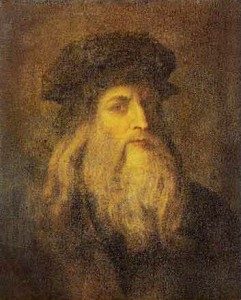
What is the difference, I ask you, between the scientific musings of a man, illiterate to the scientific language of the day (latin) and who had no formal education outside that of an artist, and a modern day paranormal investigator? I would say, for one, that the modern day investigator has a million-fold more reliable information about the workings of the natural world at his fingertips, wherein the genius of Leonardo is that he was able to suss out the correct details of much natural phenomenon without the benefit of the internet or Wikipedia, or even higher education for that matter.Is it merely the use of your senses? Well, yes, though the idea can be complicated some. Leonardo da Vinci is thought, by many scholars, to have been the quintessential observer, if not the rightful father of the Scientific Method.[2] It was not merely enough, for Leonardo, to see a thing, he needed to know it…to observe it. He would, in nearly all aspects of his long life, employ the Scientific Method to observe and describe even the most mundane details of objects, and processes and structures. It is what, arguably, made him quite possibly the master of all renaissance masters. It is also what made him, without a doubt, one of the first men of any age to demonstrate the power of astute observation (encompassing the collection of data for measurement and experimentation). Though his work, prolific as it is, remained unpublished during his life, and after death, while valuable, remained hidden from the eyes of common people, this does not negate the value of his experimentation and observation.
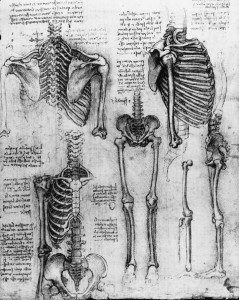
A folio page from da Vinci’s Notebooks on AnatomyI would suggest that the modern student of nature, who does not take advantage of the wealth of information lain at their feet, possesses a lazy intellect, or perhaps is simply not motivated to find truth. And is, perhaps, equivalent to the wish-thinking theologian, who holds faith that God will provide all the knowledge necessary to navigate this world.
Leonardo didn’t simply make his observations and leave the natural world to itself, however. He applied the Scientific Method in its entirety, not only making observations of his surroundings, but also making predictions about the outcome of experiments, and then comparing the results to his prediction. The fact, whether widely known or not, that he failed in his predictions more often than he succeeded, is no measure of his worth as a scientist, but rather is a testament to the validity of the process. He thought the world should be one way, based on initial observation, but when tested, it turned out that the world is actually another way, as was proven by experimentation. And this, above all else is the purpose of this discussion.
Leonardo da Vinci is an example of an everyday normal man, who, given the opportunity, turned his keen observational skills into a genius the world has scarcely known before or since.[3] He was not supernatural, nor was he fundamentally different than any educated man today. It seems that he simply knew the value of the Scientific Method, though was unable to put so succinct a name to the process.
 Even today, the world seems to be a certain way. We are continually affronted by mysteries and conspiracies, and problems and fallacies, and at the sheer volume of the questions we are, everyday, inundated, there is a process by which each of us can find answers, in truth and without the help of a Church or a God.
In light of the intervening ideas, my opening statement, “Science is the way of sceptics; belief is the way of everyone else”, is, I think, a paradox. Science is the way of the sceptic, in that a sceptic is one who questions the validity of those ideas and concepts that he faces, while those who are not sceptics may fail to see the problem through to truth, in favour of belief that God wanted things to be the way they are, and even possibly that they are not meant to know. The paradox enters where the fact becomes visible, that all people alive today benefit in some way from the toils of science, thereby making science the domain of every man, woman and child on the planet. Belief seems only to have been holding science’s place in line…for millennia or two. To solve the paradox, I might now change the statement to say that science is the way of humanity, and belief is the way of the past.
I might make that change, though I suspect I would receive some argument.
[1] The emphasis is added here, as I find it ironic that the sustaining life force and the process by which all life on earth exists, is traditionally referred to as Mother Nature, while the prevailing mindset in theology contrasts that with the idea that God is a masculine deity, as usual pitting the male and the female in opposite and incompatible positions. Though in reality, life would not exist, as we know it, without the cooperation of both sexes. This is not a new idea, just a funny one in my mind.
[2] The Science of Leonardo, Fritjov Capra (Knopf Doubleday Publishing Group) ISBN- 10: 1400078837
[3] The Notebooks of Leonardo da Vinci, Vol I & II, Leonardo da Vinci (Dover Publications) ISBN – 10: 0486225720
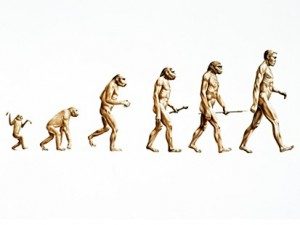 Evolution is compounding random genetic mutation. See…simple!
 DNA, when paired up with RNA (Ribonucleic Acid) – which is a similar structure, made up of amino acids as well, but which has a different function – makes for a powerful team. Without delving into the technical jargon of evolutionary genetics (the science of DNA), it can suffice to be said that where DNA is the recipe for building a living being, RNA is the cook. RNA has the function of instructing cells on their purpose, by telling them to read specific parts of the recipe (DNA), and thereby distinguishing between a skin cell and a brain cell.
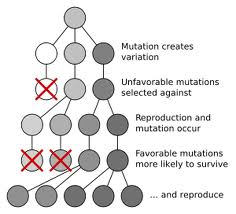 Essentially, a bug whose environment requires it to have a hard carapace (shell) would benefit from genetic mutations that caused it’s carapace to become harder, while genetic mutations that caused it’s carapace to become softer would result in those individuals dying long before they had the chance to breed, thus their genes and mutations (including the one for softer shells) would die with them.
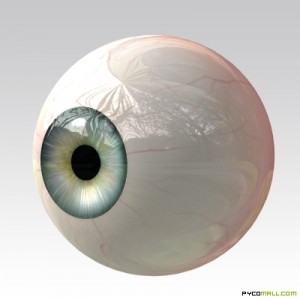 were not, but every successive mutation was built upon previous mutations. Where one mutation might have had the effect of making one cell sensitive to light, the next mutation could have had the effect of making that particular cell even more sensitive to light. And tiny mutational step after tiny mutational step, almost all animal life ended up with a collection of cells that are highly sensitive to light, and most amazingly with cells that are specially adapted to focus, limit and redirect light rays in order to compile a visual image of our surrounding environment. The effect of each small mutation is compounded over time to have a huge effect on the species as a whole. That effect, as can plainly be seen, is a natural progression toward ever increasing biological complexity, resulting in, among other things…us.
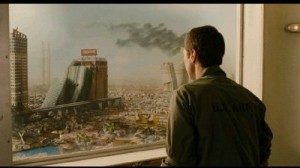 If we follow Judge’s logic, which seems sound on the surface of it, we might find ourselves in Private Joe Bauer’s future-world. A world where indulgent instant gratification has completely overtaken the power of reason, where systems crash around the ankles of a people who scarcely notice a problem, where commercialism and corporatism run rampant without chaperone and without even a rudimentary understanding of how or why they work (or don’t work as the case may be). In fact, that description seems to work quite well for our current world. A world where illiteracy is raging, where the vast majority of the population are permanently disadvantaged against the success for which they believe they’re working toward, a world that harbours a distorted idea of success that is sold to them by those same social vehicles that do constant harm to our economies and our social evolution – corporatism and commercialism. A world that is being held hostage by a few wealthy elites who, by most indications, don’t even know they’re doing anything wrong. But is this the inevitable outcome of the war on wisdom?
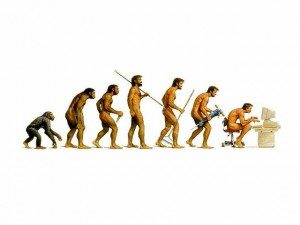 None of this speaks to the decline of intelligence though, at least not directly. One common mistake or misinterpretation of evolutionary theory is that the end result of genetic evolution was inevitable, as though the current incarnation of a species was the initial goal of the process. This easy mistake has profound implications for one’s overall understanding of the process. Evolution has but one goal, and that is not found in the quality of any species characteristics, whether that be the speed of the cheetah, the size of an elephant or the intelligence of man. That goal is simply genetic survival. There is no grand plan or scheme, and the affect that any one or any combination of genetic mutations has on the characteristics of the host species is nothing more than a side effect, albeit a side effect that is favoured by natural selection. If you think of human intelligence in those terms a realisation comes to bear; that the superiority we enjoy is an illusion. Our intelligence is a happy side effect of a collection of genetic mutations. What those mutations were is hotly debated among evolutionary biologists, anthropologists and neurologists, but all agree that our intelligence is nothing more than the product of a confluence of serendipitous genetic accidents.
 A swirling vortex of subatomic particles, influenced by gravity, solar energy and subtle nuclear forces; this is our universe…this is our reality. Some may find that description to be cogent while others may find cause to question.


