
 Well, it’s happened again, a highly valuable and prized historic monument has been destroyed by greed and in the name of “progress”.
Reported by 7News Belize on Monday 13, 2013, it seems a construction crew has demolished an historic Mayan pyramid at the Noh Mul site located in Northern Belize. Apparently a road construction crew demolished the 2300 year old pyramid in order to utilise its large amount of limestone, which is a scarce commodity in the area.
Using backhoes and excavation equipment workers of the D-Mar road crew bulldozed the monument which sits amid a sugar cane field on privately owned land. Some have said that the pyramid was overgrown with trees and vegetation, but that there was no mistaking what it was.
What is unanimously reported across news outlets is the fact that the pyramid has been completely destroyed with no hope of preservation. The site is not a UNESCO World Heritage Site and as such enjoyed the protection of the local Institute of Archaeology alone, the President of which told 7News Belize that the “destruction is horrendous, it’s deplorable, it’s unforgivable.”
Local police have stepped in and shut down the worksite as they investigate with the potential to charge both the land owner and personnel from the construction firm with wilful destruction of an historical site. What’s troubling is that this was not the first time limestone was taken from the Noh Mul site, in 1998 another of the 81 buildings on the 12 square-mile site was destroyed for similar purposes.
And this comes on the heels of the March 14th incident earlier this year in Nazca, Peru, where a mining company destroyed a part of the historical Nazca Lines, which are a protected UNESCO World Heritage Site. At this time it’s not known whether charged were levied in that case, but it does look like officials will take action in the Noh Mul investigation.
Archaeologist and member of the Belize Institute of Archaeology Dr. Jamie Awe had this to say about the incident[1]:
“I firmly believe it is important that we seek legal action otherwise we are sending a message that it is not important to preserve this heritage. A report that is being prepared by Dr. Morris is that the normal line of action is that this report gets sent to the Police Department in Orange Walk with a request from the Institute of Archaeology and that the police lay the ground works for charges to be made against those that are held responsible. In this case charges against the construction company for willfully [sic] destroying an ancient monument and the land owner who have had to be given permission for the company to access the property and then allow the destruction to take place.”
Public outrage for the incident has spread globally, thanks to the story being picked up by major US news outlets like CNN and Fox News and people around the globe are mourning for the loss of such important archaeological bounty. Personnel from the Institute of Archaeology will be inspecting the ruin in the hopes of salvaging specific artefacts and to study parts of the pyramid exposed due to the damage.
Unfortunately, as global economies suffer and fluctuate, poorer countries like Belize and Peru are forced to make tough decisions regarding what sites to protect and by what means. Leaving the potential for this kind of ignorance to result in the destruction of other sites; sites that, in all honesty, are the heritage of the entire human race, not just the people of their host countries.
It’s only a matter of time before we’ll see similar headlines decrying the ignorance perpetuated by the pursuit of the all-mighty dollar.


 Fortunately for our civilization at the time, electrical appliances weren’t in widespread use, and as a result, only a few telegraph services experienced a temporary disruption. A similar geomagnetic storm today would decimate our technologically dependent culture, rendering all computers, cell phones (and telephones for that matter) and vehicles useless, at least temporarily if not permanently.


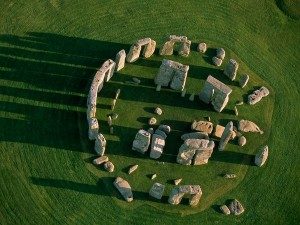 Among the megalithic structures of the ancient world, from huge pyramid complexes that boggle the mind, to rock walls consisting of precisely carved and placed stones of almost unimaginable size, to mysterious and beautiful stone circles, our history is rich with examples of ancient artistry and ingenuity.
 Rollrite Stones – Actually three distinct Bronze Age Neolithic monuments, the Rollrite Stones consist of The King’s Men, The King Stone and The Whispering Knights. The three sites are located near the village of Long Compton on the border of Oxfordshire and Warwickshire in the English Midlands. The Whispering Knights, a dolmen (a single chamber megalithic tomb), was the first to be built in approximately the 2nd millennium BCE, with The King’s Men following somewhere between the 2nd and 4th millennium BCE. The King’s Men is a stone circle believed to have trade based origins, much like Castlerigg, acting as a meeting place or market. The King Stone, located just north of The King’s Men, is a single standing stone of unknown date. It is believed to have been a marker for or a component of a Long Barrow or other burial site, but there is some speculation as to its alignment to the stone circle. The Rollritte Stones, especially The King’s Men, are an important site for neo-pagan magico-religious rituals.
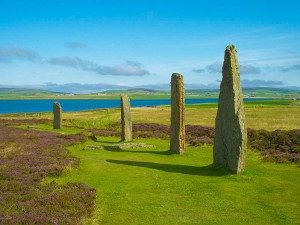 The Ring of Brodgar – (Also Brogar or Ring o’ Brodgar) The third largest stone circle in the British Isles and the youngest monument on the Ness o’ Brodgar, The Ring of Brodgar is believed to have been built between 2500 BCE and 2000 BCE. It has typically defied traditional dating techniques, and as the centre of the circle has never been excavated, little is known about its true age and purpose. The Ring sits in the West Mainland parish of Stenness, on Orkney Isle in Scotland. Among several other Neolithic sites in Orkney, The Ring of Brodgar enjoys protection as a World Heritage Site under the Heart of Neolithic Orkney. The site’s caretakers from Historic Scotland describe the site as “…the finest known truly circular late Neolithic or early Bronze Age stone ring and a later expression of the spirit which gave rise to Maeshowe.”
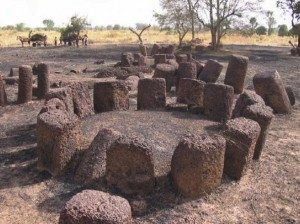 The Senegambian Stone Circles– Actually a collection of four large groups of stone circles, the Senegambian Stone Circles consist of over 1000 individual circles spread out over an area of approximately 15,000 square miles in and around Gambia, Senegal. Unlike some stone circle monuments in Western Europe, the Senegambian Stone circles, which were built around the eighth century, almost unanimously mark ritualistic burial sites. The circles were built by the ancestors of the Serer people of Senegal and have some connection to the steles of Roog, the supreme deity of the Serer religion. Also appearing on the World Heritage List, UNESCO describes the collection as “…a vast sacred landscape created over more than 1,500 years. It reflects a prosperous, highly organized and lasting society.”



 In the world of UFOlogy and Cryptozoology few characters are as spooky and memorable as those associated with the Derenberger incident. And while many people may be unfamiliar with the case itself, the characters involved are infamous, both among paranormal circles and in popular culture.
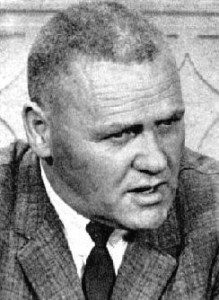
 But his story doesn’t end there, and neither does Woodrow Derenberger’s. Following the events of Point Pleasant, Derenberger made claims that Cold had admitted, through continued telepathic contact, that he was an alien from a planet called Lanulos within the galaxy known as Genemedes (both of which seem to be fictional). More than that, however, Derenberger claimed that Cold had actually taken him to Lanulos in a spaceship, where Derenberger claimed to have seen many other Lanulosians and relayed some commentary on their culture. Over the years, according to Derenberger, Cold was joined on earth by two other Lanulosians, named Demo Hassan and Karl Ardo, both of whom were apparently more discreet than Cold ever was.
 Keele believed that the first ever encounter with The Grinning Man occurred in Elizabeth, New Jersey on October 11, 1966, less than a month before Derenberger’s encounter. On that night two young boys, Martin Munov and James Yanchitis were walking home along a road that ran adjacent to the elevated New Jersey Turnpike. As they walked along the dark street, Yanchitis noticed a strange looking man standing in the darkness at the top of the treacherous incline, trapped by a chain link fence. Upon calling out to Munov, the boys watched as the figure slowly turned to face them with an unnerving ear to ear grin.