Spirit Communication; Making Waves

[Caveat – Throughout this discussion you will find me referring to spirits as real entities and with a basic definable humanity to them, however, this discussion is not an attempt to define what these spirits are, nor is its purpose in labelling them as anything more than spirits.  It is unfortunate for this discussion that we cannot simply hang up our disbelief for a moment and assume the popular definition to be true; but even so, you will find that I am being far more generous with this idea than I otherwise would be.  Additionally, the below theory does not speak to the credibility of other theories, such as psychical influence, environmental interference or Apophenia (or even blatant hoax) in explaining the phenomenon involved, it remains only a starting point for further discussion.]

Harry Houdini with his version of a Medium's Trumpet

Harry Houdini with his version of a Medium’s Trumpet

These days when one speaks of mediumship, mental images of such famous psychics as John Edwards, Sylvia Brown and even Chip Coffey (of Paranormal State) are conjured; we think of a spiritualistic gift possessed only by a select few, who have the ability to wield this power over the world of the dead (and the living in some cases).  Often we assume that mediumship is bound by rules and procedures, and is divinely regulated with a higher purpose and a nod to some afterlife mission to either dispose of or assist souls who’ve become trapped in some purgatory state beyond what we each know as reality.

Though in truth, the term ‘mediumship’ provides shelter for a wide variety of phenomenon, and it is only the more sensationalistic (and as some might argue, myself included, the more easily faked) incarnations of the term that survived history and are paraded around on TV today.

In the early days of the Spiritualist movement, to which every idea we hold about ghost hunting owes its existence, mediumship was thought of as a much more fluid term, meant to represent several ideas rooted in just the simple notion that the living can communicate with the dead.  It wasn’t an exclusive club, nor was it meant to be a money-making, commercial endeavour (though many then, as now, have worked very hard to make it that way).  Now though, a simple Google definition search will reveal the convoluted and highly suspect redefining of this term, to fit whatever biased notion the ‘definer’ wishes to convey.[1]

This is all somewhat inconsequential, though it is always good to start with an idea of where such terms come from, regardless of what they have been twisted to mean in modern times, especially when our topic today is so closely connected to the historical ideas of mediumship, rather than modern ones.  Etymologically, medium is derived from medius, which historically meant “intermediate agency, channel of communication�? (c. 1605), and you can see how that etymology eventually came to represent a “person who conveys spiritual messages�?.[2]

While the subject of mediums and the various ways in which they ply their craft is a topic of interest, and one which I may cover at another time, today I wish to discuss a specific tool that has historically been synonymous with mediums, and at one time was considered to be just as popularly accepted as EVP “research�? is today.[3]

The tool I speak of is the Medium’s Trumpet, which was a tool of so-called direct-voice-mediumship of the late 19th century.  Among other devices in the Medium’s employ, such as the medium’s cabinet, the curtain, the (tipping) table and the like, the Medium’s Trumpet was one of the earlier inclusions to the Medium’s bag of tricks.

Essentially, the Medium’s Trumpet, which is largely identical to a simple voice trumpet, is a cone of wood or tin with some kind of reed or baffle inserted into the small end to act as a vocal apparatus (similar to a musical wind instrument).  They were used by mediums to provide a physical apparatus for the spirits with which they communed through séance to speak to the rest of the group (the sitters).  This is in direct opposition to non-direct-voice-mediums, who (with all the charity I can muster) allowed the spirits to use their own vocal cords and windpipe to speak.[4]

Some relatively famous names are often connected to direct-voice-mediumship and to the Medium’s Trumpet; Margery Crandon and Eileen Garrett were among them.  This phenomenon had its investigators and sceptics too, one of them being Sir Arthur Conan Doyle (creator of the Sherlock Holmes character), and the chief call of hoax in this regard was in ventriloquism.  The first cry of which may have come from Frederick Myers (Doyle 1926), though the logic of Myers could hardly be dismissed by any sceptical observer (except maybe Doyle himself) and was often repeated.

As interesting as the histrionics of direct-voice-mediumship are, it’s the phenomenon itself I’m concerned with today.  To again relate the Medium’s Trumpet to the modern idea of electronic voice phenomenon, underlying all of these strange happenings is a relatively simple concept, spirits of the hereafter (whatever and wherever that may be) are communicating with this reality on a fairly regular basis.  That concept may be simple to lay out under a single defining statement like this, but it’s anything but simple to explain, or even to describe what is happening in either case (EVP or DVM).

The modern conundrum with EVP has been how exactly, a spirit can make a vocal impression on a recording medium, whether that be digital or analogue, without causing an actual audible sound in the environment of the recording device at the time.  And here, I think, is the connection…

As was suggested by Margery Crandon’s control Walter[5]: “we can walk on the vibrations of your laughter.�?, Nandor Fodor, one time associate of Sigmund Freud and author of the Encyclopaedia of Psychic Science (University Books 1952), suggested that environmental vibration was key to spirit voice communication.

As we all know, sound is the product of vibration moving through our environment, whether the air, or through another medium (i.e. structures, water, etc), and ultimately becoming sound waves.  It is the interaction between the vibrational medium (air, water, etc.) and the receiving device (whether the ear or a tape recorder) that creates sound.  In this interaction there are typically believed to be three elements; the source of the vibration, the vibrational medium and the receiver; but what if we consider that the vibration itself is another independent element in this equation?
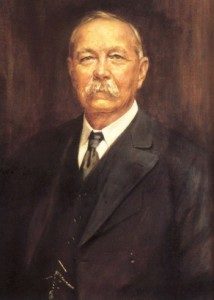
Sir Arthur Conan Doyle

The most prevalent problem we encounter when trying to explain both direct-voice-mediumship and EVP is how does the spirit cause a sound without causing a sound?

With the Medium’s Trumpet, it was said that the trumpet was meant to facilitate the spirits voice by giving them an apparatus with which to cause audible vibrations, suggesting that they do not possess such ability inherently.  Is this inability linked to the fact that they do not inhabit the vibrational medium in which the sound would travel?

I realise that the above is highly unclear, so let’s look at it from another perspective; sound doesn’t occur in the vacuum of space.  This is because there is no vibrational medium to carry the sound from its origin to a receiver.  Does this, however, mean that a device such as a radio speaker placed in such a vacuum is not creating audible vibrations?  Certainly it is…the problem is not the vocal apparatus; it is the vibrational medium.

If we turn that same idea inside out have we not created conditions similar to that which would be experienced by a spirit?  Wherein the spirit does not possess the apparatus to create vibrations which are compatible with our vibrational medium, which means that spirits, in common circumstances, cannot affect or create sound without assistance.  Unless that is, they eliminate the need for the vibrational medium altogether.

If we go back to our radio singing away in the vacuum of space, though not making a sound, can we think of any way to fix this problem (without resorting to adding an alternative vibrational medium)?  I would suggest that connecting the radio speaker directly to a receiving device, through physical contact (i.e. placing it in contact with one’s ear), would eliminate the need for the vibrational medium (though I suspect the sound experienced would be muffled and distorted).  If we again turn this idea inside out, I believe it explains a great deal about both EVP and the Medium’s Trumpet.

Courtesy of www.skeptiseum.org

I’ll deal with each individually for clarity’s sake. Along the same line of logic laid out above, if we concede that the problem for spirits in communicating with persons in this reality is restricted by the vibrational medium (air) in our environment, then we must eliminate that restriction from the equation.  In doing so, we eliminate the possibility of sound being transmitted at all, unless we use the same problem solving technique employed in the space radio issue.  I believe EVP and the idea of the Medium’s Trumpet are both examples of dealing with the problem on two separate ends of the equation.The Medium’s Trumpet:

In accordance with the above theory, to communicate in our vibrational medium (as a spirit) one must physically connect the speaker or origin of the signal (in this case whatever means the spirit uses for creating their equivalent to sound vibrations, herein called foreign signals) with something capable of translating those foreign signals into audible vibrations.  Might that unknown translation device be a baffle or membrane attached to the inner surface of the instrument?  If the spirit is able to physically connect with the baffle, in turn to physically manipulate the attitude of the baffle or membrane, would we not end up with precisely what many séance sitters claim they hear (distorted and disjointed voices)?

In my research, I have been unable to find a consistent plan or schematic for such a Medium’s Trumpet, in that those available differ so greatly, that one cannot come to an agreement about the possible science behind the idea.

For my purposes here, I make an unfounded assumption (beyond the initial assumption that spirits both exist and want to communicate with the living), which is that the historical Medium’s Trumpet, with exception, was constructed with the use of a mechanism that may have been similar to the vibrating membrane found in a child’s kazoo (silly as it sounds); but more so that the basic mechanical theory behind the Trumpet was such that it provided a means for communication by employing some such vibrating apparatus, that did not also require a moving column of air independent of the membrane itself.  I suggest that they could not have been constructed to use a reed, such as would be found in any musical wind instrument.  I note that in wind instruments, the reed or vibrating apparatus is not the chief sound making element in the instrument, but rather the moving (vibrating) column of air through the instrument is that element.

In the case of the reed, independent physical manipulation of the reed’s physical status (causing it to move or vibrate) would not produce the sound reported, unless that effect was combined with air flow.  In the case of the membrane (kazoo), airflow is not required, as the membrane itself causes air pressure changes within the chamber of the instrument.  Though membrane thickness, orientation, tensile strength and tautness would be critical factors in the success or failure of such an instrument, and there is no indication that Medium’s Trumpets, now or in the past, have undergone such engineering in their construction.

Nonetheless, in the case of the Medium’s Trumpet, I suggest that direct manipulation of such a membrane apparatus is/was the cause of the experienced sounds.  Unfortunately, until such time as I can conclusively determine the nature of the trumpet’s construction, this part of the theory will remain untestable.

soundwaveElectronic Voice Phenomenon:

As I said above, these two spirit communication events seem to be placed at two ends of the same problematic equation.  In terms of EVP, if we were faced with our space radio problem again, and we determined that changing the format of the transmission (by connecting the origin with a translation device, as done above) is insufficient to overcome the problem or is undesirable in given circumstances, then might we try to connect the origin of the sound directly to the receiver?  If physical position is irrelevant to the spirit (which it is by most accounts), then can we accept that they might be capable of directly affecting the receiving device (a microphone) in a very similar way, as they may do with the above translation device (the trumpet)?  And in doing so, would they not be affecting the same outcome, which is to eliminate the restrictive effect of the vibrational medium?

The most common type of microphone used today, in consumer grade electronics that would most commonly be used to record EVP evidence, is the Electret Microphone.

(A full understanding of precisely how this type of microphone operates would be beneficial to this discussion, but is not absolutely necessary.)

microphoneAll microphones operate on a single principal, which is to change sound vibration into an electrical signal via a thin membrane which interacts with an electrical field in various ways.[6] Electret microphones use a conductive membrane as a diaphragm which is positioned parallel to a second conductive plate across a dielectric compound (thus creating a capacitor).[7] The diaphragm is positioned to interact with sound vibrations in its environment; as the sound vibrations contact the diaphragm, they change its position relative to its corresponding plate, and those changes cause fluctuation in the inherent electrical charge of the capacitor.  In layman’s terms, the membrane moves in relation to its corresponding plate, according to the sound waves contacting it from the environment (moving it closer to, or pulling it away from), it is the measurement of those subtle changes in the distance between those two plates that accounts of the sound recorded or amplified by the device fed by the microphone.

In this process there seems to be room for manipulation, both physically and environmentally.  EM-Interference is a particularly difficult problem for microphones, especially cheaper, less shielded models.  Electromagnetic radiation in our environment, as caused by electronic devices, electric appliances, power lines, communication signals and even naturally occurring EM-Fields can cause and is blamed for a large number of EVP cases, as those fields easily interact with the inherent and necessary electromagnetic fields that the microphones depend on to perform (they specifically measure the changes in their own electric capacity to translate sound into electric signal).
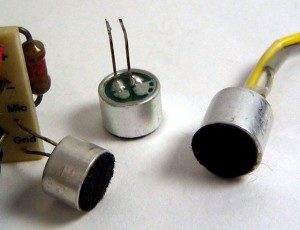
Electret Condenser Microphone Capsules

Secondly, and more importantly for this theory, all microphones are be prone to physical manipulation; it’s easy to understand that touching, moving or physically manipulating the housing of a microphone can and does cause sound transference through the diaphragm, after all this is precisely how microphones are intended to work.  In the science of microphones, vibration equals sound, regardless of the origin of that vibration.  With that in mind, is it not conceivable that a spirit, in an effort to remove the restrictive properties of the vibrational medium of air in our environment, could be affecting the diaphragm directly, and in turn causing sounds to be recorded that were not audible in the environment at the time?  In point of fact, there would be no sound present in the environment at the time, just vibrational contact with the microphone’s diaphragm.

To accept this, we have to accept also that (as above) spirits do exist in some form or dimension, that they have the ability to interact with our environment on some physical level (inherently precise and subtle it seems), that they wish to communicate in some form, and that they do not inherently possess the apparatus necessary to do so without eliminating the problem of incompatibility with our atmosphere.  Once we make those assumptions, whether they are justified or not, a striking similarity appears in this theory, between the possible method of interaction between spirits and both the Medium’s Trumpet and an EVP recording device.

As convoluted and confusing as the above may be, I want to make clear here and now, that I am not proclaiming this theory to be true, nor am I suggesting that it is more valid than any other; my purpose was, and is, to provide a possible answer to the question posed above: how does the spirit cause a sound without causing a sound?


[1] See Google Definition; Mediumship: http://www.google.ca/search?hl=en&source=hp&q=define%3Amediumship&btnG=Google+Search&meta=&aq=f&oq=

[2] See the Online Etymology Dictionary entry for “medium�?: http://www.etymonline.com/index.php?term=Medium

[3] I put the word research in quotations here, because it is clear to me and many of my colleagues, that what passes for research in the case of electronic voice phenomenon these days, is little more than enthusiastic play of a paranormal nature.  Capturing a large and questionable library of EVP recordings with no eye toward investigating what they are and where they come from is hardly research.

[4] In other words, non-direct-voice-mediums, used their own voice to allow the spirits to speak, which offered certain obvious opportunities for blatant hoax, though there have been historical cases that defied explanation due to certain language and dialect issues as well as details in the information relayed, but which leaves the same room for hoax as does the possibility of cold reading in modern psychics.

[5] A control (often known as a spirit control) is the personality being brought through by the medium during séance, often mediums made contact with a single spirit who would return regularly, and were often thought to be their “spirit guide�?.

[6] For reference see the Wikipedia entry on Microphones: http://en.wikipedia.org/wiki/Microphone

[7] Again, see the Wikipedia entry on Electret Microphones for more detail: http://en.wikipedia.org/wiki/Electret_microphone
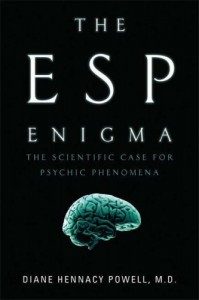
The ESP Enigma; The Scientific Case for Psychic Phenomena – A REVIEW

I’ve recently finished reading a book titled: The ESP Enigma; The Scientific Case for Psychic Phenomenon – by Diane Hennacy Powell M.D., a Johns Hopkins University trained doctor of neuroscience, and one time Harvard Medical School faculty member – and I must say, my passion for the subject has been rejuvenated.
This is what I had to say about it on Facebook’s LivingSocial Visual Bookshelf:

I loved this book! It is easily one of my top 5 favourite titles now.

My thoughts on the subject have been somewhat disorganized, though I do admit that I’ve always harboured a belief in ESP (in its many forms), Diane Powell’s astute research and insight are inspiring to say the least. I did question some of her conclusions, as they seem to be more like authority arguments rather than logical hypotheses, but overall I have to say I agree with her.

I’ve even been inspired to think of and arrange some experiments of my own, and I intend to put some effort into the study of lucid dreaming as well.

I would say that any book, which possesses such passion and coherent thought, that can inspire a reader to act beyond a mere “hmm” at the last page, is a whopping success.

If you are even remotely interested in either ESP in its many forms, or in neurology / neurobiology, this is the book for you…highly recommended!

This book is a succinct collection of facts about ESP or extra-sensory perception, which includes telepathy, clairvoyance, prophetic dreams, Synesthesia[1] (which is an unendingly interesting subject all on its own) and even remote viewing.  More than that though, it’s a thorough and up-to-date discussion on the meaning of consciousness, tempered with the benefit of professional insight in neuroscience and psychology.

This is the book that has been missing from the cannon of information available on the psychic trades.

I’ve been quite clear in the past, in my public distain for psychic charlatans, and I’m not about to change that position.  All the while, I’ve harboured a nascent belief in the phenomena itself.   Sort of a one percent-er rule, wherein the vast majority of people who would publicly (and for profit) claim that they possess an ineffable psychic ability (or some combination thereof) are more than likely full of proverbial bullshit, there are, to my mind, a small percentage of people in the general population who do indeed possess some undefined ability that bears more than a little scientific scrutiny.  Though this scrutiny need not necessarily be to determine the level of bullshit involved, more so to determine how the process works, by what mechanism and ultimately, in what medium.

Powell draws some startling conclusions from her work and from the collective work of many, many scientists over the past 100 years or so.  The most interesting may be (or one of the most interesting) her assessment of the phenomenon of consciousness.  She discusses the two primary schools of thought regarding a definition of consciousness – monism vs. dualism – and presents a more abstracted vision of what consciousness might be (I’m particularly fond of the idea that consciousness is a subatomic field accessed by our minds, through a complex process of neurochemistry and synaptic function).

All of this intertwined with the most astute assessment of so much famous and relatively obscure scientific study of ESP phenomenon the world over.  As I said in my earlier review: “I loved this book!”


[1] Synesthesia (also spelled synæsthesia or synaesthesia, plural synesthesiae or synaesthesiae)—from the Ancient Greek σύν (syn), “together,” and αἴσθησις (aisthēsis), “sensation“—is a neurologically-based condition in which stimulation of one sensory or cognitive pathway leads to automatic, involuntary experiences in a second sensory or cognitive pathway. People who report such experiences are known as synesthetes. http://en.wikipedia.org/wiki/Synethesia

The Scientific Method; Not Just Another Belief System

Science is the way of sceptics; belief is the way of everyone else.

Being an atheist in any time is a difficult thing, though hardly as much now as it was, say, in the 17th, 18th or 19th centuries (a period known as the Dark Ages).

I am an atheist, proudly, in that I don’t believe in theology.  I don’t believe there is a God, of any colour, and I don’t believe in any of the dogmatic practises that follow from such belief.

I don’t decry your belief in such, should you hold it, though I question the depth of your knowledge on the subject, and on several other subjects for that matter.  And while I hold a level of distain for certain “inalienable rights” held by many western governments and societies, such as the right to religious expression,  I, unlike my counterparts in theological circles, and apparently unlike some of my contemporaries, do not subscribe to an “us vs. them” mentality.

I believe in the Scientific Method; though the word “believe” in that statement is somewhat misleading.  The Scientific Method does not require belief in its power or in its efficacy to proceed, unlike religion.  Though, the inaccuracy of that statement is less about the semantics of opposition than it is about a misunderstanding or a misidentification rather, of one or the other.  Some would juxtapose the two, the institution of science with that of religion, as a feature of some greater intra-secular battle, but in reality, science is not an institution.  It is not a structure or a lobby group, or even a community as such…it is, as the name suggests, a method, a way of doing things, of looking at nature and the problems she[1] presents, so as to afford the best chance of finding a solution.  It just so happens that the solutions traditionally offered by the Church (the institution of religion) are and have been wholly inadequate to address the real world problems faced by humanity, save for the typical wish-thinking of prayer and faith.

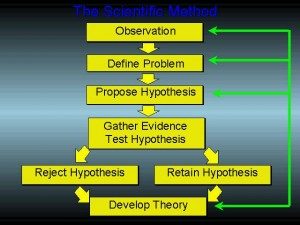
Again though, the Scientific Method is not an institution, it is a method, and is clearly spelled out for all to see.  Question, predict, experiment, observe and conclude.  More specifically, the Scientific Method is quite simply a way of collecting data, or information, through observation and experimentation, with care taken to eliminate any and all biases from the process.  I dare suggest, with a great deal of common sense backing me up, that our entire world, the world of the 21st century, is based upon and entirely dependent on the fruits of that particular method.
Every technology we enjoy is the product of some application of the scientific method; from indoor plumbing (on the scale enjoyed in western society) to cellular telephones and the internet, and everything in between.  Even art, and music and literature are the result of an application of the scientific method, in practise if not in origin.  But there are rules to the endeavour.

One cannot simply declare that a certain finding is true, or that another is false.  Logic and reason must prevail, and indeed, only in those cases where they both have done so, has there been any success.  It has been said that good science is good observation, by who is unavailable to me, though I’m sure it was someone more philosophical than I.  But what is observation?

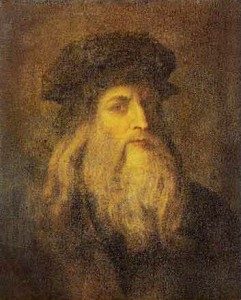
Leonardo da Vinci


What is the difference, I ask you, between the scientific musings of a man, illiterate to the scientific language of the day (latin) and who had no formal education outside that of an artist, and a modern day paranormal investigator?  I would say, for one, that the modern day investigator has a million-fold more reliable information about the workings of the natural world at his fingertips, wherein the genius of Leonardo is that he was able to suss out the correct details of much natural phenomenon without the benefit of the internet or Wikipedia, or even higher education for that matter.
Is it merely the use of your senses?  Well, yes, though the idea can be complicated some.  Leonardo da Vinci is thought, by many scholars, to have been the quintessential observer, if not the rightful father of the Scientific Method.[2] It was not merely enough, for Leonardo, to see a thing, he needed to know it…to observe it.  He would, in nearly all aspects of his long life, employ the Scientific Method to observe and describe even the most mundane details of objects, and processes and structures.  It is what, arguably, made him quite possibly the master of all renaissance masters.  It is also what made him, without a doubt, one of the first men of any age to demonstrate the power of astute observation (encompassing the collection of data for measurement and experimentation).  Though his work, prolific as it is, remained unpublished during his life, and after death, while valuable, remained hidden from the eyes of common people, this does not negate the value of his experimentation and observation.

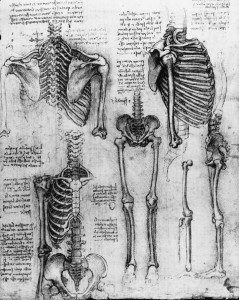
A folio page from da Vinci’s Notebooks on AnatomyI would suggest that the modern student of nature, who does not take advantage of the wealth of information lain at their feet, possesses a lazy intellect, or perhaps is simply not motivated to find truth.  And is, perhaps, equivalent to the wish-thinking theologian, who holds faith that God will provide all the knowledge necessary to navigate this world.

Leonardo didn’t simply make his observations and leave the natural world to itself, however.  He applied the Scientific Method in its entirety, not only making observations of his surroundings, but also making predictions about the outcome of experiments, and then comparing the results to his prediction.  The fact, whether widely known or not, that he failed in his predictions more often than he succeeded, is no measure of his worth as a scientist, but rather is a testament to the validity of the process.  He thought the world should be one way, based on initial observation, but when tested, it turned out that the world is actually another way, as was proven by experimentation.  And this, above all else is the purpose of this discussion.

Leonardo da Vinci is an example of an everyday normal man, who, given the opportunity, turned his keen observational skills into a genius the world has scarcely known before or since.[3] He was not supernatural, nor was he fundamentally different than any educated man today.  It seems that he simply knew the value of the Scientific Method, though was unable to put so succinct a name to the process.

Even today, the world seems to be a certain way. We are continually affronted by mysteries and conspiracies, and problems and fallacies, and at the sheer volume of the questions we are, everyday, inundated, there is a process by which each of us can find answers, in truth and without the help of a Church or a God.
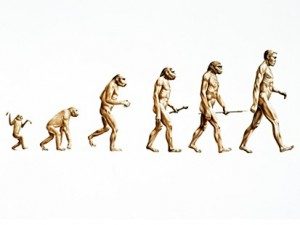
In light of the intervening ideas, my opening statement, “Science is the way of sceptics; belief is the way of everyone else”, is, I think, a paradox.  Science is the way of the sceptic, in that a sceptic is one who questions the validity of those ideas and concepts that he faces, while those who are not sceptics may fail to see the problem through to truth, in favour of belief that God wanted things to be the way they are, and even possibly that they are not meant to know.  The paradox enters where the fact becomes visible, that all people alive today benefit in some way from the toils of science, thereby making science the domain of every man, woman and child on the planet.  Belief seems only to have been holding science’s place in line…for millennia or two.  To solve the paradox, I might now change the statement to say that science is the way of humanity, and belief is the way of the past.

I might make that change, though I suspect I would receive some argument.


[1] The emphasis is added here, as I find it ironic that the sustaining life force and the process by which all life on earth exists, is traditionally referred to as Mother Nature, while the prevailing mindset in theology contrasts that with the idea that God is a masculine deity, as usual pitting the male and the female in opposite and incompatible positions.  Though in reality, life would not exist, as we know it, without the cooperation of both sexes.  This is not a new idea, just a funny one in my mind.


[2] The Science of Leonardo, Fritjov Capra (Knopf Doubleday Publishing Group) ISBN- 10: 1400078837

[3] The Notebooks of Leonardo da Vinci, Vol I & II, Leonardo da Vinci (Dover Publications) ISBN – 10: 0486225720

The Super Stupendous Random Life Generator Device

Have you heard the news?  Did you see the special report?  Did you get the re-tweeted Twitter tweet with a shortened twitly link?

Science has finally figured it out!  They’ve solved the ultimate question: where did we come from?  It’s actually quite stupendous, as the name might suggest: The Super Stupendous Random Life Generator Device or SSRLGD for short.

Wouldn’t you believe it though, the process is so convoluted and multifarious that most scientists had mistaken the process by which it works for a natural Rube Goldberg machine.  This veil has been lifted though…the light has shone, and their eyes have seen…SSRLGD is real and it explains everything!

I’ll get to the details in a minute, but first, let’s look at some other examples of seemingly pointless, overly complex and ultimately unfeasible machines at work.

Imagine, all this time, the answer was right under our noses!  So what is it?  I’ll tell you, but you won’t believe me.

SSRLGD is…

All right, so I’m blowing smoke up your miniskirt.  Clearly there’s no such thing as a Super Stupendous Random Life Generator Device, and as much fun as Rube Goldberg machines are to watch, (as opposed to building one), they really don’t make much sense.  And while you might now be wondering just what my point is, I have the sad privilege of informing you that there are a lot of people who look on the process of evolution with much the same disbelief.  You might be one of them.

To many people, the idea of evolution seems…acceptable, if not highly complex and confusing (much like the SSRLGD?).  A lot of people claim to understand the process, though in reality they haven’t the first clue how it works.  Others have latched onto a dangerously small bit of the explanation and are running around, flailing their arms in the air and screaming something about blasphemy and the apocalypse.  But I’m here to tell you that an understanding of the idea, the theory and the facts of Evolution by Natural Selection is not out of your reach.  It really is simpler than a machine that turns on a light by way of a bowling ball, a blow torch and a mouse trap.

Evolution is compounding random genetic mutation.  See…simple!
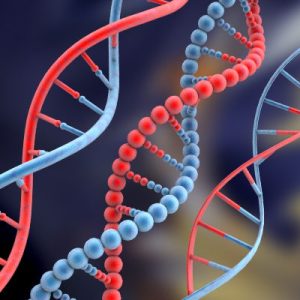
It really is as simple as that, but to explain it further, I have no choice but to complicate things a bit…I’ll try to keep it simple.  Let’s talk DNA.

Deoxyribonucleic Acid, or DNA, is actually a real life Super Stupendous Random Life Generator.  It is the reason we’re here, it’s the reason you’re able to read these words, it’s even the reason your lungs have air to breathe.  It’s an incredible thing, if I do say so myself.

Your DNA is the recipe for building a You.  Each of your cells, all fifty to seventy-five trillion of them, contains a twisted ladder structure consisting of protein molecules called amino acids.  Amino acids come in many different shapes, sizes and flavours.  On a microscopic level amino acids like to group together with other amino acids to form chains.  As these chains grow and become longer, eventually they become what are known as genes.  It is genes that make up the structure of the DNA double helix.  The DNA in your cells is identical; every cell in your body has exactly the same DNA structure, organized with amino acid chains in exactly the same order.  This makes You.

DNA, when paired up with RNA (Ribonucleic Acid) – which is a similar structure, made up of amino acids as well, but which has a different function – makes for a powerful team.  Without delving into the technical jargon of evolutionary genetics (the science of DNA), it can suffice to be said that where DNA is the recipe for building a living being, RNA is the cook.  RNA has the function of instructing cells on their purpose, by telling them to read specific parts of the recipe (DNA), and thereby distinguishing between a skin cell and a brain cell.
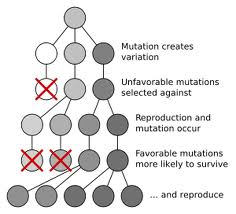
The magic of evolution happens during the combining of DNA from two individual biological beings, through embryology.

Embryology is the science of baby-making, and it just happens that the process of making babies is where evolution starts, for the individual.  Most everyone understands the process by which species breed and procreate (if you don’t, I would recommend some prerequisite internet browsing before proceeding), through that process DNA from each parent is, essentially, spliced together to form a new double helix for the offspring.  Which, as above, means that the new baby will have a new recipe, from which their RNA will construct them, ultimately, the baby’s cells will contain DNA that is similar to each parent, though not an exact 50/50 split.  However, the splicing process is, shall we say, less than perfect, though to suggest that this is a flaw in the system would be an error.

When the baby is conceived, that is, when the sperm cell penetrates the egg, the parent’s respective DNA will be copied inside the egg, using some genes (long chains of amino acids) from the father and some from the mother.  However, occasionally the mechanism responsible for copying genes makes mistakes.  Sometimes those mistakes are small and sometimes they’re quite large.  Geneticists refer to this as copy fidelity, and actually, photocopy machine technicians use the same term.  Copy fidelity is a fancy way of saying “reliability of the mechanism for copying genes (or parts of an image) without making errors.”  Genes are notoriously poor copiers; however, they need to be in order for evolution to work.

Every time a copy error is made, there is some change in the cells that corresponds to that particular part of the recipe, resulting in a change to the biological make up of the individual.  Sometimes that change is good, for the baby, and sometimes it’s bad.  (We’ll be coming back to this…it’s very important to the process.)  These errors are called mutations, and it is the effect of many, many mutations over the course of many millions of generations, over many millions of years that are referred to as Evolution.  Each time a baby is born (of any species of animal or plant), whatever mutations it carries in it’s DNA will ultimately be passed on to it’s own offspring, whether new mutations or old ones passed on from it’s parents, grandparents, great grandparents and on back through time to it’s earliest ancestor.  Every aspect of every form of life on earth is literally the result of a mistake in gene copying at some point in history.

So, basically, we’re made up of little unreliable photocopy machines, housed inside cells who get bossed around by various kinds of protein molecules.  I suppose that’s it, in a nut shell.  But wait, we’re not done yet.

The basic unit of evolution is the gene, it is the instruction inside the DNA recipe that tells the cells what to be and what to do.  There are genes (instructions) for literally every possible aspect of life, and believe it or not, our DNA contains many of the instructions for making the cells of monkeys, dogs, whales and even fish.  It is the combined effect of our entire DNA double helix that ultimately determines whether we’ll be a hagfish or a human, but don’t worry your baby won’t be born with gills.

If the gene, in the micro world, is the true engine behind evolution, which it is, how does it affect the macro development of the body?  Earlier it was mentioned that genetic mutations could be small or large.  The idea doesn’t easily transfer to the effect of those mutations on the macro scale however.  Generally speaking, a large volume of genetic mutation over a span of a few generations might well go unnoticed in the macro world, and those kinds of genetic changes that get passed along the generational line are the ones that really count in the really long term.  Significant genetic mutations that cause large and noticeable effects in the macro being are often so disruptive to that being’s ability to survive, that those mutations fail to be passed along to future generations.

This is called Natural Selection.

A mutation, is a mutation, is a mutation.  There is no way to place a value on a genetic mutation in one way or the other.  (I told you we’d be coming back to the good, the bad and the ugly.)  Until, that is, such a mutation causes an effect in the individual that either impedes that individual’s ability to survive or helps it.  The word survive in this context, doesn’t necessarily mean happily ever after.  It means live long enough to breed, and hence, pass those genes, complete with any and all previous mutations up the genetic line.  Any mutation that is sufficient to cause a change in the individual that will allow that individual to better compete against it’s environment, to the end of surviving long enough to find a mate and breed (including in some cases, living long enough to care for the offspring), will be favoured among the mutations of that species other individuals.

Essentially, a bug whose environment requires it to have a hard carapace (shell) would benefit from genetic mutations that caused it’s carapace to become harder, while genetic mutations that caused it’s carapace to become softer would result in those individuals dying long before they had the chance to breed, thus their genes and mutations (including the one for softer shells) would die with them.
Those things in the environment that would cause the premature death of an individual are called Selection Pressures.  Selection Pressures can be simple environmental conditions, changes in food quality and availability, predators, population size and density and disease.  Changes in these areas will cause individuals to compete for survival amidst that environment, against other species and their own species.  This had been termed The Survival of the Fittest historically, though that term lead to a great deal of misunderstanding about how evolution works, because it caused people to think of individual animals and plants competing for resources, rather than the true source of evolution, the competition between genes for survival.  The ultimate goal – which is a dangerous term to use when speaking of evolution – of evolution would be to continue to pass genes on to future generations.  I say that using the word goal is dangerous because it has a tendency to cause people to think of the process in a backward manner.

The macro world cannot affect genes directly.  It can only have an impact indirectly by not allowing certain genes (mutations) to pass on to future generations.  And thinking of it like that provides a glimpse of the fallacy involved in speaking of evolutionary goals.  It seems silly to think that the macro world has any care to affect a gene, even if only to allow it to pass along or not.  The macro world is not an entity, it has no will, and to suggest so is just silly, but the reverse is also true.

Evolution has no will.  Genetic mutations are just that, mutations.  There is no planning involved, there could never be.  A gene mutates as a result of a mistake in copy fidelity, and the resulting change to the individual is incidental at best.  So, one might ask, precisely how did such complex creatures evolve if the process is all about the survival of genes?

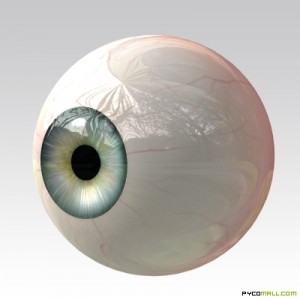
We, you and me, my friend, are simply genetic vessels.  Our purpose, the whole reason we were born into this world, is to carry our genetic material long enough to pass it on, and in the case of you and me, to live long enough to care for the product of that purpose, until it too can fulfill the same purpose.[1] In the long term, and I mean the extremely long term, the competition between genes for survival resulted in individuals who were more fit for surviving their particular environment.  Each successive generation presented its own mutations, some of which were passed on, some were not, but every successive mutation was built upon previous mutations.  Where one mutation might have had the effect of making one cell sensitive to light, the next mutation could have had the effect of making that particular cell even more sensitive to light.  And tiny mutational step after tiny mutational step, almost all animal life ended up with a collection of cells that are highly sensitive to light, and most amazingly with cells that are specially adapted to focus, limit and redirect light rays in order to compile a visual image of our surrounding environment.  The effect of each small mutation is compounded over time to have a huge effect on the species as a whole.  That effect, as can plainly be seen, is a natural progression toward ever increasing biological complexity, resulting in, among other things…us.

So, Evolution by Natural Selection is a process of compounding random mutations over time.  I told you it was simple.  OK…maybe it’s not that simple, but it can be understood with a little effort.  And I would recommend, highly, that anyone who is interested in gaining a full grasp on the specifics of this amazing and somewhat counter-intuitive process, should seek out and pick up Professor Richard Dawkins book series The Blind Watchmaker, Unweaving the Rainbow, Climbing Mount Improbable, The Selfish Gene and The Greatest Show on Earth.

In the end, it’s relatively apparent that the Super Stupendous Random Life Generating Device is real.  It’s the gene of the DNA double helix.  It is the process by which all life evolves using random mutation after random mutation to build a creature or plant that is better suited to survive its environment than its predecessor.


[1] Some say that this is a particularly bleak way to look at life, though, when one asks the question of the empty space around them (as in prayer); what is my purpose?  The silence they are faced with seems pretty bleak to me.

Idiocracy and the Decline of Intelligence

Of the endless possibilities that lay before us, mankind’s future seems destined to ever increasing social and technological complexity coupled with a declining ability to deal with that complexity.

Why does western society glorify and reward stupidity?  I am constantly amazed by an apparently complete lack of common sense among my peers and neighbours.  Information that seems to be trivially common to me inevitably comes as a surprise life lesson to those around me.  People seem to revel in their own ignorance, as though there is a secret competition to achieve the most success with the least wisdom.  In point of fact, that seems to be precisely what our higher learning institutions are about these days; over specialisation, elitist admissions and zero real world accountability.

It seems my experience in this regard is quickly becoming the norm too, as is evidenced by a recent rash of best selling books on this very subject.  ‘Empire of Illusions’ and ‘The Watchman’s Rattle’ come to mind quickly[1], though so too do the many, many books being published on the emerging science of Memetics, which, if anything else, is the study of common knowledge.

I’m reminded, constantly, of Mike Judge’s 2006 movie Idiocracy, as though Judge and his writers were prophets akin to Nostradamus or Cayce.[2] It seems real, it seems as though we’re headed, collectively, toward a precipice marked by our own steady and steep decline into ignorance.  Blank stares, mumbled expletives, questioning grunts and an all around disinterest in anything resembling the slightest prospect of increasing a person’s intelligence…this is what surrounds me.

If we follow Judge’s logic, which seems sound on the surface of it, we might find ourselves in Private Joe Bauer’s future-world.  A world where indulgent instant gratification has completely overtaken the power of reason, where systems crash around the ankles of a people who scarcely notice a problem, where commercialism and corporatism run rampant without chaperone and without even a rudimentary understanding of how or why they work (or don’t work as the case may be).  In fact, that description seems to work quite well for our current world.  A world where illiteracy is raging, where the vast majority of the population are permanently disadvantaged against the success for which they believe they’re working toward, a world that harbours a distorted idea of success that is sold to them by those same social vehicles that do constant harm to our economies and our social evolution – corporatism and commercialism.  A world that is being held hostage by a few wealthy elites who, by most indications, don’t even know they’re doing anything wrong.  But is this the inevitable outcome of the war on wisdom?
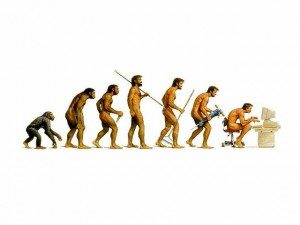
Speaking strictly about the fantasy world of Idiocracy, Judge’s interpretation of the decline in collective intelligence fails to account for a few key points in the argument.  Chiefly, that evolution favours intelligence, and more subtly, that IQ is the prize of a successful resolution of the nature vs. nurture debate.  Right off the bat, one can counter any argument for a future of culturally profound ignorance by realising that the process of evolution will always make available in the population, individuals who, despite social disadvantages, are prone to intellectual achievement.  Savants, if you will, though that term could easily be misunderstood.[3]

But I’m getting ahead of the discussion.  Is intelligence the inevitable outcome of evolution, and are we somehow diluting that evolutionary advantage, say through artificially eliminating the consequences of bad decision making?  Have we, through medical science and nutritionism, the insurance industry and through the instant gratification networks of corporatism and commercialism, sidestepped the powerful influence of Natural Selection?  It might seem so on the surface.

Possibly the most basic component of the process of biological evolution is the idea that the competition between species, between organisms, and more accurately between genes, is essentially a race to sexual maturity and procreation.  Medical science – including germ theory and advanced surgical techniques – and nutritionism have, in the last 100 years or so, virtually guaranteed that every viable human infant has an equally high chance of developing to sexual maturity and of successfully mating.  There are exceptions – some obvious – though on the whole, the human population benefits from these medical advancements to equal share, and then enters insurance, the rule of law and our ever present evil C twins (commercialism and corporatism).

If medical science affects natural selection as it applies to biological evolution, it can be said that insurance affects social evolution in much the same way, but overall, its effect is not limited to memetics.  The simple way of putting it is to say that these social institutions have worked hard to successfully achieve the eradication of all consequences for poor decision making.  It used to be, in our world, that making the wrong choice in any given situation could potentially have catastrophic results for the decision maker and those around him.  These days, even the most monumentally bad choice is successfully mitigated by these social and scientific institutions.  Insurance guarantees that our bad choices do the least financial harm possible, while medical science virtually guarantees that the effect of those same bad choices can be reversed, and at the most we suffer only mild discomfort and inconvenience as a result of choices that once would have eliminated us (individually) from the competition for resources and mates.

As has been discussed ad nauseum over the last several years in anthropological circles, the impact that agriculture has had on our species on the whole is such that the switch from a hunter-gatherer society to an agrarian society has been the single largest mitigating factor in our continued evolution.  But the larger story is that all these things combined have the effect of all but completely shielding us from the power of natural selection.  This doesn’t mean that we’re no longer subject to evolution, just that the random nature of the genetic mutations we experience throughout the population are free to exert their changes without the guidance of natural selection.  It’s no longer a “survival of the fittest” scenario, now it’s “survival of all but the most severe”.

None of this speaks to the decline of intelligence though, at least not directly.  One common mistake or misinterpretation of evolutionary theory is that the end result of genetic evolution was inevitable, as though the current incarnation of a species was the initial goal of the process.  This easy mistake has profound implications for one’s overall understanding of the process.  Evolution has but one goal, and that is not found in the quality of any species characteristics, whether that be the speed of the cheetah, the size of an elephant or the intelligence of man.  That goal is simply genetic survival.  There is no grand plan or scheme, and the affect that any one or any combination of genetic mutations has on the characteristics of the host species is nothing more than a side effect, albeit a side effect that is favoured by natural selection.  If you think of human intelligence in those terms a realisation comes to bear; that the superiority we enjoy is an illusion.  Our intelligence is a happy side effect of a collection of genetic mutations.  What those mutations were is hotly debated among evolutionary biologists, anthropologists and neurologists, but all agree that our intelligence is nothing more than the product of a confluence of serendipitous genetic accidents.
But this is good news.  This means, among the idea that our self-righteous superiority is unjustified, that evolution still has our back, genetically speaking.  We still posses the genes for large brains and for intelligence, in spite of the fact that a great many people choose to squander that gift.  Our powerful disposition for abstract problem solving, for creativity and for language are going no where, but that isn’t to say that these elements of our society are immune to the own evolution.

Overall, the point of the above argument is simply that mankind still holds the genetic tools necessary for intelligence, or more accurately – increasing intelligence, and that we seem, simply, to be adverse to using those tools in the general population.  This, while it presents new problems for the big picture, is good news.  It means that this is a problem of motivation, not of inability.  It means that we can fix our education systems, and that we can inspire people to feats of intellectual greatness.  Wisdom is not lost, though it may be forgotten, and in the coming years, as that social and technological complexity plays out, we will be faced with problems that require a much more generalised genius, and as history has taught us, necessity is the mother of invention.  Great minds may be fewer and further between, but they still exist, and they are just as valuable today as they were in our earlier periods of enlightenment.  It may be that common sense is uncommon for a reason; it might serve to highlight true genius.


[1] Chris Hedges Empire of Illusions: The End of Literacy and the Triumph of Spectacle, ISBN 10: 0307398471 and Rebecca Costa The Watchman’s Rattle: Thinking Our Way Out of Extinction, ISBN 10: 1593156057

[2] …In that both were little more than colourful conmen wrapped in mysticism and intrigue.

[3] Typical savants are individuals who excel in one area of expertise, usually without formal training or education, but who fail to achieve success in other areas of life, including socialisation, which could be called hyper-specialisation.  In this case, one could argue that what were talking about is exactly the opposite of a savant, or an asavant, in that an asavant, in a world of overspecialisation, which is essentially the characteristics of a classic savant – hyper-specialisation – is one who achieves a much more generalised understanding of the world around them without formalised education, in contrast to the citizens of Idiocracy’s future-world who have little understanding beyond their individual and limited vocational expertise.  In simpler terms I’m talking about people who, without education, just seem to get things on a broad scale and in contrast to those around them.

Consciousness and the Zero Point Field: Are Akashic Records Real?

A swirling vortex of subatomic particles, influenced by gravity, solar energy and subtle nuclear forces; this is our universe…this is our reality.  Some may find that description to be cogent while others may find cause to question.

I am real, my world is real, and it is made up of real things, with texture and depth and value. Or is it?  The science of physics, coupled with the sciences of evolutionary biology and neurobiology, have given us a grander, closer view of reality, closer than most are aware.  It has shown, with remarkable accuracy and overwhelming consistency, that we and our world are nothing more than a massive collection of particles, spinning and vibrating in different ways, depending on our spatial relationship to the various energies that surround us.

Physics or more specifically, quantum physics is the study of small things, the micro universe, the subatomic universe and beyond.  Its principal endeavour is to find, through scientific experimentation and theoretical mathematics, a way to describe the entire universe –or to find a theory of everything.  The likes of Stephen Hawking, Michio Kaku, Brian Greene and many, many more brilliant theoretical and applied physicists have defined reality to an amazing depth.  They have, collectively, provided answers to some of life’s most vexing questions, and they, along side some of the most brilliant minds of natural science, such as Richard Dawkins, P.Z. Meyers and a host of others are on the brink of finding definitive answers to any question mankind might ever conceive.

Though one question still stands unanswered, a question that has been the focus of philosophy’s greatest orators for millennia…Consciousness.  What is it?  Where does it come from?  Is it intrinsic to all life, or is it unique to higher mammals?

Erwin Laszlo

Erwin Laszlo

Even a brief search for theories of consciousness will bring forth a dizzying amount of scientific information on the many different ideas that science and philosophy have generated on this topic.  There are more than two dozen completely different and valid philosophical theories of consciousness, and at least as many scientific theories expounding on the origins and mechanics of consciousness.  Suffice it to say, few theorists agree on this issue.

There are though, a few theories that stand out of the crowd, one of those theories is called is called Akashic Field Theory[1], which is a rather obscure but unendingly interesting blending of philosophy and physics in an attempt to provide a deeper understanding of consciousness.  Discussed in-depth by its most vocal, recent advocate in his 2004 book Science and the Akashic Field: An Integral Theory of Everything, Hungarian born philosopher of Science Erwin Laszlo[2]presents the idea that all knowledge in the universe (or more accurately, the metaverse) is carried as an energy wave in, or as a part of, the quantum vacuum.

That’s a complicated idea, one that isn’t easily explained, let alone understood, but bear with me and I’ll try.

Quantum Vacuum is a state of matter found in the universe, or rather it is a state of space-time that is free of known matter and energy; the state itself is called a Zero Point Field.  Essentially, it’s a condition wherein all matter, all particles of matter -any matter, and energy are removed from an area of space by whatever mechanism, leaving what should be a pure vacuum, an area of space that is truly empty.  Physicists are able to create such Zero Point Fields (ZPF), they do so to create experimental conditions suitable for testing various theories in quantum mechanics, but a funny thing happens in a ZPF, where there should be nothing…there is something.  Mysterious and unidentified energies permeate such Zero Point Fields, and they interact with a known but equally mysterious form of matter called virtual particles[3].

A working understanding of the mechanics of Zero Point Fields is not necessary for the current discussion.  Suffice it to say the science behind the above is highly complex.

Edgar Cayce

Edgar Cayce

So how does this relate to consciousness?  According to Laszlo, this field, or more accurately, the energies within it are the mythical ether or akashic field.  If this sounds familiar to you, it might be because the famed Sleeping Prophet, Edgar Cayce claimed that his ability to foretell the future was derived from his unique method of accessing the ether or akashic records[4] with his mind.  He believed that he possessed no personal knowledge of the event that he predicted, but that he had simply looked it up in the ether.  This idea has largely been dismissed by sceptics and mainstream science as classic subterfuge by a successful con man, but some have found a small bit of credibility in the idea that there are those among us that have the ability to access the knowledge of the universe, in fact, there are those who believe, or want to believe that all of us have this ability.

Dr. Diane Hennacy Powell M.D. is one of those people, and through an apparently thorough and impartial investigation of the unbelievably huge body of information amassed on the phenomenon of ESP, she presents the possibility that these akashic records may actually be the substance of consciousness.[5] The idea, while not exactly new, finds some scientific credibility in the ZPF mystery, as famous scientists such as David Bohm and Rupert Sheldrake both, along with Laszlo, called the ZPF a storage medium which the brain (presumably all mammalian brains) are able to access.

Accessing the Akashic Records

This line of reasoning gives rise to the idea that memory and even conscious thought is actually non-local, that it originates outside of our brains, in the ether, and that our brains simply access and utilise the information for navigation through and identification of various elements in our environment.  More than this though, is the idea that every particle in the universe receives instruction from this field for the local rules that govern their spin and movement.  Laszlo claims that his Akashic Field Theory provides solutions to many of quantum physics larger theoretical problems, such as non-locality and quantum entanglement.

Now, the science behind this is highly complex and not easily understood by the layman, but its implications are profound and far reaching.  It engenders visions of invisible strings of energy reaching from our brains to a mysterious field of energy and matter, a field divided into personal portions that hold our individual memories and thoughts.  It might even inspire the idea that we are puppets on strings, controlled from the ether.  Whatever it means the idea deserves further study; it deserves the serious attention of the scientific mind.  Some questions arise even from a cursory review of the idea…

Does this mean that my thoughts aren’t my own?

Are “psychics” simply able to access the akashic records or “personal portions” of other people?

Is there an evolution to the process?  Will we eventually be able to access more of the field than we can now?

In truth, the questions are never-ending, and answers may be a long time coming, but at least the questions are being asked…there can be no progress where knowledge is complete.


[1] László Ervin (2004). Science and the Akashic Field: An Integral Theory of Everything. Rochester, Vermont: Inner Traditions.

[2] Erwin Laszlo (László Ervin): http://en.wikipedia.org/wiki/Ervin_L%C3%A1szl%C3%B3

[3] I lack both the expertise and literary skill to explain what these energies and particles are, why they’re there and what they mean in the context of quantum mechanics, though readers are free to conduct their own research on this topic.  Wikipedia offers a decent rudimentary explanation as a starting point.

[4] Kevin J. Todeschi (1998). Edgar Cayce on the Akashic Records. A.R.E. Press ISBN – 10: 0876044011

[5] Diane Hennacy Powell M.D. (2009). The ESP Enigma: The Scientific Case for Psychic Phenomena.  New York. Pp 222.

A Steady Diet of Pseudo-Science…

Type the word ‘cholesterol’ into a Google search page and hit enter.  What comes up is a veritable cornucopia of nutritionist advertising touting both the ills of cholesterol and the almost magical effect of whichever nutritionist’s cure-all drug or vitamin, or tracking system or holistic diagnosis.

Actually, you don’t even have to go to that kind of effort, just log into Facebook, chances are you’ll see, eventually if not right away, an advertisement titled as follows: “Click to learn what three foods, formerly thought healthy, will add inches to your gut.”, or some variation on that particular theme.

Hell, one of the oldest nutritional memes, which also happens to be one of the widest held incorrect beliefs about food in modern times, is that salt is bad for you.

Here are some little known facts, offered free of charge and I don’t even ask for a donation.

“…Dietary cholesterol makes a very small contribution to our blood cholesterol levels.  Every 100 milligrams of cholesterol intake increases blood cholesterol by about 0.06 millimoles per litre, which is practically insignificant.”[1]

To bring that into perspective, one egg yolk contains approximately 266 milligrams of cholesterol[2], which is only 50 milligrams below the daily recommended intake of dietary cholesterol by most nutritionists (300 milligrams[3]).  Add that to virtually anything else you might eat in a day – various meats, cheeses, seafood, desserts etc – and you can see how quickly we all exceed the recommended daily intake of dietary cholesterol.  Now here’s the perspective, even at twice the recommended daily intake of cholesterol, you might be increasing your blood cholesterol levels by as much as 0.09 – 0.12 millimoles.

But here’s the kicker…do you know how much a millimole is, compared to how much your blood cholesterol level would have to change for it to have an impact on your health?

According to the Mayo Clinic (no pun intended), the ideal target cholesterol level for the average person, is 5.2mmol/L (mmol is the standard abbreviation for millimoles, so this would be 5.2 milimoles per litre of blood).  The diagnostic range for LDL – or bad cholesterol – is between 5.2mmol/L (ideal) and 6.2mmol/L and above (high risk).[4]

So, does a change of between 0.06 – 0.12mmol/L really seem all that significant in the long run?  Especially when you consider that there are elements in everyone’s diet already that help to actively reduce LDL, as well as the positive effects of exercise in which most people partake.  An individual’s LDL level is a fluid or non-static process, the number will fluctuate constantly, depending on many, many factors, such as age, activity level, predisposition to both high LDL and to heart disease, and diabetes and many other common things.

In short, the link between dietary cholesterol and ill health is tenuous at best, but the myth continues to be spread as gospel truth, even though the science behind it is not that difficult to understand.  I am not a doctor, nor am I trained as a dietician or nutritionist, though I am a former bodybuilder and I have a knack for cutting through the bullshit of modern meme-itus, and well, I understand it perfectly.  Let’s be clear though, I am not advocating a high fat diet coupled with an excessively sedentary lifestyle (even though I tend to subscribe to the same personally from time-to-time).

How about that pernicious Facebook ad?  I would think most people are coherent enough to see through such flimflammery, though with the success of diet fads in the distant and not-so-distant past, it seems I may be wrong.  Without disparaging the efforts of medical science, I’m not about to say that we should all embark on a journey of culinary carnality; eating anything and everything in sight, so as to make Viking feasts look like unsatisfying appetisers.  However, the true science of metabolism is well-known and easily studied by anyone who wishes to look.

Food – whichever variety you choose to imbibe – is broken down by the body’s digestive system into constituent elements.  Those elements are used to fuel the body in the short- and long-term, to build and re-build tissue, bone and everything else we’re made of, and to aid in the efficient functioning of our various systems (immune, nervous, neural etc).  Food is food, eat it and your body will do with it, what it can.  For years the nutritionist industry has been peddling the idea that “you are what you eat” and in all honesty, this is total horseshit.  It’s amazing to me that no one has picked up on the idea that dietary health is just as complex and, dare I say, multidimensional as any other human endeavour.  Restricting cholesterol, or salt, or fat or whatever it is that your Glamour Magazine says you should cut out of your diet is just as useless as changing the air filter on your car when you’ve run out of gas.  Adjusting one variable with questionable relatedness to the problem won’t solve the problem.  You must address all the variables, adjusting the ones that need tweaking and supporting the ones that work well.

In our world, that is the Western world, the single largest dietary problem we face is that we don’t know how to serve food.  Go to nearly any popular restaurant and here’s what you’ll see: huge plates with huge servings and a dining room full of people competing to see who can pack away the most food in one sitting.  Your metabolism is laughing at you!

I’m going to cut through the bullshit for you and just tell you what the problem is…portion control, meal frequency and food quality.  That’s it!  Smaller portions (much smaller in some cases), more frequent meals (6-8 per day…everyday) and wholesome, real food (you know, stuff that either had parents or was pulled from the ground by someone’s hand rather than a machine).  Improve these elements of your diet and combine that with daily exercise, and guess what…you’ve just found the best, longest lasting and most trendy diet that ever existed.  It will maximize the potential of your metabolism, it will boost your immune system, give you more energy and have you looking exactly the way you want, but the trick is…you actually have to do it.

See, this is no get skinny fast gimmick, this is no “what the stars use” fad diet…this is a life change.  Do you want to know why more fitness and nutrition gurus aren’t spouting the benefits of, well, eating properly?  It’s because there’s no way to sell common sense.  They want your money, plain and simple, and to get it, they think they need to dress up a gimmick in a sequence dress and parade it around in front of your with lights and music…the surely you’ll pay them for their expertise!

People fall for it all the time, and some even achieve some measure of success with the various nutritionist scams out there, but this isn’t about any one person’s weight loss story.  This is about sifting through the pseudo-science of the supermarket and getting the most out of your money and your time.  In essence, I’m asking you to forget everything you think you know about the science of food and nutrition and just live your life in moderation.  I’m telling you to stop giving your money to gimmick peddlers (in every respect) and start doing things for yourself, including thinking about fuelling your body.


[1] Joe Schwarcz Ph.D, Brain Fuel – 199 Mind-Expanding Inquiries Into The Science Of Everyday Life (Anchor Canada, 2010) p46

[2] Desserts-recipes.com, Cholesterol Content in Common Foods, http://www.netrition.com/rdi_page.html

[3] Netrition.com, Reference Values for Nutrition Labelling, http://www.netrition.com/rdi_page.html

[4] Author Not Listed, Cholesterol Levels, What numbers should you aim for?, http://www.mayoclinic.com/health/cholesterol-levels/CL00001

10 Answers A Creationist Doesn’t Want To Hear

This afternoon I stumbled upon yet another poorly written creationist diatribe, touting a singular ability to refute the brilliant scientific minds of the last three centuries of enlightenment.  Every time I read one of these idiotic monologues, it strikes me that the author has less knowledge of the subject for which they treat than an infant does calculus.

Anyway, this particular piece issued a challenge, it requested that “evolutionists” review the 10 questions he or she had posted in the body of the article, which are supposed to be definitive proof that “evolution is stupid”.  And since I’m a huge supporter of remedial science for the illiterate, I thought I’d give it a go.  The questions are listed above my answers in order as they appear on Breaking The Presidium[1].

1. Which came first? Time, Space, Matter or energy?

In the current model presented by quantum mechanics, all four were created simultaneously out of the Big bang.  An ultra-dense singularity, also known as a black hole, is thought to have been the mechanism of compression-expansion that acted as, if not a trigger, then an accelerator for universal expansion.

2. Where did the necessary materials to create the universe come from and where did they exist if there was no space?

The universe is, for lack of a better term, mostly space, so in reality there wasn’t near as much “material” needed to form the planets etc following the initial expansion.  However, the material was ejected from the singularity.  It was contained, again for lack of a better term, in that ultra-dense state and spread out as gases and dust.  The tiny particles of dust, each having their own gravitational pull began to clump together, unevenly due to slight fluctuations in the temperature of space at the time, and eventually became stars, planets and all other celestial bodies.

Incidentally, neither this question nor number one have anything to do with the evolutionary model.  These are questions of cosmology and physics, not biology.

3. Where did life originally come from if it can not appear spontaneously?

Life can appear spontaneously, under the right circumstances.  Several experiments have produced such circumstances and have successfully induced both RNA and DNA amino acid chains to spontaneously develop in laboratory conditions.  Life requires (at least the brand of life we see on Earth) the presence of various amino acid building blocks, oxygen, water, an increased ambient temperature and electrical stimulation…this is fairly widely known.

4. Which came first? Male or Female?

Neither.  This is mammalian chauvinism at its best, not even every creature alive today uses sexual reproduction for procreation, let alone throughout the history of the world.

5. Why do we find petrified trees standing up through millions of years worth of geological layers?

Do you not see the paradox you present in your own question?  A million year old tree?  Does this not prove that life on earth is much older than the creationist view?

6. What were the first elements to be formed?

Hydrogen and helium…you could look this up in Wikipedia.

7. When and how did the stars come to be?

As mentioned in my answer to question #2, all of the matter contained in the big bang singularity was spread fairly evenly throughout the early universe, but minute fluctuations in the temperature of its accompanying energy (heat) cause some of that matter to clump together.  When this started, the gravitational pull of the clumps started pulling more and more matter into the clumps.  As the clumps grew, the pressure (from gravity) and heat (from friction) inside the clumps began to rise to an incredible state, eventually causing atoms to split (which is a nuclear reaction) thus creating stars.

8. When did the laws of nature(i.e. Gravity) first come into effect?

There is evidence that suggests that the laws of nature have always been in effect, in any event they were present at the time of the big bang.

9. Why is an unproven theory used as fact?

None are that I’m aware of, however if you are referring to evolution then I must point out that the theory of evolution has been experimentally verified many hundreds of thousands and even millions of times.  Do you know what the difference is between a Chihuahua and a Doberman?  Genetically speaking, not much, they’re both descended from wild wolves.  Mankind has bred them each for their current characteristics…how did this happen without evolution?

However, since I suspect you may actually be talking about the big bang theory, as you have confused the two theories throughout this piece, it too has been experimentally verified, many times over.  Edwin Hubble discovered, through some fairly common sense mathematics and through his astute observation of the stars above us, that every star in the universe is travelling away from all other stars at a rate that is commensurate with each star’s distance from all other stars.  This means that our universe is expanding.  From that simple observation (not guess), much has been extrapolated and predicted.  Since that time, scientists have successfully confirmed almost every prediction made about the big bang theory since its introduction.  There still are questions, but the overwhelming majority of evidence says that they’re right on the money.

10. How did the universe start(please provide specified details)?

It’s called the big bang theory, and I’ve already explained the process.  Though, I’ll say that no one knows for certain.  Certainty is unattainable.  There will always be gaps in our knowledge, however those gaps are not places for superstition to hide, they are uncharted territories of scientific discovery.  Inserting God in those gaps of knowledge does nothing, and in fact creates a logical fallacy that cannot be overcome.  If you plan to say that God must have created the universe, because the universe is too complex or special to have come into existence by the means mentioned above, then how did God come into existence?

Having answered your questions, I’ll give you some background on my own understanding of the above.  I am not a scientist, I am not formally educated, I’m not even the smartest person on the bus at any given time…but I read.  This is something you might want to consider doing yourself.  I read a lot and I love to read about science.  This makes me scientifically literate, which is something I cannot say for you.  I’ll suggest that reading about science would be a better pastime for you then scribbling your inane creationist propaganda all over the internet.

You may chose not to “believe” my answers to your questions, but that does nothing to affect or negate their validity.  The evidence is there for you to examine.  I ask you though, where is the evidence for creation?


[1] Breaking the Presidium:  10 Questions Evolution Can’t Answer. http://breakingthepresidium.wordpress.com/2011/02/18/10-questions-evolution-cant-answer/

Continuing the Argument: Atheism vs Theism

I’m an atheist; many of my readers (at least three out of four of them) already know this.  I’m a twit-a-holic too (as in I’m biologically incapable of turning off twitter), which many might not have known, and those two facets of my life, when put together, make for some colourful experiences.

I “follow” many fellow atheists, and apparently I’m “followed”, in turn, by quite a few as well.  Though when one has any large number of out-spoken atheists on their twitter follow list, one better be prepared to be engaged in, or at least be witness to a litany of theological debates turned knock-down, drag-out internet argument.

Twitter’s 140 character message limit seems almost perfect for this kind of debate, even though the argument is far more complex than either side often admits.

There was a time, back in the heady days of massive internet message boards, that arguing with people on the internet was the very picture of futility.  That was a time, at least in my experience, when most arguments were fuelled by an exaggerated sense of one-up-man-ship and very little real world knowledge.  Things are different today though.  The vast majority of atheists on my follow list, who’s well written, if not stunted arguments litter my timeline, are not out to one-up every troll they can find, and their knowledge of the subject is, with few exceptions, impeccable.  I often find myself humbled by their eloquence and expertise, though all too often I’ve found myself questioning their purpose lately.  Not the validity of their statements, or the logic of their position, I still agree with them, and I’m still an atheist.  I find myself questioning their methods alone.

What is the goal of all this argument?  Is it conversion?  Or just bragging rights?  Quite obviously it depends on who’s doing the arguing, but I can’t help but feel like each and every debate I witness results in no winner one way or the other.  Both sides are entrenched, both sides are passionate and both sides feel that they alone are right.  To an outside observer, the quality of the debate may seem somewhat disproportionate, it certainly does to me, and at times it seems like each side is speaking a different language.

Isn’t a debate supposed to be a meeting of minds?  Isn’t it supposed to be a frank discussion of the highs and lows of the argument, with the ultimate goal of clarifying issues and enlightening the darker areas of human understanding?  Now, most everyone knows, such a discussion requires both participants to have the same goal in mind, it requires a voluntary referendum on authority arguments, ad hominem tactics and straw men.  Unfortunately, it seems that one side in this particular argument is largely incapable of supporting such a referendum, and as such I question the validity in continuing such discussions in the face of an opponent who refuses to play fair.

Today though, I participated in an exhaustively long debate with a worthy opponent.  Our positions are inconsequential, what’s important is that we both argued our respective opinion with civility and passion.  We learned the basis of each other’s beliefs and, though I don’t want to speak for anyone else, I think we both learned something new about ourselves as well.  We argued for nearly eight hours, with not so much as a bathroom break –which to some may seem a monumental waste of time.

What was the final result of the debate?  Neither of us budged an inch on our opinions, neither of us conceded any real points and neither of us was converted or otherwise convinced to accept the others point of view.  The outcome was simply that we became acquainted with each other, and as internet pursuits go, among surfing for porn and shopping, connecting with another human being, one whom you might not otherwise have had the chance to meet, seems to be a laudable end in-and-of-itself.

But my experience today is not typical.  It’s not the norm for interactions on Facebook or twitter or any other online venue, people generally like to run their mouths and shut their eyes (the online equivalent to sticking one’s fingers in one’s ears).  Basically, I’m saying that a lot of people are talking, but few are listening.  This may not be a surprise to anyone, but it does point out the fallacy of the thing being pursued by so many people.

One of my favourite quotes from antiquity is credited to the ancient Greek philosopher Socrates.  He said, quite famously: “…as for me, I know only, that I know nothing.”  He was talking about the ability of the Greek senate to find justice for its people and was chastising his opponent for unreasonable arrogance.  Regardless of the context, his point seems to be universal.  Intellectual humility is a far richer commodity than ignorant arrogance.

Now, I’ve had my moments of both ignorance and arrogance, but it should be known that I do actively try to exude humility.  My wish is that more people did the same.  I want for people to be able to say “I don’t know” without any additional qualification or positioning.  Admitting a lack of knowledge is not the end of an argument, it’s the beginning of a moment of learning, and learning from one whose position is not your own is the fastest way to fill gaps in your knowledge.

As for me…I know only, that I know nothing.  But I’m willing to learn from you, if you’ll indulge.

Paradox; The Puzzle Box of the Universe

Who doesn’t like a good puzzle?  Tests of our knowledge and dexterity, word play and numerical problem solving, these are the things that have propelled science to its currently lofty status…a genuine need to solve the puzzles of the universe.

But not all puzzles can be solved.  Some are inexorably unsolvable, and the word used to describe such puzzles is paradox.

I would think that most people are familiar, at least with the word and its definition, but for argument’s sake, I’ll lay it out for you. The Encarta English Dictionary (North America), lists the following: something absurd or contradictory; a statement, proposition, or situation that seems to be absurd of contradictory, but in fact may be true.  Or self-contradictory statement; a statement or proposition that contradicts itself.

The idea is quite rudimentary though the practical application of the word can be a bit tricky.  In some cases, the thought process that leads up to a paradox is akin to mental gymnastics, and to that end I’ve included a few below.

THE GRANDFATHER PARADOX

This is a contradictory situation created by theoretical time travel, it goes as follows:

Suppose a man invents and builds a time machine for the purpose of travelling back in time to kill his biological grandfather before the latter met the traveler’s grandmother.[1] As a result, one of the traveler’s parents (and by extension the traveler himself) would never have been conceived. Of course, had the time traveller not been conceived, no time machine could have been constructed, and no time travelled achieved, thus the grandfather would continue on and eventually produce through his genetic line, the time traveller born anew.  This would imply that he could not have traveled back in time after all, which means the grandfather would still be alive, and the traveler would have been conceived allowing him to travel back in time and kill his grandfather. Thus each possibility seems to imply its own negation, a type of logical paradox.

The Grandfather paradox, first put down on paper in 1943 by science fiction writer René Barjavel, is a classical example of a logical paradox, and happens to be one of the more easily understood examples.

We deal with paradoxes in the real world on a regular basis, as is evidenced by the colloquial use of the term Catch-22, which is: being in need of some thing that can only be had by not being in need of it.

THE BARBERSHOP PARADOX[2]

Briefly, the story runs as follows: Uncle Joe and Uncle Jim are walking to the barber shop. There are three barbers who live and work in the shop—Allen, Brown, and Carr—but not all of them are always in the shop. Carr is a good barber, and Uncle Jim is keen to be shaved by him. He knows that the shop is open, so at least one of them must be in. He also knows that Allen is a very nervous man, so that he never leaves the shop without Brown going with him.

Uncle Joe insists that Carr is certain to be in, and then claims that he can prove it logically. Uncle Jim demands the proof. Uncle Joe reasons as follows.

Suppose that Carr is out. If Carr is out, then if Allen is also out Brown would have to be in—since someone must be in the shop for it to be open. However, we know that whenever Allen goes out he takes Brown with him, and thus we know as a general rule that if Allen is out, Brown is out. So if Carr is out then the statements “if Allen is out then Brown is in” and “if Allen is out then Brown is out” would both be true at the same time.

Uncle Joe notes that this seems paradoxical; the hypotheticals seem “incompatible” with each other. So, by contradiction, Carr must logically be in.

There are more complex logical paradoxes as well, some that have a deeper meaning, such as below.

THE GOD PARADOX

The arbitrary suspension of one of more laws of physics, as is prescribed by virtually every Biblical Miracle, requires the progenitor of such an action to be, by definition, omnipotent – all powerful.  Conversely, Biblical creator ideology demands that the same entity be omniscient –all knowing.  These two concepts are in conflict and create an insurmountable paradox.

An entity that is omnipotent has both the will to do anything and the power to achieve whatever end.  Not the least of which is the power to choose between one course of action and another.

An entity that is omniscient possesses complete knowledge of the universe, including knowledge of whatever actions the entity itself will take in the future.

This knowledge of future events rules out free will – the entity will already know the choices it will make in the future and their subsequent effects.  Such preordained choices cannot be changed otherwise they will not have been preordained.

Though an all powerful entity –omnipotent- has the ability to do anything, including the ability to make a different choice, however, the will to make a different choice would already have been foreseen –or preordained- and therefore the resulting change would not have been a different choice from that foreseen.

The resulting paradox creates an infinite regress that cannot be overcome.

If one deigns to be a logical person, one cannot deny the contradictory relationship between the two states above, though I suspect that few will acquiesce to the idea that the very existence of a God is by nature a logical paradox.


[1] This of course notwithstanding the question of why he would want to do such a thing

[2] Courtesy of Wikipedia: http://en.wikipedia.org/wiki/Barbershop_paradox