
 Please, please, please, let 2014 be the year of reason, of critical thinking and common sense.
I don’t know who that was directed at in particular, whether it be an imaginary man in the sky, or my cat, but the sentiment seems to be one a good many people are expressing in their own way, in these early days of the new year.
2013 was a hallmark year for hoaxes, though that sort of depends on how you define hoax. A good many of the stories that circulated social networks last year fell under the general definition of hoax, but while erroneous and apparently maliciously false stories may seem more common now, in the information age, pulling the wool over people’s eyes is most definitely not a new thing.
From academia to popular culture, there is no shortage of people trying to get one over on the general public, and while a lengthy examination of the hundreds of hoaxes that have been pulled off over the years, some more successful than others, would be both interesting and entertaining, I want to take the time to look at the one aspect of the hoaxing trend that seems to defy definition: why?
 When you consider some classical hoaxes, from the Piltdown Man, or Orson Wells’ War of Worlds radio show, there seem to be obvious motivators that the perpetrators clung to in their planning and execution. Whether malicious in nature or purely innocent, these scenarios have typically been born of a desire to make the punch line stick. Of the two examples given above, whomever the hoaxer of the Piltdown bone fragments actually was, it seems clear that the intention was to ridicule and embarrass the paleontological scholars involved in examining the found materials. Orson Wells however, had innocent intentions; he simply wanted to entertain and, perhaps, took his good humour a little far (though some suggest that the real hoax is that the ensuing panic never actually happened, or is that yet another hoax?). In the end though, in both cases the purpose seems to have been to get a good laugh on the part of the hoaxer.
Perhaps it’s our distance from these hoaxes that makes them seem humorous or charming, but even more recent events have their charm, to a point.
 2009’s Balloon Boy hoax is a good example of a hoax that not only went too far, but also defies any attempt to reason through their motivations. Why do what they did? The obvious answer is to achieve that 15 minutes of fame to which we’re each entitled. But is that hollow recognition really the primary motivator for hoaxing?
There is always, and probably always will be a financial aspect to this kind of trickery. Many modern day hoaxes are attached to marketing schemes and viral campaigns for popular media and movies, capitalizing on the public’s ever present appetite for scandal and gossip, but this isn’t always the case, is it?
Recently there have been a number of high profile hoaxes in the Fortean world, from cryptozoology to OOPARTS or, if I may coin a term, xenoarchaeology. I’ve covered a number of these stories in the past, from Melba Ketchum’s Bigfoot DNA debacle, to the Ted Litton / Megalograptus hoax, and there are more to come. One of the things that can be said about Ketchum, is that she really seems to believe her own BS, which may be a feature of her own deluded rationalizations, and when compared to say, Rick Dyer’s new Bigfoot body extravaganza, how much credit should we give these people for believing in, or feigning belief in their own stories?
Really though, this all boils down to lying. Why do we lie? Although the perpetrators of some or all of the hoaxes listed above might argue that they aren’t lying, I think we can all agree that hoaxes are really just the elaborate products of simple lies.
To answer that question – why do we lie? – one must first look at how prevalent lying really is in our society. According to a study published in the Journal of Basic and Applied Psychology by psychologist Robert Feldman of the University of Massachusetts, lying is a reflexive defense of our self-esteem.
“It’s tied in with self-esteem,” says Feldman. “We find that as soon as people feel that their self-esteem is threatened, they immediately begin to lie at higher levels.”
 Feldman says that in his study 60 percent of participants lied at least once during a 10 minute conversation. The majority of participants, denied having said anything untruthful, and were genuinely surprised when video footage was replayed. Feldman says that lying is, at this level, a subconscious reflex used to maintain self-esteem, not only from the perspective of others but from themselves as well.
So, we do it to make ourselves feel better about ourselves, and this would suggest that it is the result of feelings of inadequacy, both in our own eyes and in the eyes of others. This makes sense, at least as it relates to small, so-called white lies. Small untruths that have little impact on our lives or on the lives of those around us, but does the depth of the lie relate to the depth of inadequacy? It may to a point, but it seems that bigger lies are the result of a misjudgement of the likelihood that the liar will be caught.
University of New England’s associate professor of philosophy, David Smith PhD, says that lying is a perfectly natural part of human society, and that there are generally six reasons why people lie:
- To Save Face
- To Shift Blame
- To Avoid Confrontation
- To Get One’s Own way
- To Be Nice
- To Make One Feel Better About Themselves
So, where on this list would the hoaxer fit? With a good many hoaxes, there’s a certain level of anonymity at play. Many who perpetrate hoaxes are never exposed, and as such it’s unlikely that saving face or avoiding blame have any real impact on their motives. Depending on your view of the situation, it could be said that hoaxers are going out of their way to find confrontation, albeit in a detached manner, and they certainly seem to be getting their own way, though nice rarely has anything to do with it.
 Ultimately, from this list, it would have to be that they’re attempting to boost their own self-esteem, but I would suggest that this list is inadequate to answer our question. It certainly seems like, with most hoaxes, that the people involved are trying to bolster their own self-esteem by lording such falsities over the heads of the public, at least those in the public who entertain such things, so as to feel superior to those who weren’t capable of “seeing the truth” as it were. It seems more than a lie, it seems a manipulation of people’s beliefs and fears in some cases. It seems a feature of the anti-establishment movement and a method for pushing misinformation into the discussion for the purpose of derailing productive discourse. It seems political and self-serving and deleterious, and if we look at individual hoaxes, we can see elements of all of the above, but it doesn’t seem like any of them can be considered the one true culprit.
Our society, that is the internet society we’ve built over the last two decades, has in it certain mechanisms for rewarding such conspiratorial behaviour. Why do they hoax? Because they can, and they can get away with it, even if people like me search them out and expose them, and there is a very specific reason for that:
“It’s easier to fool people than to convince them that they have been fooled.” ― Mark Twain
People in general are ready to believe, they are ready to accept that there is more to this world than meets the eye, and they actively seek out information that supports their desire to be mystified. In years past it was the side-show, the magician, the mesmerist who satisfied that craving, today it’s paranormal gurus, cryptozoologists and spiritualists who answer the call. The problem is that the boring establishment, the entity that most in the effected community feel the need to rebel against, has no position on such topics, beyond the accusation of pseudoscience. So those who provide answers, whether those answers are based in fact or not, are rewarded with adoration and fame, however undeserved it may be.
And so we’ve come full circle. Is it empty fame, money, or a boost to one’s self-esteem? I would say it’s all three, and a combination of all of the other factors discussed therein. The only weapon we have against it is an insatiable desire for truth – clean, bare truth – and the means to find it among the detritus. Those who wish to believe will continue to do so, and those who wish to exploit that belief will also go on with their hoaxes.
 Anyone who knows me, or perhaps who is a regular reader, knows that I have an affinity for big hairy hominids. Well, actually, I should probably clarify, there’s one particular big hairy hominid that I have in mind, not just dudes with a lot of back hair. I’m referring to Bigfoot, or Sasquatch if you prefer.
 In that vein, I tuned in to Spike TV’s newest reality show last night, the 10 Million Dollar Bigfoot Bounty, starring Dean Cain. This show has been hyped in style over the last several weeks, especially among Bigfooters and their associated blogs and online communities, of which I am not necessarily a member. It had been promised that it would be a serious effort to find talented people, who are, after all is said and done, more likely than most to actually find that elusive evidence of Sasquatch. We’ve been promised that the cast and producers will take a pointedly scientific tact and that the whole thing will be treated as a scientific endeavour, rather than a TV spectacle.


 I suppose this is all part of the TV hook though, it gets the viewer riled up and passionate about the contestants and the show, and keeps them coming back for more.
 Some particularly gruesome incarnations of the alien invasion scenario have flooded our movie theatres of late, though this is nothing new. Hollywood and by extension, western culture, has been obsessed with the subject of violent contact with extraterrestrials for decades. Even before the advent of moving pictures on the silver screen Orson Welles presented his listening audience with a fright they never forgot, in his adaptation of H.G. Wells’ classic novel The War of the Worlds. One thing Hollywood has made clear is their caricature of humanities fear of visitation from another world.
 Even in-so-far as there are those among us who are unable or unwilling to discern between the truths of fiction and the falsities of reality, many have speculated on just what form such a visitation might take. Ultimately such speculation becomes a prediction (however un-provable) about not only the existence of, but the nature of extraterrestrial life in the universe. The sciences of Astronomy and Cosmology and Theoretical Physics have given us glimpses of what may be elsewhere in the cosmos. They speak of the probability of organic life being spread throughout our galaxy and beyond. They speak of the likely development of such life and the best-case chances of such life developing to some point that we might call it intelligent. And in fact the learned men, such as Stephen Hawking, Carl Sagan, Brian Green, Chris Impey, may be the best theoretical chance we have of defining exactly what or who we might face in the deep, dark void of space.

 Further, it would be entirely conceivable that such alien visitors could have evolved apparatus and biological processes for uses that we would find truly alien. In this vein one can imagine many such mechanisms: something equivalent to the mysterious human psi abilities, or rapid regeneration, and even the emission of plasmatic or acrid or totally unimaginable materials….just to name a few. Though as has been presented in recent films, any special abilities that our visiting aliens might possess, would be entirely incidental and any negative effect that they might have on Earth’s biology would be coincidental at best. As will be discussed later, it is inconceivable that an alien race could specifically evolve abilities that are specially adapted to aid or hinder human physiology, since our physiology would have had no impact whatsoever on the process of natural selection on their world.
 An extraterrestrial however, could not necessarily be said to be sustained by light and its derivatives as we are. Though if an alien did exist which did rely on solar radiation for survival, it would not necessarily follow that such an alien would be sustained by the specific type of radiation being expelled by our sun.
 From an admittedly anthropocentric position, it seems reasonable to claim that extraterrestrials likely will have eyes of some sort, though this is far from certain. If their environment is predominantly without light, we might find species that are kinetically sensitive to electromagnetic fluctuations in their immediate environment, much like many types of fish on Earth, including sharks. Or we might find that ET is visually able to detect light energy in a much larger band, say from low frequency radio waves to gamma ray radiation.
 With the holiday season still hanging around in our rear view mirrors, many of us have embarked on the quintessential New Year’s resolution, the one that serves to line the pockets of fitness centre owners everywhere. That is, we ate too much during our winter solstice revelling and now we feel compelled to make at least a token effort to lose some weight. Well, some of us are, while some others (myself included) continue to stuff our faces well into the New Year.
 No, this is not the introduction to a new weight loss scheme or a fad diet, but rather a discussion of the physics of weight, or mass to be specific.
 Using the above, one can in fact work out the weight of the Earth, or, more accurately, the mass of the Earth. And it turns out this is one heavy planet.
 Every bit of energy used on this planet comes from our sun, as in solar radiation energy. It is used either directly, as in photosynthesis or solar power collection, or even heat, or indirectly as in fossil fuels, or through the consumption of plant materials by animals etc. (There are other ways, of course, but this will suffice for the current discussion.) The same is true for electricity, whereas it’s either direct or indirect solar energy that initiates the flow of electrons in electric circuits, which by definition is electricity. Electrical systems make use of this flow by either powering components and thereby using up the indirect solar energy, or storing the potential of the energy in capacitors or batteries for later use.
 It can be scaled up though, and according to Michael from Vsauce in a video on his YouTube channel (see below), when you apply the same logic and mathematics to larger collections of digital information, say the internet as a whole, it turns out that such data weighs on the order of 12 grams or as much as the average strawberry.

 There’s a new menace in the sky these days, and considering the state of the old menaces, you’d think this would be a big headline. There are a lot of things floating above our heads at any given time; airplanes – both commercial and military – drones, birds, even
 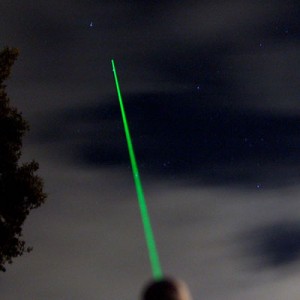 On January 7th 2014, Australian UFOlogist Alan Ferguson posted a video to his website wherein a fellow UFO enthusiast, Peter Slattery, used a consumer grade laser pointer to “power up” an unidentified object in the sky over Albury, Australia.
 Laser pointers, like any laser, use electricity to generate a coherent beam of light. In the case of consumer grade pointing devices, they have limited power. In the US such lasers are limited to 5mW of power, while in the UK, Australia and some other countries they’re limited to 1mW by law. As a result of this low power, the average laser pointer is extremely unlikely to do direct harm to an aircraft or to affect its operation in any way, except if the beam happens to penetrate the cockpit and temporarily blind the pilot.
 As mentioned, lasers are coherent beams of light, or electromagnetic radiation. This means that they emit photons in a straight, tightly packed beam. This cohesion gives the beams the ability to travel large distances without losing appreciable amounts of energy. But they don’t travel forever.