Everyone’s A Little Psychic, They Just Don’t Know It

“After studying these phenomena as a scientist for about 30 years, I’ve concluded that some psychic abilities are genuine, and as such, there are important aspects of the prevailing scientific worldview that are seriously incomplete.”[1] –Dean Radin PhD.

Over the past two years I’ve written many blog posts on many topics, but among the masses there are a few that run together in a sort of series.  These posts deal with what I believe are true psychic abilities, in contrast to what I believe are completely fake psychic abilities.  Each of the posts that I will refer to herein describes scientific efforts to quantify and measure certain phenomena that are colloquially referred to as PSI.  They are my attempt to bring some of this scientific advancement to the fore, but I’ll admit that I have had an ulterior motive.  To me, these posts are like strings of thought, and using them I’d like to braid a cohesive idea, a monologue that resembles the tiny inkling of a thesis that simmers in the back of my mind.

It has been my idea for some time now, that psychic abilities are real and measurable, that they are a vestigial feature of our prehistoric brains.  To put it bluntly, I believe that we all have intrinsic psychic abilities, and I believe that those abilities are an inheritance from our early ancestors; though I think that this potentially advantageous birthright is going the way of the vestigial tail in most of our population.

As I discussed in my previous article titled PSI…Where Does It All Come From, French scientific researcher and biologist Rene Peoc’h used baby chickens imprinted on a tychoscope (sic) to prove that a certain incidence of said chickens had psychokinetic abilities.[2]  By inference, Peoc’h’s experiment was successful in demonstrating that such ability seems to be rooted in areas of the brain that are responsible for instinctual behaviour.  Peoc’h showed that his chicks were able, somehow, to cause his tychoscope to remain proximal to group of chicks when imprinted as a parental figure.  He claimed that this effect was acting over great distances, though after reading the details of his experiment, I’ve come to think that the chicks were acting directly upon the tychoscope, rather than on the computer randomly controlling the tychoscope (23 kilometres away).

I have previously argued that this psychokinetic ability is rooted in the hypothalamus, an area of the hindbrain that is responsible for instinctual behaviour in all vertebrate animals.  Mind you, this is my assertion, not that of Rene Peoc’h.

Among other things, the hypothalamus is responsive to olfactory stimulation; it is connected to the olfactory bulbs, and plays a role in connecting our sense of smell to areas of the brain believed to be responsible for long term memory storage, namely the cerebral cortex.  In this way, I believe that the hypothalamus is partly responsible for some psychokinetic abilities, I’ll explain as I go along.

In my recent post titled Synesthesia, Can You Hear The Colours, I discussed the rare and interesting neurological condition called Synesthesia, wherein those afflicted had their senses jumbled up in the brain, causing them to see sounds, taste colours and feel odours (among many other combinations).  Neurologist V.S. Ramachandran has done much work identifying the cause and function of this affliction, and has narrowed the search for a culprit down to the angular gyrus (a small area of the parietal lobe that is responsible for, among other things, decoding sensory information and allowing us to conceptualise our external reality).[3]  The angular gyrus is a choke point for sensory information, as the neuro-electrical signals generated by all five senses passes through the angular gyrus on their way to the cerebral cortex.  Ramachandran believes that Synesthesia is the result of “cross talk” between different sensory pathways within the angular gyrus.

What’s interesting about this, as noted by Dr. Diane Hennacy Powell, is that there is known to be a connection between the angular gyrus and a number of psychic phenomena,[4] specifically, out of body experiences (OBE’s), near death experiences (NDE’s) and psychokinesis, as well as the ability to see auras.  This connection doesn’t necessarily confirm the existence of such phenomena; it simply states that, where a person claims to have such experiences, there is usually found to be a problem with the angular gyrus.  I personally find it to be more than coincidence that both the angular gyrus and the hypothalamus regulate sensory information being fed to the cerebral cortex, and that both of them seem to be prime suspects for the origin of psychic phenomenon.

One of the biggest roadblocks for researchers trying to prove the existence of psychic phenomenon is the notion that the human brain (or any brain for that matter) does not have the ability to transmit signals outside of the body (except through conventional means of communication).  But the lack of evidence for this, does not necessarily rule out the idea.

In other recent posts, namely those titled Presentiment Effect, An Emotional Roller Coaster, and Consciousness and the Zero Point Field: Are Akashic Records Real, I discussed the idea that there is a mechanism by which our brains can access information that would otherwise be out of reach.  Philosopher of Science, Erwin Laszlo contends that Zero Point Field research will eventually discover that there is a field or wave which permeates the universe, and which is a repository for all the knowledge of the universe.  That might sound a bit grandiose, but there may be some merit to the idea.  As Laszlo points out, in zero point fields, where there rightfully should be nothing, and I mean literally nothing, no particles or energies of any kind, physicists find a field of energy that cannot be explained or even accurately defined.  It is this field that Laszlo points to as evidence for his claims.  But the story doesn’t end there; some have made a connection between Laszlo’s claim and the fabled Akashic Records. Akashic Records were made famous by none other than Edgar Cayce, whereby he claimed that he had the ability to access all the information of the universe, and moreover, that everyone has this ability.  This doesn’t speak to an explanation of such phenomena, but it does provide a starting point for identifying such a mechanism, a starting point that may be furthered by a closer look at Presentiment Effect.

Evidence for the presence of an Akashic field of sorts, can be found by looking at the research of Dr. Dean Radin PhD, of The Institute for Noetic Sciences.  His experiments have shown, quite clearly, that ordinary people have premonitory abilities.

In his experiments, test subjects were shown long series of random photographs via a video screen.  Each subject was monitored for galvanic skin response and blood volume levels in their extremities.  Astonishingly enough, his conclusions were such that a significant number of test subjects were able to react to the content of the pictures before the picture was shown.  In most cases, the responses, which were involuntary, were stronger when the content of the image was of a graphic or emotional nature, and to me, suggests a link to the hypothalamus, and to the angular gyrus.  Is it perhaps possible that these two distinctly separate parts of the human brain are cooperating, the result of which is psychic phenomenon?

To be so bold, I am willing to make such an assertion…and so much more.  I assert that certain psychic abilities are very real, and have manifested themselves in some surprising ways.  I believe fully that science will eventually prove and accept that our minds are more than the sum of their parts, and that we have the ability to transcend into a higher plane of consciousness.  And while I know that this kind of talk is unusual for me, what with my penchant for misanthropy etc., I too am sometimes prone to certain flights of fancy.  Though lest I be thought of as going soft, I will still assert that the level of ability that any one person may have is not enough to make a career out of, and I’ll say again what I’ve said many times before…I believe in psychic ability, but I do not believe in psychics.

Where does this leave us then? We know that some forms of psychic phenomenon are real, with the caveat that mainstream science does not yet agree.  We know that there are at least two viable sources for such abilities in the human brain.  And we know that this process is governed by natural selection just as any other physiological aspect of human life.  But is the presence of psychic abilities an emergence of new genetic characteristics?  Or is it a remnant of our distant past?

My hypothesis is that psychic abilities were much more prevalent in prehistory, that certain forms of psychic phenomenon were a great advantage to our ancestors, but that we are losing this ability by way of evolution.


[1] Dean Radin, deanradin.com, A Biography

[2] Rene Peoc’h, Chicks Distant Psychokinesis (23 Kilometres)http://gerp.free.fr/rpeoch-chicks.htm, 1983

[3]  V.S. Ramachandran and E.M. Hubbard, Hearing colors and tasting shapes, Scientific American.com, April 13, 2003

[4] Diane Hannacy Powell, The Esp Enigma, The Scientific Case for Psychic Phenomenon pp.148

The Survey Says…

Having some time on my hands of late, I’ve been able to catch a few episodes of SyFy’s Destination Truth.  I enjoy the show, even though each episode is pitifully reminiscent of the one before it.  It remains entertaining.  I do have a complaint though, as you probably thought I might.

At the conclusion of every episode, Josh and the crew recap their evidentiary haul for the benefit of the viewer, often calling on the so-called expertise of various Paranormal TV celebrities (such as Jason Hawes and Grant Wilson from SyFy’s Ghost Hunters).  I appreciate the cross cameo relationship between the shows, but I’m aggravated by the invariably predictable conclusions the visiting experts offer in answer to the team’s “evidence�?.

First, I loath the use of the word evidence in that context, as I’ve said before.  While in the strictest sense of the word, it does apply to the product of paranormal research, it can’t be said that this product is definitively of a ghostly origin.  So it is evidence of something, but that’s as far as anyone can take it.  This isn’t unique to Destination Truth or even to Ghost Hunters, but rather it’s a failing of pretty much all paranormal research.

But after all is said and done, we are talking about TV shows, and we must recognize that their aim is to entertain, with scientific prudence coming as a distant second to that goal.  It seems on the face of it, that few people are actually employing the scientific method to investigate claims of a paranormal nature, but if you dig a little deeper you can stumble upon a select few who are taking the whole idea a little more seriously.

One of those people would be Rosemary Breen, the founder of Psychic Revolution and author of a scientifically significant paranormal survey.  Originally conceived of for her Master of Education degree from Monash University in Australia, Ms Breen has released two special reports as a product of her Paranormal Activity Survey.

Considering the number of people who purport to be investigating the paranormal, it’s encouraging to see that some are taking to the questions raised with an analytical approach.  Ms. Breen’s reports bring some focus to the bedrock data that is needed for further study.

The following is an excerpt from a press release regarding her survey results.

The Survey Report reveals intriguing findings, including:

  • Paranormal experiences are reported more often by women than men
  • Paranormal encounters can, and do, start very early in life. At least, one in ten of every first paranormal encounter occurs before the age of six years
  • On average, paranormal experients experience five different types of phenomena in their lifetime
  • All types of paranormal experience are not encountered uniformly between nations: indications are that differences exist, depending on the country and the type of encounter being reported
  • The trend is for paranormal experients to have multiple experiences of the same type of phenomena
  • While most types of paranormal phenomena are encountered throughout life, certain experiences seem to occur more frequently in later life, and
  • Overall, the paranormal is seen as life affirming.

The paranormal survey investigates ten types of phenomenon: telepathy, reincarnation, mediumship, auras, premonitions, psychokinesis, out of body experiences, near death episodes, apparitions and déjà vu.

This second round of the survey Spontaneous Paranormal Experiences is open to the public.

The newly released Paranormal Activity Analysis Report outlines the findings of the first online survey created by the author, Rosemary Breen as part of her Master of Education degree at Monash University, Australia. Unlike many academics, Ms. Breen is reluctant to leave her research on the library shelf. She feels a responsibility to make the research findings public and so, the Report is now available free from the Psychic Revolution website.

Contrasted against the background noise of paranormal television, Ms Breen’s efforts are commendable, and her results should be viewed as important data going forward into the unknown.  I encourage everyone to participate in the second round of this survey (which can be found here), and to take the time to read the full results of the Paranormal Activity Analysis Report.

The Ghost Way, Reviewed

A light read, The Ghost Way offers a wonderful insight into the traditions and superstitions of Thai culture.  Written by Lance Smith, with the help of his wife Kung Ramanakajja, this is the story of Eot and Jak Ramanakajja, and their arduous battle with the demons of troubled ancestors.

The ghost way, or tang pi in the local dialect, is a river passage in the up-country of Thailand, near Aksala village.  The Ramanakajja’s once called the ghost way home, but since their ordeal, they’ve fled the long elephant grass and never looked back.

The story is a moral epic, providing wisdom of the ages, and bringing light to the underworld of Thai spirituality.

Purchase The Ghost Way through Amazon from Paranormal People’s Recommended Reading.

From The Desk of Darth Vader

As you may or may not be aware, Deck Commander Hennessey has failed me for the last time. He is now resting peacefully in the cold void of space (somewhere in the vicinity of the Camino system).

Please join me in welcoming this other guy to the prestigious position of Patsy…err, I mean Deck Commander; you will all now take your duty assignments directly from him. This means, in case you missed it, when you screw the pooch and let those blasted rebels get away, it’s his ass in the sling. Or rather, it’s his throat in my magic fingers. So, if you value his company, don’t screw pooches.

Secondary to this, I have decided to adjust my preferred punishment technique, and before you all rejoice prematurely, all I mean by that is, I will no longer be using the ancient art of throat pinching to express my disgust with your many failures. From this point forward I will be scrotum squeezing. I feel this will turn out to be a more effective motivator.

And while we’re on the subject, I don’t appreciate all the second guessing going on around here. When I rhetorically mention that my son is on ‘that ship’, or that Ben Kenobe is ‘here’, I don’t want any of you asking me if I’m sure, or making jokes about my tired religion. Haven’t I crushed enough throats around here for you people to get the picture? The force is with me, dammit.

Now onto safety, TK427 tells me that some of you have been working around the large open pits in the docking bay without the proper fall arrest training. I’m telling you people, if I lose my ‘15 years without an accidental workplace death’ pin because one of you assheads wants to be a hero, scrotums are gonna get squeezed!

On an unrelated note, bowling has been moved to Thursday to accommodate the Emperor’s birthday this coming Monday. And yes you are all expected to show up, and yes you are all expected to bring a gift. Leave your sex dolls/droids at home this time though, we don’t need another mix up like last time.

So, to recap; the Dude’s been promoted, his life is in your hands, I won’t accept failure, or succinct and well timed jokes about the Jedi Arts; your scrotums are up for grabs (literally), and the Emperor is another year older. Did I miss anything?

Yours truly,

Lord Vader
(a.k.a. The Emperor’s Bitch)

Dictated (but not read) by Darth Vader, transcribed by R2D7

The Divine Comedy, Vol II; Purgatory – Reviewed

This is the second volume of the Divine Comedy by Dante Alighieri; Purgatory, in this case translated by author and scholar Mark Musa (Penguin Classics).

Having thoroughly enjoyed volume one; Inferno, I had hoped that Purgatory would stand up to my rather high expectations.  In story I suppose it did, our pilgrim and his guide climb the mountain of purgatory, traversing the seven terraces of cardinal sin; wrath, greed, sloth, pride, lust, envy and gluttony.  I did find it a bit odd that these seven sins would be cleansed through purgatory, rather than punished in hell, but who am I to question the master poet of Italy?

This translation though, was somewhat disappointing.  Rather, it was Musa’s input that brought this version down.  The translation notes were thorough to the point of tedium, and being inserted after every canto they caused the story to become much too fragmented to be enjoyable.

If I were to take this path again I would choose a different translation, but all in all, I am richer for having endured.

A Universe From Nothing, by Lawrence Krauss – A Review

A Universe From Nothing.  At first glance this book seems to be a treatise on the science of cosmology, but the happy surprise is that Lawrence Krauss presents a cogent and relevant argument against Creation.  Using science as a sword he carves out a picture of nothing and explains how something from nothing is not only possible, it’s inevitable.

I admit that I didn’t fully understand all of the science, though this is no fault of Krauss, his writing is eminently readable.  The subject matter therein is, however, highly complex.  From the cosmology of the Big Bang, to the curvature of the universe at hand (which happens to be as flat as can be measured), to the quantum weirdness of quarks and protons popping into existence from the nothingness of empty space.  These topics are mindbenders to all but a select few people.

To clarify my understanding, I may pick this book up again in the future. According to Richard Dawkins (who wrote the afterword for the book) this is a seminal piece in the battle between science and religion, so a second reading might be warranted.

Despite the fact that I didn’t grasp all of the subtle nuances of the science, I do recommend A Universe From Nothing to anyone wishing to find answers to the philosophical question of First Cause.  It is a journey worth taking.

The Drake Equation, Counting the Stars

The current state of UFOlogy notwithstanding, it’s an awe inspiring thing to look into the night sky and ponder the question that haunts so many…is there life elsewhere in the universe?
It has been a question that has weighed on my mind for many years, and one that has occupied the intellect of some of our civilizations most celebrated geniuses.  To say that I stand on the shoulders of giants would be a monumental understatement, but nonetheless I offer you commentary based on the intelligence of those who came before me.

The genius I refer to is the Drake Equation (also known as the Greenbank Equation or the Greenbank Formula).  The equation bears the name of its originator, Frank Drake, one time Emeritus Professor of Astronomy and Astrophysics at the University of California, Santa Cruz.  The anecdotally fulfilling story of how and when Drake came up with the formula is an aside to the real value that the formula offers to those who search for signs of such extraterrestrial life, though it is worth telling.

In 1960, Drake conducted the first search for radio signals from extraterrestrial civilizations at the National Radio Astronomy Observatory in Green Bank, West Virginia. Soon thereafter, the National Academy of Sciences asked Drake to convene a meeting on detecting extraterrestrial intelligence. The meeting was held at the Green Bank facility in 1961. The equation arose out of his preparations for the meeting:

As I planned the meeting, I realized a few days ahead of time we needed an agenda. And so I wrote down all the things you needed to know to predict how hard it’s going to be to detect extraterrestrial life. And looking at them it became pretty evident that if you multiplied all these together, you got a number, N, which is the number of detectable civilizations in our galaxy. This, of course, was aimed at the radio search, and not to search for primordial or primitive life forms.” –Frank Drake[1]

The equation allows one to work out how many intelligent civilizations are likely to evolve within the Milky Way galaxy.  It uses a number of values that are, shall we say best guesses at most, such as the number of stars that are created in a given period, or the number of habitable planets there are at any given time.

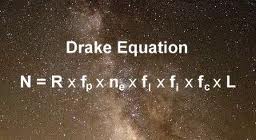
The Drake equation states that:

N= R* x Fp x Ne x Fl x Fi x Fc x L

where:

  N = the number of civilizations in our galaxy with which communication might be possible;

and

R* = the average rate of star formation per year in our galaxy

fp = the fraction of those stars that have planets

ne = the average number of planets that can potentially support life per star that has planets

fℓ = the fraction of the above that actually go on to develop life at some point

fi = the fraction of the above that actually go on to develop intelligent life

fc = the fraction of civilizations that develop a technology that releases detectable signs of their existence into space

L = the length of time for which such civilizations release detectable signals into space

Considerable disagreement on the values of most of these parameters exists, but the values used by Drake and his colleagues in 1961 were:

  • R* = 10/year (10 stars formed per year, on the average over the life of the galaxy)
  • fp = 0.5 (half of all stars formed will have planets)
  • ne = 2 (stars with planets will have 2 planets capable of developing life)
  • fl = 1 (100% of these planets will develop life)
  • fi = 0.01 (1% of which will be intelligent life)
  • fc = 0.01 (1% of which will be able to communicate)
  • L = 10,000 years (which will last 10,000 years)

Drake’s values give N = 10 × 0.5 × 2 × 1 × 0.01 × 0.01 × 10,000 = 10.

Little consensus can be found for the values above, while R* is based on a considerable amount of astronomical data and is the least argued value, others, such as ne and fl are hotly debated.  As shown above, Drake came to the conclusion that there should be 10 intelligent civilizations with the capability of communicating within the Milky Way galaxy (via radio waves etc).  The one factor that the Drake Equation does not address is when these civilizations might exist, which is the chief criticism of the formula.

Critics of the formula cite that many of the values are soaked in anthropic bias, or in common terms, they are based on information that is true about Earth, but may not be true of other planets.  Over the years various other people have worked the Drake Equation using different values, whether based on scientific data (i.e. geology, astronomy and anthropology) or even just intuition, ultimately causing great divergence among their individual values for N, providing for between 0.000065 to 20,000 communicative civilizations.

Ultimately the critics are correct, while the equation may provide an invigorating thought experiment; it does not provide any real answer to the question that preceded it.  Since most of its values are little more than guesses, the resulting expression is worthless.

Or as noted by science fiction author Michael Crichton:

“The problem, of course, is that none of the terms can be known, and most cannot even be estimated. The only way to work the equation is to fill in with guesses. As a result, the Drake equation can have any value from “billions and billions” to zero. An expression that can mean anything means nothing. Speaking precisely, the Drake equation is literally meaningless…”

The God Helmet and the World Grid

As anyone whose read my blog in the past already knows, I am not a spiritual or religious man.  In fact, I am an atheist; in that I don’t believe in God (I’ll forgive a slight gasp of disbelief for those who are new to my writing).  I find the whole idea to be nonsense, but this is my choice, as it is the choice to believe for anyone else…but is it really a choice?  Are we born capable of intellectualising such matters?  Some would say yes, others would say no, and I have another argument to offer.
As much as anyone might be able to rationalize and compartmentalize such a choice, there is a growing amount of scientific evidence to suggest that a propensity for religious belief is a hardwired function of the human brain, meaning that our brains are programmed to believe in deities, though it doesn’t stop there.  There may be a correlation between religious piety and belief in extraterrestrials or even the paranormal.

Ancient Astronaut theorists have long proposed that the deities we so passionately worship today are nothing more than highly advanced extraterrestrial creatures who, quite literally, played God in our distant past.  In fact, many of the arguments used to deny the existence of God can easily be adapted and used to argue against the existence of these ancient aliens.  But that’s another discussion entirely.

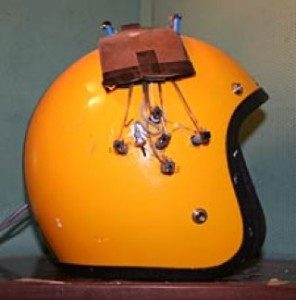
What if I told you that your propensity for belief, whether in God or aliens or ghosts or what-have-you, is actually the product of your brain interpreting electromagnetic signals in the atmosphere?  Whatever you might say, I would tell you next of Canadian Neuroscientist Michael Persinger’s God Helmet.  Literally a device that is purported to bring about religious or spiritual experiences, the God helmet has been the focus of much scrutiny of late.  Originally conceived to aid Persinger and his research partner Stanley Koren in a study of creativity and the effects of subtle stimulation of the temporal lobe, the God helmet was found to provide a much more profound experience than just inspiration.

Now there is some argument over the replication of Persinger’s results, but Persinger does stand by his findings.  The God Helmet was not specifically designed to elicit visions of God, but to test several of Persinger’s hypotheses about brain function.  The first of these is the Vectorial Hemisphericity Hypothesis, which proposes that the human sense of self has two components, one on each side of the brain, that ordinarily work together but in which the left hemisphere is usually dominant.  Persinger argues that the two hemispheres make different contributions to a single sense of self, but under certain conditions can appear as two separate ‘selves’.  Persinger and Koren designed the God Helmet in an attempt to create conditions in which contributions to the sense of self from both cerebral hemispheres is disrupted.

In any event, the God helmet uses complex magnetic signals patterned after physiological processes, such as one derived from limbic burst firing, to elicit a response in the subject’s experience.  His subjects reported feelings of a presence in the room with them, visions of angels or of deceased persons known to the subject, and most poignant, a feeling of being in the presence of God.
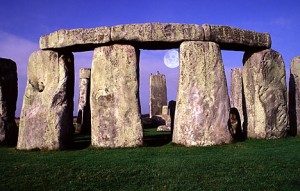
It strikes me that these feelings are comparable to those reported by persons visiting various spiritual locations the world over such as Stonehenge in Wiltshire, England, or Machu Picchu in Peru, or even Cambodia’s Angkor Wat.  It’s also interesting that each of these places are reported to have or emit strange electromagnetic fields.  Furthermore, these locations, and many more, are points of inclusion in the world grid.

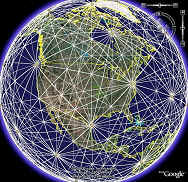
Also called Ley-lines, the world grid is a series of lines that criss-cross around the globe, connecting a large number of sacred or spiritual sites all over the world.  It’s thought that the world grid is the manifestation of complex EM fields, that when mapped out create invisible geometrical shapes.

Ancient Astronaught theorists like to assert that the world grid is an old world navigation system, used by extraterrestrials and possibly taught to ancient man.  In some circles it’s said that these ancient spiritual sites are in fact revered as sacred because of those teachings.
As mentioned above, it strikes me that these locations, the ones that are considered to be situated at convergent lay-lines, seem to emit or posses special electromagnetic energy and I wonder if the spiritual nature of these sites is related to the effect seen in Persinger’s God Helmet.  In short, I suggest that those EM fields at sites like Stonehenge etc. act in much the same was as the God Helmet, creating religious experiences through the subtle manipulation of the temporal lobes of those who visit such sites.

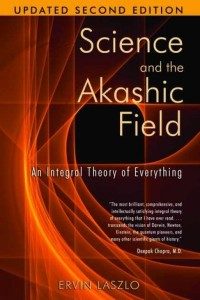
Science and the Akashic Field; An Integral Theory of Everything

Science and the Akashic Field, a relatively small book, is definitely not a light read. Written by philosopher of science Ervin László PhD, this is a thorough tour of virtually every contemporary science on the way to an understanding of László’s Integral Theory of Everything.  Where the likes of Einstein, Newton and many others have created various theoretical works, none have been able to encompass every aspect of the reality we all experience.  It appears that László has succeeded in revealing such a TOE, an I-TOE.  He has spent decades examining the works of other theoreticians in search of evidence for what he calls the Akashic field, or the A-field, which is the foundation of his theory.
While I’m not knowledgeable enough to provide you with a complete explanation of his I-TOE or the A-field, I do come away from this book with a deeper understanding of coherence as it pertains to the quantum world and to the cosmos.  I did find László to be utterly convinced of the efficacy of his own theory, even though, to my understanding, he has non-conventional views of evolution and quantum mechanics.

I wouldn’t recommend this book to anyone who has limited knowledge of physics, cosmology, evolutionary biology and even psychology, but to those well versed in contemporary science, it would be a worthy effort.  All in all, I found Science and the Akashic Field to be a fulfilling read.

Artificial Intelligence

Artificial Intelligence or the scientific pursuit of AI is insulting to me as a biological entity.

The very idea of replacing human control over both the developmental pace and capacity of computers is to me an idea fraught with folly.  Not the least of my concerns is the eventual obsolescence of humanity on earth, but more to the point, I think there are better ways to apply the collective knowledge of genomics, nanotechnology, computational engineering, evolutionary biology and cyber-neurology

What is meant by the often abused title Artificial Intelligence?

Intelligence exhibited by an artificial (non-natural, man-made) entity; the branch of computer science dealing with the reproduction or mimicking of human-level thought in computers; the essential quality of a machine which thinks in a manner similar to or on the same general level as a human being.” [en.wiktionary.org/wiki/artificial_intelligence]

A computer that thinks; this is opposed to the computers we have currently, computers that are exceptional in their computational abilities, but which cannot perform even the simplest task without instruction from a human being.

Even without invoking the ever popular notion that Skynet will take over the world –in a violent attempt to either defend itself against destruction (or deletion, or disconnection, or whatever other apocalyptic processes a computer might eventually deem it needs to defend against) or act to protect us from the perceived threat of, us– I can articulate a number of other possible negative outcomes of the race to AI.

Perhaps our robotic progeny will advance so fast in intellect and reasoning ability, somewhere in the range of an exponential increases in both computational power and cognitive scope, as many who work on such projects realistically predicts will be the case, that our interference will be deemed akin to the presence of termites in the walls of our homes, and of course be subject to extermination.  Or perhaps our little AI creations will simply leave us behind, ejecting themselves off and away from this planet doomed to biological destruction, forsaking all that which we most self-righteously demand they owe us from their creation.

It has always annoyed me, the scope to which humanity’s anthropocentric attitude blinds us to the unbiased reality of our environment.  Every assignment of the idea that we are at the top of the food chain, that we are the most intelligent beings on this planet, or that we somehow deserve evolution’s progressive respect (as such demanding that we should stay in our self-imposed position of superiority over nature), is an insinuation that our position is anything more than an egomaniacal fantasy.  Our big brains are an impressive example of evolution’s propensity for bio-complexity, but the result is nothing more than luck.  We are not the winners in a global lottery of species, now righteous in our celebration of the riches we’ve won.  We are freaks of nature, and a more succinct description could never be designed by either evolution, or monkeys on typewriters.  Our brains, and in turn our vast intellect are products of genetic mutations accumulated over millions of years of biological development; accidents of copy fidelity in our respective DNA and nothing more.

Perspective in mind, does the creation of an Artificial Intelligence preclude the notion that we have some right to sit where we do in terms of intellectual superiority?  No, it most certainly does not.  Hence, at the first opportunity, our position at the top of the ladder will quickly be supplanted by the first entity that is capable of doing so, whether created by us or Mother Nature.

If the worst case scenario is death and destruction, and the median might be abandonment, could the best case scenario be captivity?  I’m not necessarily saying that all AI research be stopped immediately, not at all.  AI research holds the potential to unlock the secrets of our vastly complex and secretive brains, it can, through its respective contributory sciences, serve to engineer humanity itself into that golden seat of actual superiority, immortality and infinite intelligence.

All that I’m suggesting here is that the pursuit of AI would be better aimed at integrating the longevity of computers that learn directly with human intelligence.  Whether that be a neural download (or would that be an upload?), a confluence of technological systems with biological systems…or even a full realisation of the Bionic Man’s opening Mantra: “…we have the technology, we can rebuild him.”

To me, the difference amounts to making devices that can outrun our intellectual possibilities, or increasing our own intellectual possibilities themselves.  It should be known that there are people working on both sides of this coin, there are those scientists who would have every home equipped with an AI butler, there are those that would have the internet converted into a learning machine (which presents me with a frightening mental picture), and there are those who would take AI research to the level of creating a whole new class of artificial entities, based on human technology and neurology.

This doesn’t belie the actual research being done on both fronts, AI and BioEngineering, wherein scientists are, with relative quickness, making discoveries that will doubtless enhance what it means to be human, not the least of which is the prospect of using nanotechnology and biomedical engineering to re-grow severed limbs and organs, or the decoding of human neurology in order to facilitate notions of radiotelepathy and neuronally transmitted communication.  We are moving ahead, as a species, this is a fact none can rationally deny; where we’re headed is another question, and is wholly up for debate.