How to Sit in a Chair; An Excerpt

The following excerpt is a sneak preview of my current work-in-literary-progress, ‘How to Sit in a Chair’ is a book I’ve been working on for some years.  I thought I’d share it with you, if only to fish for feedback and criticism.  Even though this work remains unpublished, it is covered by the copyright of this website, and as such may not be copied in whole or in part without expressed, written permission.

“It is our creation

And like all things we see

Is made up of the same stardust

As you and me

Look around you, what do you see?  Furniture?  Possibly a chair or two?  Small objects, big objects, soft things, hard things, people, animals, plants, earth, and even stars if you look up.

You are surrounded by the miracle (and I use that word loosely) of the universe.  Every particle of every atom, of every cell, of every thing came from the same small source, billions upon billions of years ago.  It seems strange to use a human convention, the word years, to describe the evolution of the cosmos, but such as we are, we will have to remain.  Somewhere between five and six billion years have passed since that first galactic event, The Big Bang; an explosion, so vast it sprayed cosmic elements across an expanding area so vast that our minds are largely incapable of comprehending its size.  So much so that I won’t even try to illustrate it.

Since that initial event, regardless of its cause, time has worked its magic.  Floating disks of gas slowly combined in empty space, they captured more gasses, combining elements in ways that now seems so basic.  As progress held its course, these gas disks compressed under the growing forces of gravity, driving elemental gasses together with such pressure that the first chemical reactions took place, eventually becoming the bright stars we see in the heavens above the earth.

This process was crushingly violent, though cosmically slow.  Over times’ course, the pressures that created the stars served to force the chemical processes which created elemental by-products; hydrogen and helium, as well as heavier components such as iron and carbon.  These elements make up everything in the universe. They, together with all of the base elements on the periodic table, are the foundation of every celestial body our minds can conceive and our technology can scan.

We too, are made from the dust of stars; our wondrous evolution was made possible through the most violent of acts.  We are the children of a cosmic accident (in more ways than one, quite possibly), and in that spirit we move on, we grow and learn and build.

As mentioned earlier, everything you can see, touch and experience is made up of the same stuff; Carbon is the building block, but the atom is the engineer.

Atoms, with neutrons and protons and nuclei; spinning, vibrating and orbiting, make up everything you can see and experience.  The subtle difference between your rear-end and the chair it rests on, is the simple matter of a vibrational frequency.  Essentially, the frequency of vibration of an atom and it’s complementary nucleic particles, determines it’s alignment with other atoms, and through that process, determines what type of matter it makes up on a macro scale.  Though, again, the difference on the atomic scale is almost negligible, and in effect reduces the difference between you and your chair to semantics.

Does that reduce your intrinsic meaning?  No, not necessarily.  That subtle difference between you and your chair is the same as the difference between you and a bar of gold, or your chair and the body of a Lamborghini.  Though, as we move up the scale of magnification on both your body and the chair, the effect of those differences becomes apparent and undeniable.  The similarities are also highlighted; you are both made up of biological matter, reinforced by elemental matter, and at different times, you are both energized by the power of the sun’s radiation.

The fact that you and your chair are made up of the same special stuff, the same stuff that makes up everything in the universe, means that you are both governed by the same laws of physics.  You are both at the mercy of gravity, you are both limited by the speed of light, and you’re both subject to the weird rules of time.  My lack of understanding in the science of non-Euclidian geometry not withstanding, I’ll spare you the tedium of a mathematical assessment of your chair, and its interaction with the environment at large, and in place I’ll open the door a little further to exploring the physics and biology of the chair.

Empty space is especially intriguing, and at reading that statement you might wonder if I’m making a joke of some kind; let me reassure you, I’m not.

When you think of matter, you most likely imagine a solid thing, an object, a fluid, a person or a planet.  But there is much more to matter than meets the eye.  If you close your eyes and imagine the atomic structure of matter, do you envision a cluster or grouping of tiny atoms, stuck together, standing shoulder-to-shoulder in a huddle, straining against the varied forces of nature to maintain the shape they hold?

What if I told you that the molecular structure of matter contains more empty space than solid mass?

Consider that the molecular structure of a chunk of rock resembles a single molecule, standing alone on the centre of a professional football field in a large NFL stadium, and his next closest kin stands on the edge of the stadium’s parking lot.

That’s a lot of empty space.  So much so that the mind can scarcely believe it’s true, for if there is that much distance between molecules, why does anything appear solid?

The same applies to your chair, more empty space than solid mass, in fact, far more empty space than that of the rock.  So much empty space that the lonely NFL fan molecule’s closest kin would be several city blocks away.  While you consider what that means, try not to think about what’s keeping them connected.

Perspective is everything in the universe, if you and I were naturally tiny enough for us to see the molecular structure of our chair, without the aid of a very powerful microscope, we would certainly have no need of a chair any longer, but then our perspective would be such that the empty space would seem most practical.

As it is, our perspective has necessitated the need for objects with mass to appear completely solid, hence, the chair can support your tush for while longer.

Where would we be without Sir Isaac Newton?  Well, probably right where we are, we’d just be a little worse off is all.  Where would we be without gravity?  Better yet; what would we be without gravity?  This would be very different indeed.  Gravity defines life on earth; it binds us to our planet and binds our planet to its position in the solar system.  It also binds our sun in its position relative to the rest of the universe, even though that position is ever changing; gravity is what makes everything make sense for us.  It is a constant in our universe (though cutting edge science is beginning to refute that idea) and it dictates what we can and can’t do.

It governs our weight, relative to our atmosphere, it provides the means to assign a value to mass, and in fact it was the first invisible phenomena of our universe to be detected, categorized and measured.  In essence, gravity is the reason we’re here at all.

Without gravity, the chemical wastes spewed out by our sun billions of years ago, would never have had the chance to connect, to congeal and to ultimately form a solid.  Without gravity, hydrogen and oxygen molecules could never have condensed to create water, and well, without water, we don’t exist.  Gravity is the ultimate designer too, it provided the means by which plants grow their many varied structures, and eons ago it forced early sea creatures to adapt their biology in order to survive on land (among other things).

It restricts us as well; it says we can’t fly, and proves it every time we jump off a cliff.  Gravity gave birds the advantage of flight, but they tricked it by reducing their mass by way of hollow, non-dense bones, making them light enough to glide on air currents while big enough to survive.

And in this way, gravity has shaped the chair.  This one constant demanded that we abide by its laws and be governed by the pressure of the universe pushing down on us.  Inevitably, we got tired and decided to sit down, and the chair was there to support us in our time of need.  Its structure is sturdy, four legs (though sometimes not), supporting a seat, a back support (or not) and possibly some arm rests, all of which are under the same pressures as us, they feel the same weight, the same pull as us, and yet, the chair holds us.  In structure and form, the chair defies gravity.

This is no big deal you say; after all, most everything on earth defies gravity in some way or another, and you may be right…in fact, you are right.  It’s nothing special, until you think of life without gravity!

Amorphous blobs of proto-matter, floating, hovering and clinging to the atmosphere.  They resemble giant three-dimensional pools of toxic waste.  They’re grey, sticky in texture and seemingly lifeless, until you hear it.  It’s quiet at first, a low rumble, like the infancy of some great gurgling burp in the belly of a bar-stool football fan.  The rumbling gets louder, it creates sound waves that resonate deep inside you, and soon it becomes a deafening boom, over and over, and through all this invisible commotion, you finally see it; the grey blobs of matter begin to move, slowly at first, but they pick up speed, moving away from you, changing shape and propelling themselves by sound waves.

On this strange planet, gravity, or the lack thereof, helped evolution create a very different animal population.  They didn’t feel the force of gravity pushing them toward the earth, they didn’t have to fight against their own weight to move through their environment, and as a result, natural selection took them on very different paths of evolution than us.  They have no need for legs or supportive structures; they have no need of limbs at all, for locomotion or for any other reason.  Theirs is an existence of weightless leisure, though I’m certain they face perils none-the-less.  Weather patterns exist on even the most barren and alien worlds we know, so for sure, this planet would suffer the same changing winds, and I would imagine a species whose life is spent hovering above the surface of the ground, would be acutely affected by the winds.

Consider the chair in such an environment, it would be utterly absurd.  To confine ones self to the rigid formality of furniture, when the atmosphere is more than supportive and much more appealing; who would do such a thing?  Though, if a higher intelligence evolved in such a place, would they not have need to structure and organize the things in their lives?  The acquisition and collecting of things may be uniquely human, and it may be limited to us because of our gravitational environment.  In our gravity, things generally stay where we put them, though not necessarily so on a low or zero gravity world.

This is only one end of the gravitational spectrum however, what about life on giant planets, whose gravitational fields are many hundreds of times greater than that on earth?  Can life survive in that environment?  The answer is yes, resoundingly; we know from the study of extremophiles here on earth -a growing field of micro biology studying single celled and some multi-cellular but simple life forms mainly classified on both the archaea and eucharyote branches of the biological tree of life – that species of microbial life, such as bacteria and protists, thrive in the vast and crushing depths of our deepest oceans, huddled near geothermal vents in the sea floor, and virtually unchanged for the past billion years.  Life can, and does, exist and flourish in such extreme environments.  So what does that mean for the chair?

One would imagine that the demands of survival in such crushing gravity would necessitate the development of very small organisms, creatures whose structures must be dense enough to survive the atmospheric pressure, yet small enough to ensure their super dense mass doesn’t make movement impossible where necessary.  Very little in this environment would venture above the crust of the planets surface, and most life would exist inside protective rock formations.  It, again, would be ridiculous to conceive of such life making use of chairs.

These are two extremes however, and while we may not reside at the mean mark of the universes’ gravitational spectrum, we are at least living in the only environment that we could possibly have survived.

Mankind, even among the many thousands of species of life here on earth, is exceedingly fragile, we are frail and weak compared to our evolutionary counterparts, we are naturally ill-equipped to survive even in the environments we continually inhabit.  Outside of a small swath of tropical and sub-tropical locales around the equatorial belt of this spinning blue ball, humans would surely perish if left to survive only with our uncovered flesh exposed to the elements, anywhere but within walking distance of a sandy white beach.  Indeed, just beyond that beach is a soup of oceanic life, teaming with diversity and evolutionary adaptability, all of it surviving and thriving in an environment that is in direct opposition to that which is necessary for our own survival, and none of it, not a single species other than man, has ever seen fit to design, construct and use a chair of any kind.

It’s our big brains which leave us seated high at the top of the remedial food chain, not by brute force or natural predatory skill, but by ingenuity alone.  We adapt at a rate far faster than any creature ever known to this small planet of ours.  Through that adaptation, we have collectively harnessed the power of physics; we’ve manipulated, tweaked and experimented with those immutable laws, and used them to our advantage.  Thanks to that adaptability, we now inhabit nearly every corner of the globe, largely changing the face of the environment with the core purpose of protecting our fragile selves from the harshness of that same ecology.  We change everything we see and everything we touch, we force it all to become our slave, slaves to comfort, slaves to aesthetics, and slaves to progress; the chair is no different.

Whatever its shape, whatever its size, we can all recognise its form as that of a chair.  Its purpose, clearly, is to be sat in.  To support us, to provide respite and shelter from the long journey of life that has left us weary and tired, or to house our ingenuity as we careen recklessly down the varied roads of life.”


The Hidden Reality; Parallel Universes and The Deep Laws of The Universe

Brian Greene does it again, with a spectacularly informative book. Though a warning to all who wold crack this book open, this is not a light read and though Greene’s writing style is eminently readable, it is not meant for the unfamiliar layman.

I come away not feeling sure I understood every section, but am now armed with a working knowledge of the various multiverse/extra-dimensional theories and interpretations that quantum mechanics allows.

Whether you feel an affinity for the quilted multiverse, the inflationary landscape interpretation or the megaverse, should you get to the end of the book, you will be awed by the detail weaved into each chapter.

In my opinion, Greene is possibly the best physics author of our time, and I give this book a 4.5 out of 5.

Pick up your copy of The Hidden Reality today, through Amazon.com

The Grand Design, by Stephen Hawking; A Review

I quite enjoyed this book. It seems Hawking and Mlodinow make a dynamic team. Much of the information provided is a rehashing of previous works by Hawking and by many other physicists, but their conclusions were surprisingly new and understandable.

Not only does this book provide more food for thought, but it could be paradigm shifting, and should be read by anyone who might call themselves informed on physics and cosmology.

My only complaint would be that the final chapter, the one which draws those new conclusions, seems unfinished. Their point is delivered and then…the book just ends.

As already mentioned, it’s a worthwhile read, I just would have appreciated more commentary on the overall point. Either way, the evening that I finished the book, I found my mind wandering about the landscape, awed by the idea that of the possible universes, our is such that stars and planets could form, that heavy elements could be created, and that biological life could develop…but most inspiring is the idea that from all that chaos could form beings who are capable of questioning, analyzing and understanding all of these details. Who needs God, when we have the world.

Pick up a copy of The Grand Design today, through Amazon.com

The Weight of the Technological Age

With the holiday season still hanging around in our rear view mirrors, many of us have embarked on the quintessential New Year’s resolution, the one that serves to line the pockets of fitness centre owners everywhere.  That is, we ate too much during our winter solstice revelling and now we feel compelled to make at least a token effort to lose some weight.  Well, some of us are, while some others (myself included) continue to stuff our faces well into the New Year.

We – that is to say some of us – are, it seems, obsessed with our body weight.  Having had some experience with the arena of amateur bodybuilding in my younger days, I am all too familiar with the mechanism that serves to make us overly focused on how much we weigh (though I am no longer afflicted so).  What happens to that weight when you “lose” it though?

No, this is not the introduction to a new weight loss scheme or a fad diet, but rather a discussion of the physics of weight, or mass to be specific.

What is weight?  It is the product of gravitational pull on the mass of an object.  Every object has mass, from the smallest organisms to the largest planets, but weight depends on those objects being close enough to each other to combine their natural gravitational pull.

Sir Isaac Newton, who was the first to describe and measure the force of gravity, expressed the gravitational pull of spherical objects (where the majority of their mass can be assumed to be at their core) in terms of the following equation:

F = G (M1*M2/R2)

  • F is the force of attraction between them.
  • G is a constant that is 6.67259 x 10⁻¹¹ m3/kg s2 (known as the Gravitational Constant).
  • M1 and M2 are the two masses that are attracting each other.
  • R is the distance separating the two objects.

So, again, everything has mass, so everything has a measurable weight relative to another object.  On Earth, that other object is generally given as Earth.  When you step on that bathroom scale, the number given is a representation of the result of the above equation.  It gives you a measurement of the gravitational pull between you – your body – and the Earth, expressed in the common terms of pounds or kilograms.  But as you might now be asking, if the scale tells you your weight relative to the Earth, then what does the Earth weigh?

Using the above, one can in fact work out the weight of the Earth, or, more accurately, the mass of the Earth.  And it turns out this is one heavy planet.

The Earth’s mass is approximately 6×1024, or 6,000,000, 000,000,000,000,000,000 kilograms. And one might add that it’s gaining weight, albeit ever so slowly.

In addition to the tons of space dust and meteorite material that enters our atmosphere annually, there is a phenomenon occurring now that is directly related to us and our technology, believe it or not.

It can be argued that Earth’s biosphere is a closed system.  That is to say we, as a planet, neither lose nor gain appreciable amounts of matter or energy as time goes on.  Our material resources are finite, and the use of those resources amounts to a huge exercise in recycling.  This is true, to a point, but it’s inaccurate.

Every bit of energy used on this planet comes from our sun, as in solar radiation energy.  It is used either directly, as in photosynthesis or solar power collection, or even heat, or indirectly as in fossil fuels, or through the consumption of plant materials by animals etc. (There are other ways, of course, but this will suffice for the current discussion.)  The same is true for electricity, whereas it’s either direct or indirect solar energy that initiates the flow of electrons in electric circuits, which by definition is electricity.  Electrical systems make use of this flow by either powering components and thereby using up the indirect solar energy, or storing the potential of the energy in capacitors or batteries for later use.

Believe it or not though, this is contributing to the fluctuation of the mass of the planet.

According to John Kibiatowicz, professor of computer science at the University of California, Berkley, a Kindle e-reader weighs more when it’s fully loaded with e-books than when it’s empty.[1]  Admittedly, the weight difference is so slight that it’s technically unmeasurable in a single e-reader device.  The difference is said to be approximately 10-18 grams, which is about a billionth of a billionth of a gram, or what is known as an atogram.  Since today’s most sensitive scales have an effective resolution of about 10-9 grams, it’s beyond negligible, but there is a difference.

It can be scaled up though, and according to Michael from Vsauce in a video on his YouTube channel (see below), when you apply the same logic and mathematics to larger collections of digital information, say the internet as a whole, it turns out that such data weighs on the order of 12 grams or as much as the average strawberry.

This may not make much sense to you, as it didn’t to me until I looked into it.  After all, digital data is just a particular arrangement of imaginary 1’s and 0’s on a hard drive, or on a more fundamental level, the specific arrangement of electrons on the surface of a memory device.  Where they are on the disk shouldn’t amount to a hill of beans in terms of the weight of the device on which they’re stored.  However, as mentioned above, even electrons have mass, and if they have mass, they have weight.  In the case of electrons that weight is beyond infinitesimal, but when there’s a lot of them it can start to make a difference.  Thus, adding more information means adding more electrons, and more weight.

The same is apparently true for fully charged electronic devices vs. devices with no battery power, since charged means only that there are more electrons stored in the devices battery or capacitors.

So how does this mean the Earth is getting heavier?

As mentioned, the Earth is considered a closed system, but it really isn’t.  We’re bombarded on a second by second basis with particles from the sun.  All manner of particles, including electrons.  Some of these particles pass right through, others bounce off our magnetosphere, and others are absorbed in the form of solar energy.  In general this is a two-way street, as heat energy and electromagnetic energy are constantly ejected into space from our atmosphere, however, with the advent of electronics, much more of that energy is retained in our devices than has been released historically.

As has been illustrated though, energy has mass has weight, therefore the more energy is retained in our massive planetary system, in the form of electric potential, the more the planet weighs.  It would never be an extreme weight gain, but compared to other ages of our planet, our penchant for electronic toys has had a measurable impact on the weight or mass of the planet Earth.  This of course has no real impact on anything resembling reality, it’s just interesting food for thought.  Mmm…food.


[1] C. Clairborn, Ray. The Weight of Memory.  The New York Times. October 24, 2011: http://www.nytimes.com/2011/10/25/science/25qna.html?_r=2&src=tp&

A Stroll Along The Continuum of Probabilities

I’ve been thinking a lot about probability lately.  That’s probability as it pertains to physics, not the likelihood that this post will be read.  No, I’ve been thinking about the ‘all histories’ principle or as some call it, Many-Worlds Theory.

The story begins with an explanation of the ‘double slit experiment’.  First postulated by English Polymath Thomas Young, the double slit experiment is used to demonstrate and study the wave theory of light[1].

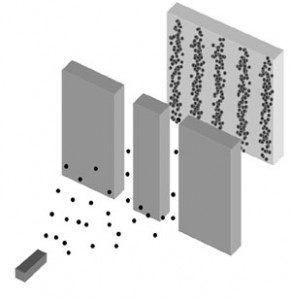
Essentially, a beam of light is aimed at a plate which has two identical vertical slits cut into it.  Common sense tells you that light should travel through both slits and should create an image of two slits on the wall behind the plate.  However, this is not what happens when you carry out the experiment.  Instead of two slits projected beyond the plate, you end up with a classic interference pattern[2], or a band of alternating light and dark lines where intuition says there should be just two lines of light.

Unfortunately, at least for the layman, you need a laser or photon cannon to reproduce these results, but you can see the effect when you shine a cheap laser pointer onto the surface of a CD and let the light reflect onto a nearby wall.  All this is caused by the duality of light, this is the idea that light is both a particle and wave at the same time, and it’s a fairly weird thing to get used to.

Modern physicists have advanced the methodology of the double slit experiment and set it up using particle emitters –devices that emit a single particle at a time, rather than a stream of millions- and photosensitive screens that record the impact of each particle.  Amazingly enough, the same interference pattern is achieved when the experiment is done this way too.  This means that even single particles –photons of light- which should travel through one slit or the other, actually travel through both slits at the same time!

This curious idea has been the object of much study in the last 100 years, and the obvious question it begs is, can we measure and predict the path a particle will take on its way from the emitter to the screen?  What physicists found when they tried to measure the path of the photon, was that the interference pattern disappeared!  The act of measuring the particle caused it to travel along a definite path, but more specifically, it caused the particle to behave as a particle, rather than a wave.

This is a direct demonstration of the idea that the particles emitted exist at all points along the experiment path simultaneously, or in other words, that every particle –not just the ones used in these experiments but all particles in the universe- exist in multiple, if not infinite states of probability, as waves of probability.  That is to say that there is an equal probability that the particle can be found at any given point along a continuum at any given time.  The effect of measuring the position of the particle is to cause that continuum to collapse into a single reality.

A representation of the Double Slit Experiment

You might be wondering how this relates to ‘all histories” or Many-World theory, and quite simply, both ideas are a common sense extension of the double slit experiment effect.

Both schools of thought suggest that, as all particles hold a potential to be anywhere at any time, all states of matter all possible histories and futures exist all at once.  This is not a new idea -in fact the Many-World Interpretation was first postulated by Hugh Everett in 1957- but my thoughts have been gravitating toward it for some time nonetheless.

What’s attractive to me, intellectually speaking, is the idea that in all the chaos of the universe the element that brings coherence to reality is consciousness.   I realise that this may be a stretch, but some thought may bring you around to my side.

There are many ways to measure the attributes of a system, such as the universe, but the one constant in all measurement is the observer.  In fact that is the definition of measurement in terms of quantum mechanics, a sampling of variables by the senses of an observer.

Think of a circle with lines drawn through it in such a way so that all of the lines connect perfectly in the absolute centre of the circle. Envision that all of the lines on the left side of the circle are paths into the present, and all of the lines on the right side of the circle represent pathways into the future.

The circle represents a model of existence, permeated with potential timelines.  In the past there are an infinite number of histories –or paths into the present, some are more likely to be realised than others, but only one is the actual history of the present.  Extending into the future there are an equal number of choices –or paths out of the present.  Again, some are more likely to be realised, but only one will prevail and become reality.  The possibilities begin spread out, then they converge into a single reality at the present and again spread out as time moves forward, and it’s no coincidence that all of the possible paths converge at the present…at the observer.  It is the observer who collapses the entire field of possibilities into a single path.

Essentially, what I’m saying is that our consciousness is the defining element of reality.  You’ve all heard of Philosopher George Berkely’s most famous thought experiment; if a tree falls in the forest and no being is there to hear it, does it make a sound?  That same sentiment is reflected in renowned physicist Erwin Schrodinger’s “cat” thought experiment[3]; wherein a cat is placed inside a box with a vial of poison and a mechanism for breaking the vial at random.  Once the box is closed, since one cannot know if the poison has been released or not, the cat must exist as both a live cat and a dead cat.  It is only upon the opening of the box that our observation causes the cat to be either dead or alive.

A representation of the Schrodinger’s Cat thought experiment

The morbid nature of the thought experiment notwithstanding, the basic punch line is that the particles that make up the atoms that make up the cells that make up the cat exist as a wave of probability and it is our observation of their position etc that causes that wave to collapse into a solid state of reality. But the experiment goes further than that, it says that both states are a reality, and this means that all realities exists simultaneously.  All particles exist at all points along the continuum, and therefore all histories must exist.

I realise that this is difficult to understand, and I also realise, all too well, that my explanation of the concept leaves something to be desired.  Nonetheless, my own mind wrestles with the idea that every history that could ever exist does exist, and since we’re talking about particles, particles that permeate the entire universe, every possible history (and future for that matter) in the entire universe also exists simultaneously.  There are infinite worlds in infinite galaxies in infinite universes.  And there are infinite you’s and me’s in infinite states, in all those worlds, galaxies and universes.

It’s a big idea that is born of such a simple idea, consciousness is the one element of our universe that has the power to snap particles into place, to form a coherent reality in the present.  When you combine this with such ideas as akashic records and even presentiment effect, you end up with some mind blowing conclusions.  But I digress and I leave you to ponder the consequences of the above discussion on your own.


[1] See Young’s Experiment via Wikipedia

[2] An interference pattern is the result of combining two superposed waves with similar or the same frequency that come together and reinforce each other.  When combined the two waves create a completely new wave that will present the pattern of interference referred to above.

[3] Widely known as “Schrodinger’s Cat”

Laser Pointers: The New UFO Menace

There’s a new menace in the sky these days, and considering the state of the old menaces, you’d think this would be a big headline.  There are a lot of things floating above our heads at any given time; airplanes – both commercial and military – drones, birds, even chunks of meat sometimes, and of course, the ever popular yet elusive UFO.
In recent years, the study of and search for UFO’s has become a national obsession in the US and other countries.  So much so that amateur sky-watchers are gathering in droves to, well…look up.

There are upwards of 50 professional UFO networks or groups operating around the world, and probably many thousands more amateur UFO groups seeking evidence of UFO’s.  MUFON, or the Mutual UFO Network is the largest self-managed UFO group today and through them thousands of would-be investigators are documenting and actively seeking encounters with and sightings of unexplained objects in the air.  There appears to be no shortage of related phenomena to experience, though some people are trying to hedge their bets a bit and take things into their own hands.

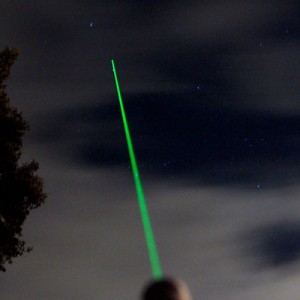
When a UFO enthusiast or UFOlogist ventures out into the night (or day really) to search the skies for UFO’s, they’re at the mercy of unknown forces.  Will they see something?  Will the night be a waste?  Who knows?!  Some people, however, are trying to tip the odds in their favour by attracting or enhancing UFO’s with the use of simple consumer electronics.  They’re using laser pointers to target objects in the sky, and in some cases to “power up” UFO’s.

On January 7th 2014, Australian UFOlogist Alan Ferguson posted a video to his website wherein a fellow UFO enthusiast, Peter Slattery, used a consumer grade laser pointer to “power up” an unidentified object in the sky over Albury, Australia.[1]  Ferguson’s associated commentary tells of a similar experience he had himself a week earlier, noting that in his case the object increased in size by five times when he targeted it with a laser pointer.  Ferguson claims that this practise of pointing lasers at UFO’s is a part of a shift in understanding about such phenomenon and that the video is an example that progress is being made.

There are some problems with this approach, not the least of which is the apparent lack of understanding of how light interacts with objects of different opacity and density, thereby making the video and Ferguson’s direct experience interesting to look at, but hardly helpful in terms of evidence.  More importantly though, this practise is potentially dangerous, and some are speaking out to condemn it.

In response to Ferguson’s post, pilot and retired president of an Australian pilot’s association, Barry Jackson expressed his concerns to NT News, claiming that such efforts could potentially have catastrophic effects if the laser beam interferes with the operation of an airplane.[2]

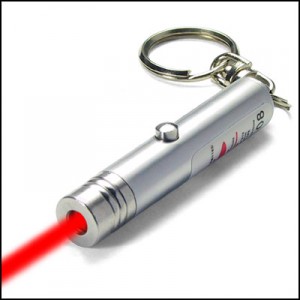
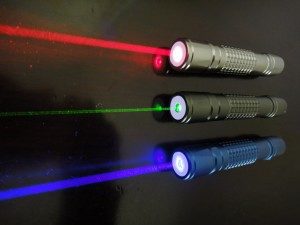
Laser pointers, like any laser, use electricity to generate a coherent beam of light.  In the case of consumer grade pointing devices, they have limited power.  In the US such lasers are limited to 5mW of power, while in the UK, Australia and some other countries they’re limited to 1mW by law.  As a result of this low power, the average laser pointer is extremely unlikely to do direct harm to an aircraft or to affect its operation in any way, except if the beam happens to penetrate the cockpit and temporarily blind the pilot.

This danger has been known for some time, and laws are in place to protect people from the potential hazards.  Even low-power laser pointers can cause temporary injury to the retina if the beam is directed into the eye for a prolonged period and the person actively resists the blinking reflex.  Though the higher the laser power, the greater the potential for damage.

All is not safe though.  Even with regulatory laws in place to limit the power of consumer grade lasers, it is possible to obtain higher-powered lasers with little effort.  Such “burning lasers”, with power exceeding 5mW and often requiring AC power rather than batteries, are marketed as tools for cutting light plastics and paper, and their appearance can be very similar to the low-power units.  This of course, gives rise to the potential for accidental exposure to higher-powered lasers.

The issue isn’t really as cut and dried as that though, in spite of many people and organizations trying to make it so.

As mentioned, lasers are coherent beams of light, or electromagnetic radiation.  This means that they emit photons in a straight, tightly packed beam.  This cohesion gives the beams the ability to travel large distances without losing appreciable amounts of energy.  But they don’t travel forever.

A standard consumer grade laser pointer can generate a beam that is capable of travelling over 50 feet before it very gradually starts to lose cohesion.  Beyond that point, the further it travels the less cohesive the beam will be at its terminus.  You can see this in action when you point one at an object at great distance; if you can still see the dot, you’ll notice it’s bigger than it was when pointed at closer objects.  Higher power lasers have greater cohesion and therefore can travel further while retaining that cohesion.  The less cohesion, the less dangerous the beam will be in terms of damage to the human eye.

Some simple math should tell you that a consumer grade laser pointer isn’t going to have a big effect on a commercial airliner travelling at 500mph at 30,000 feet.  Even if you were lucky enough to hit the cockpit and the pilot’s eye, the plane would likely be on autopilot and the resulting disaster would be avoided.  Planes don’t stay at 30,000 feet all the time though, and it’s when they’re closer to the ground that the problem exists.

According to Jackson, many airplanes don’t have automatic landing systems, therefore the pilot is in full control of the craft as they land.  A stray laser beam at this time could indeed be disastrous.  While damage to the pilot’s eyes is still unlikely at that distance, distraction during a period when they require total focus would be the likely outcome.  Obstructing glare and temporary night-blindness could also result.

So it’s clear that laser pointers and landing aircraft are a terrible mix, but is the call to alarm over this issue really necessary?  There is much to read about the dangers of laser pointers, and while there is a sensational story out of JFK airport in New York – wherein a JetBlue pilot sustained retinal damage from a laser pointer being aimed at his plane during a landing attempt – and several stories exist about people being arrested and jailed for similar attempts, to date, not one aircraft has been brought down because of a laser pointer.

The potential remains, so it’s a good idea to not flash laser pointers into the sky, and of course, the benefits of doing so also remain unclear.  Are there really that many UFOlogists targeting aircraft with lasers of any power level?  Seems unlikely that this is happening as often as some think.  As such the underlying point of all this furor is valid, but the hype may not be necessary.

A Review of Periphery by Alexx Bollen

18127917This book will change you. You may question your sanity before the end, and you will certainly question the author’s.

Periphery is a complicated book, but therein lays its charm. Alexx Bollen is a masterful wordsmith, and the prose of this story is surpassed only by its, sometimes very subtle, layering. The use of metaphor and the duality of, not only the language, but the very nature of this world, creates a compellingly weird drama with the central theme that all experience is dependent on the perspective of the observer.

This book inspired me to think of alternate dimensions (as inaccurate as that term is), and pulled me into an all too familiar dervish of existential confusion and ponderance about the nature of reality.  The observer effect has long been an interest of mine and I suspect the idea will remain at the forefront of my mind for some time to come, all thanks to Periphery

Small orange plastic dinosaurs notwithstanding, there is much you can miss if you lack the correct vision.

Buy the book and check out Alexx’s other work at his website, and follow him on Twitter.

A Series of Cryptic Letters Turn Up at a Canadian University: Can You Crack the Code?

An edited image of one of the Weldon Letters

Most of you know that I’m a Cannuckian (A.K.A Flannel Shirt Wearer, A.K.A Neighbour to the north, A.K.A Resident of America’s Hat)  Much of my writing though, focuses on locales far from my little hometown.  Weird stuff happens all over the world, some places more than others (looking at you Australia), and it’s relatively rare that I get to report on a story that originates in Canada, let alone from the region in which I live.  Today is such a day however!

This one is particularly weird, even among the stories already covered on this website.  It’s the case of the Weldon Notes.  I’m sure you are, as yet, unfamiliar, so read on!

The Weldon Notes are a series of letters that have been found hidden between the pages of various books in the D.B. Weldon Library at London, Ontario’s Western University.  That might not strike you as all that weird, but it gets weirder.

The 18th Weldon Letter

The letters, of which there are now 18 confirmed examples, are cryptic messages printed in an unidentified script similar to the wingdings font.  They are comprised of some 40 different colour pictographic symbols.  The message is, as you might expect, a complete mystery thus far.  But that’s not the end of it.

Western University’s assistant professor of business, economics and public policy, Mike Moffatt, is credited with finding the first official letter, as he was browsing the library’s economics and political science section.  When he picked up a copy of International Economics: Trade and Investment, written by Soren Kjeldsen-Kragh – a book one would think holds few surprises – he opened its cover and a plain white envelope fell out from its pages, landing at his feet.

Thinking that perhaps the book’s last reader had left it as a bookmark, he scooped it up and flipped it open, only to find a seriously strange correspondence inside.

The 17th Weldon Letter


The letter, as with all subsequent letters, was accompanied by an object, in that case a small, green, plastic leaf.  The leaf had been marked with two small blotches of paint, but was otherwise unmarked.  On the reverse of the letter was a reference to a website: 000xyz.blog.ca.  You’ll note that this website, which sports a .ca domain registration, is nothing more than an empty and unused blog.

Moffatt explains, on his personal blog, that all of the letters have been found under similar circumstances.  Each one was accompanied by a single item, such as the leaf, or a feather, and on the reverse side held a picture of an object like a vase or table or some such thing.  Since finding that first example, Moffatt has offered a small reward for anyone who can crack the code of these letters, and through that effort, many other people have come forward claiming to have found similar letters as long as two years ago.

Moffatt has documented all of the letters, their accompanying accoutrement, and their envelopes, as well as information about where and when they were found, and by whom, all in an effort to solve this mystery.

Theories thus far have been somewhat mundane, which is atypical of such a mystery, were it not for the fact that this is Canada.  The leading hypotheses are that the letters are remnants of a student organised scavenger hunt, and were simply never found during the game.  Others think it might be an artistic stunt being perpetrated by someone affiliated with the library or school.  The more fanciful among the sleuths suggest it could be an elaborate publicity stunt.  Either way, the mystery endures.

Of course, there’s no shortage of similar stories that have engendered all kinds of mystery mongering, to coin a phrase.

Kryptos in Langley, Virginia

As was forefront in Dan Brown’s novel Digital Fortress, there are whole organizations in place, dedicated to finding and cracking so-called undecipherable codes.  Kryptos, a memorial sculpture that sits in a courtyard outside of CIA Headquarters in Langley, Virginia, is one of the most enigmatic codes currently known.  Of the four encrypted messages carved into its surface, only one has been solved since it was erected in 1990.

In the form of undecipherable letters though, perhaps the most famous, and most gruesome examples are the Zodiac Killer’s letters.  These infamous correspondences were sent to several newspapers at the time of the murders, claiming responsibility for the crimes and taunting authorities.   They also included a 408-symbol cryptogram, which went unsolved for several years.  The killer claimed that the cryptogram contained his identity, but when it was solved in 1969, it was found to be more of a manifesto of sorts, wherein he claimed that he was collecting slaves for the afterlife.

The Zodiac Killer, of course, was never identified or caught, but his letters exist as a sort of morbid reminder of his dark skills and twisted mind.

The Zodiac Killer’s Cryptograph

Now, I’m not suggesting that the Weldon Letters have anything to do with a serial killer or even a crime of any sort, but the mind does conjure some interesting scenarios when one considers the potential of the messages.

Is it a secret communiqué between nefarious parties?  Is it perhaps an innocent game between students, or perhaps a messaging system between star-crossed lovers?  Or is it just a meaningless prank by someone with too much time on their hands?

We don’t know, and Mike Moffatt is prepared to offer $100 to anyone who can crack the code contained in the Weldon Letters.  Give it a shot, everything you need can be found on Moffatt’s website.

The Nain Rouge, The Scourge of Detroit

A Screen Capture from a video supposedly showing the Nain Rouge

Does the Mothman have a rival, or is the Nain Rouge just another incarnation of the apocryphal winged man who foretells of doom?

The Nain Rouge –which translates from French as “The Red Dwarf” or “The Red Goblin”- is a little known legend originating from Normandy France in the mid to late 17th century.  It is said that the Nain Rouge foretells of impending doom, though some accounts have this little devil taking an active part in the outcome of various disasters.

Its legend derives from the French fairy tale “Le Prince Lutin”, written in 1697 by Marie Catherine d’Aulnoy. In it she describes the Lutin –otherwise known as a brownie, elf, fairy, gnome, goblin, hobgoblin, imp, leprechaun, pixie, puck or sprite- as a gnome like creature with the power to travel anywhere, take multiple forms (including a saddled horse), and to be invisible/visible at will.

“You are invisible when you like it; you cross in one moment the vast space of the universe; you rise without having wings; you go through the ground without dying; you penetrate the abysses of the sea without drowning; you enter everywhere, though the windows and the doors are closed; and, when you decide to, you can let yourself be seen in your natural form.”

An Artists rendering of “The Red Dwarf”

The list of disasters associated to or blamed on the Nain Rouge is long indeed, from famed attacks on the first settler of the Detroit region in 1701, to the frightening tales of the Battle of 1812, to a 1996 account from the Michigan Believer, where “two admittedly drunk nightclub patrons who claimed to both have heard a strange ‘cawing sound, similar to a crow,’ coming from a ‘small hunched-over man’ who was fleeing the scene of a car burglary. The creature was described as wearing ‘what looked like a really nasty torn fur coat.’”

The common theme among all Nain Rouge reports is the foretelling of disaster, whether man-made or natural, which is a similar Modus Operandi to the famed Mothman. Though instead of being feared, the little Lutin is being venerated as a city wide mascot in the annual Marche de Nain Rouge, a yearly costumed parade that seeks to take advantage of the long history of the Detroit Dwarf by bringing much needed tourism and foot traffic to the Midtown/Cass Corridor neighbourbood.

Though Detroit isn’t so lucky as to have an exclusive relationship with the Nain Rouge, accounts have been reported in Quebec, Canada, and there are stories that may connect it to the legend of Père Noël in Lapland, Sweden; making the “Red Dwarf” out to be one of Santa Claus’ elves.

Like any such legend, there are believers and there are sceptics, though it seems that both sides of that coin can enjoy the tales of Nain Rouge in the Detroit area.  Cryptozoology can be big business, especially for regions that are under the financial stress that the city of Detroit has felt over the last few years.   It seems that citizens may be taking advantage of the legend, much the way local leadership in Mexico have taken advantage of the Chupacabra legends in South America.  But any way you slice it, there seems to be something strange going on in and around the Great Lakes of North America.

The New Jersey Devil

Next to Bigfoot, there aren’t many cryptid legends with the staying power of the New Jersey Devil.  Famous for its connection to various people of some historical provenance, the Jersey Devil is one of the world’s oddest tales.

Said to be a mix between a horse and a bat, the Jersey Devil is among the weirder cryptids in the field. The origins of the legend point to witchcraft and devil worship, attributing the birth of the creature to “Mother Leeds” in the Pine Barrens of Southern New Jersey.  Mrs. Leeds is said to have been a promiscuous woman of the night and upon the birth of her 13th child, she is said to have uttered the curse: “let it be the devil”.  The story differs from telling to telling, sometimes claiming that the newborn infant transformed in front of the vile Mrs. Leeds, into a winged beast with the hooves of a cow and the head of a horse, whereupon it flew out the window screeching into the night.  Other tellings purport that Mother Leeds abandoned the child, who thereafter grew fur and contorted into the form known as the New Jersey Devil.

Perhaps it’s most famous adherent is none other than Napoleon Bonaparte’s brother, Joseph.  He claimed to have seen a bizarre looking creature while hunting on his estate in Bordentown New Jersey and the sightings have been pouring in ever since.

The Jersey Devil has been blamed for any number of atrocities, from livestock deaths and mutilations, to strange tracks and sounds in the night.  While the devil has been reported many times, no one has ever managed to snap a photograph, which does raise a flag or two in the sceptical mind.  Regardless of the nefarious nature of the beast, locals have taken to the story like moths to a flame; they even named their National League Hockey Team the Devils.

Though there’s no need to be afraid, while you sit at your desk or at your stand up deskbehind your computer. It is not the type of creature that breaks into your house, it is the type of creature that you may see outside in the woods, while you are all alone.

Does the New Jersey Devil exist? Maybe it does, maybe it doesn’t, but one thing is for sure, its reputation will be here for a long time coming.