Ghosts and Cemeteries; What A Grave Subject

Everyone knows if you come across a property exhibiting signs of ghostly activity, especially those with a tendency toward malevolence and spite, the cause is always due to that property’s proximity to the sacred land of an ancient Indian burial ground.  Everyone knows this, right?   Hollywood has trained us all too well; but of course, Hollywood would also have us believe that the plains and mountain regions of Canada and the northern US were chocked full of native tribes, with the landscape of most areas being packed shoulder to shoulder with whooping and dancing Indians.  This must be an accurate picture, for, in order for there to currently be the vast number of scared burial sites currently rumoured to be infringed on by certain paranormal enthusiast, the native populations would have to have been in the hundreds of millions.

The AIBG hypothesis, otherwise known as the silliness that is ancient Indian burial grounds being blamed for every manner of paranormal activity in North America, is just about as ridiculous as the hyperbole surrounding Ouija Boards (and you all know how I feel about that).  The reality of this situation, as with so many others in this genre of interest, is that Hollywood has twisted our minds into forgetting our own history and that of our native hosts.

Quite possibly the most famous instance of the AIBG hypothesis showing up in entertainment history is the convoluted and confusing story of Poltergeist (1982), though this is hardly the first introduction of cultural prejudice fuelling our wild and easily manipulated imaginations.  Stephen King even used this contrived idea as the basis for his 1983 novel Pet Sematary [sic], which was adapted to the big screen in 1989.  But whatever the origin of the myth, there are some poignant truths people tend to forget when they let their imaginations run wild.

To some this will come as painfully obvious disclosure, but I shall offer it anyway.  Sacred ground, as identified by First Nations people is quite rare, and likely due to the fact that it’s considered sacred, is rarely lost to their knowledge, thereby allowing the “white man” to develop and build on top of it.  This is in contrast to burial grounds, which can also be sacred though aren’t always so, but which are much more common.  And here we come to yet another one of those unfortunate truths I so revel in sharing; in the world of paranormal research, the burial of human remains bears so little connection to ghostly activity that most reputable researchers cringe at the very mention of an amateur seeking evidence of paranormal activity at cemeteries, grave yards and burial sites.

There are, as is so often the case, a few opposing schools of thought among the paranormal community, the defining lines of which are often blurred beyond recognition.  Some researchers, or more accurately, ghost hunters, seem to be of the impression that burial sites (whether ancient or modern) are the perfect locations to gather their so-called evidence of spirits run amuck.   Others still suggest that the spirit activity at these locations is too intense and potentially dangerous to make evidence collection feasible.  Though, as any who’ve undertaken to read my work in the past can attest, not only do I not subscribe to these schools of thought, I typically scoff at such ignorance.

The truth of the matter is that certain assumptions must be made before a person can genuinely believe such claims, assumptions that are not supported by the facts of our collective understanding. A term coined by a colleague of mine with the leading Canadian paranormal research body (PSICAN) encompasses the nature of one such assumption: the Dead Person Hypothesis.  This is as the term suggests; the idea that ghosts or spirits (or whichever other term you might choose to ascribe) are the immortal manifestations of dead people.  This is a popular idea and one that is adopted by many without even a moment’s consideration for alternatives.  An extension of this idea, for some, is the notion that spirits (in this line of logic being the essence or soul of a dead person) are tied in some way to the physical remains of their corporeal self, and in turn are likely to be found in proximity to their grave.

Even with a most charitable attitude toward this idea, one can scarcely ignore the logical flaws encountered therein.  Namely, if ghosts are bound to their physical remains then ghosts could not be encountered in areas where their physical remains are not.  Most researchers will understand that this is simply not the case.

A variation on the above is the idea that such ghosts, under the DPH, will frequent locations that hold emotional context for their own psyche (whatever that may be), though again, there are some undeniable flaws of logic in this idea.  Notwithstanding the notion that we cannot, through a lack of verifiable information, reasonably assert that there is a discernable psychology to ghosts and their behaviour, does it not follow (with certain exceptions) that the spirit of a passed-on human, would rank many other places as being more emotionally significant than the location of their grave?  This of course, takes other unverifiable notions for granted as well, such as the idea that such a spirit is bound by some physical law, to appear only in one location at one time.

Beyond the above exercise of logic, is the undeniable fact that the huge amounts of data and information collected by enthusiasts and researchers over the past 200 years has shown that gravesites are notably poor locations for the study of ghosts.

So is this conflated notion that ghosts show some favour to cemeteries and the like the result of a Hollywood agenda, or is it a simple misunderstanding of facts based on an ever more present anthropomorphisation of such ghostly activity.  I personally have great difficulty accepting even the DPH, let alone ascribing any support to the notion that ghosts or spirits or what-have-you, are compelled, whether by emotion or some physical law, to accompany the dusty remains of their physical body in death.  There is much we need to learn, and even more we need to forget, before we can come to any real understanding of the phenomena of ghosts.

A Christmas Carol, The Ultimate Ghost Story

An original illustration from A Christmas Carol

Ebenezer Scrooge, the miser of all misers, the progenitor of the inimitable phrase “Bah Humbug”, and the hallmark of the so-called power of the Christmas Spirit -that spirit of course being the objective sense of community and generosity one is supposed to feel once they’ve been visited by their very own Diskens’-esque trio of misfit ghosts, who in turn bring tidings of what was, what is and ultimately what will be.

A Christmas Carol is perhaps the most famous tale in the whole of classic literature, along side Hamlet and maybe The Tell Tale Heart.  Dickens’ work has been twisted and torn and morphed and adapted for every manner of presentation.  It’s been cartoon-ized, modernized and simplified, but in the end the story remains largely the same.  It’s a morality tale, but is the moral really what TV networks and cartoon production companies push at us almost nightly from December 1st right up until the celebrated arrival of old Saint Nick?

It has always struck me, the propensity for people to ignore the harder truths of such stories, in favour of those more easily digested.  It is a convenient thing to see that Scrooge took heed from his wispy callers, and quickly changed his own outlook on the nature and value of Christmas, that he ultimately opened his eyes to all that was wrong with his life and his person as a result of this harrowing experience.  Isn’t it telling though, that a man should need the outside influence of the supernatural in order to see the error of his ways?

Scrooge though was a larger than life character, as is to be expected from such prose, so we should excuse the lengths to which Dickens went to teach his protagonist a lesson.  I think though, that Dickens was hiding a deeper moral truth in this work, hiding it right under our noses.

Despite this, what follows is an editorial critique of the story, from the perspective of a fictional ghost hunter (me).

2416_zSetting aside that we know conclusively that this story is entirely fictional; can we set up some pseudo-facts to examine, in an effort to determine if our beloved Scrooge did indeed experience the company of four ghosts on that fateful night?

The first encounter our unwitting hero experiences is a timely reunion with a dearly departed friend.  Moreover, Scrooge is faced with the gruesome and frightening apparition of his old partner and mentor Jacob Marley; who, in the various incarnations of the story, appears to Scrooge in clanking chains and rotted flesh -apparently a punishment for his own miserly ways in life.  His coming to Scrooge is a warning that Ebenezer himself is lined up for a similar fate, and to punctuate that warning Marley has arranged for three spirits, ghosts of particular ability and affiliation, to visit him on this eve, and so explain to him the virtues of embracing the Christmas Spirit, as though a late conversion is better than none at all.

In the original story, as opposed to the any one of its modern perversions, Marley appears to Scrooge shortly after he retires for the night following a particularly stressful day.  The encounter is anything but typical of a ghostly experience.  It ends up being an interactive apparition with ectoplasmic form and clairaudience.  Shall we say…rare?

Much like the other spirits, Marley speaks directly to Scrooge, though in this case, Scrooge rightly suspects that these ethereal visions are the result of a partly digested bit of bad pork.

Bill Murray and Carol Kane (Ghost of Christmas Present) in Scrooged(1988)

Next up of course, is the first of the three Ghosts of Christmas, in this his first lesson, Scrooge is transported into the past, so that he may observe and reflect on his various misdeeds and poor choices.  The highlight of this segment is the warming of Scrooges heart to the idea that he did once love and indeed can love again.  It is this transportation through time that lends credence to the experience for Scrooge; he heard the Spirit’s words, he felt its touch and its presence, and for that matter he had heard and felt that same essence with Marley, but this time he believed.

Secondly, and only after finding himself safely, warmly back in his own bed, Scrooge is visited by the Ghost of Christmas Present (a nice play on words, which I’m sure wasn’t intended by Dickens, but rather is relevant only to modern readers in a time of incensed materialism).  This time his guest fly’s him out the bedchamber window and proceeds to show him the harm his attitudes have done to the people of his life who are in need.  People Scrooge saw daily, whom he interacted with and whose lives he knew virtually nothing about.  Ebenezer was right to feel ashamed, to be abashed by the effect his behaviour has had on those less fortunate.  The highlight of this episode is the life and home of Ebenezer’s employee, Bob Crachit and his hobbled son Tiny Tim.  It would not have been adequate for Scrooge to simply experience and identify with the hardships of poverty and then to see that in spite of this hardship Crachit bears him no ill will; no, the handicap of Tiny Tim was the catalyst for change in this act, apparently to suggest that mere paucity is too mundane for the Spirit of Christmas to handle.  Or was it that Scrooge was extra deserving of a lesson or two in the face of all that was wrong with the Cratchit household?

Once again Scrooge found himself safe and warm in his bedchamber at the close of this second encounter, though to his own admission he needed no further encouragement from the spirits to change his ways, and drastically.  He had seen what was and what is, and had decided like any other that he would do more to help those in need –though more, in Scrooge’s case, was tantamount to raising Bob Crachit’s salary and allowing him to care for himself and his family (and in my mind would have been a better outcome).

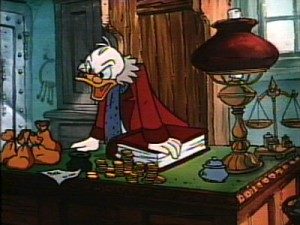
Disney’s Scrooge McDuck

However, on his third and final encounter, Scrooge found himself in the company of a menacing and intimidating spirit -the Ghost of Christmas Future.  Given images and ideas of isolation and solitude, of dying alone and unappreciated, of bearing no legacy on the world, other than to perpetuate the overly thrifty survival of his Counting House, or as in the original, the untimely and unfortunate death of the crippled Tiny Tim; this it seems was too much for Ebenezer Scrooge.  He begged and pleaded with the spirit to allow him a chance to change things, he was motivated now, to off-load his immense wealth through charitable donations, and to seek the value of people rather than of things and money.

Aside from examination of the ghostly elements of this story, I feel compelled to point out that the plot would have worked out much the same, had the story taken place over another holiday, say Labour Day, or even over a regular Tuesday in the middle of summer.  The moral herein is no more exclusive to Christmas than is the idea of kissing under the mistletoe –which is connected to Christmas only because Holly flowers in December.

Now, considering all that we know about Ebenezer’s campfire ghost story, the most obvious conclusion is that he experienced a night terror that was connected to sleep paralysis.  Each encounter took place as an interruption to his nights sleep, and the indication that he had been preoccupied by distaste for Christmas prior to retiring suggests that the issue weighted heavily on his dreams as well. This would have been a frightening experience for sure, but not fundamentally supernatural.

The physical elements of each encounter are not entirely foreign to night terror experiences, often Experiencers claim that their dreams are so vibrant and convincing that they cannot believe they were simply dreams.  One argument could be made for the seemingly accurate details Scrooge gleaned of Crachit’s home and life, details we are to believe he didn’t have prior to this experience.  For explanatory purposes, we can present two possibilities, each with their own merits though one may seem more plausible than the other.

Ebenezer and the Ghost of Christmas Future

Over the years, working closely with Crachit in the Counting Office, Scrooge no doubt heard countless details of Crachit’s life, and though he may consciously have avoided acknowledging these details, his subconscious mind would have stored the information and in turn it would have shaped his view of Crachit and what Crachit meant to the community.  This subconscious accounting of Crachit’s life would have been ample for constructing a sufficiently accurate mental picture of what the Crachit family would have been experiencing during the Christmas holiday.

Alternatively, it could be said that old Scrooge had a bit of the vision in him.  That he was psychic, at least partially.  I admit this is a stretch, and as I said earlier, one of these possibilities holds more water than the other.

All in all, the facts of the story don’t seem to support the idea that Ebenezer’s new acquaintances were ghosts.  No one but Ebenezer saw or experienced them; in fact during the events, Ebenezer came into contact with people in his life, but none of them saw or experienced him either, suggesting that the events took place in his head.  The fantastic physical feats performed by the spirits and visited on Scrooge also suggest a dream, flying, teleportation, transmutation; all of these elements are common to dreamscape.  We know that the story is fiction, Ebenezer Scrooge did not exist, and neither did Jacob Marley, Bob Crachit or Tiny Tim, but there is a drastic difference I would like to point out, between believing that Scrooge had been visited by Ghosts in this fairy-tale, and in believing that he dreamed his own conversion to charity and humanitarianism.

If we accept that the Ghosts of Christmas Past, Present and Future were to be thought of as real elements of Scrooge’s world, then we inherently believe that our attitudes and beliefs are guided by an outside force, that we must depend on others to show us the ways charity, others with a higher moral authority.   Alternately, if we believe that Scrooge dreamed these events, does this not suggest that he, like us, was ultimately in control of his attitudes and actions and it was his own moral compass that spoke to him while he slept, forcing him to acknowledge that he had been a miser of the worst kind, and ultimately allowed him to change for the sake of goodness on its own?

Whatever you take from this examination, or even from the classic tale of A Christmas Carol, there are lessons to be learned by each of the characters, and as I personally have no love of Dickens’ collected works, I do believe that his more popular stories should be found on the bookshelves of anyone claiming to be well read and learned.

A Christmas Carol was written by English author Charles Dickens, its original or full title is: A Christmas Carol. In Prose. Being A Ghost Story of Christmas .  The book was first published December 19, 1843 with illustrations by John Leech, and is one of very few classical tales that has never been out of print since its first edition.

Astrology, A Science for the Scienceless

Astrology, not to be confused with the legitimate, highly valuable and experimentally verified [actual] science of Astronomy, is the pseudo-science of tracking the position of various groups of stars (known as constellations) and relating those positions to the wellbeing, personal characteristics and prospective future of every human on Earth, through mystical and wholly unscientific methods of, believe it or not, divination.

Astrology is actually an ancient and historically significant aspect of human cultural evolution; it is rooted in the development of scientific observation, of not only the stars, but our own surroundings.  Widespread use of Astrology owes its popularity to the scholars of the Library of Alexandria, in Egypt in the 3rd century BC.  Believe it or not, Astrology was once a complimentary science along side, and historically often indistinguishable from, Astronomy.  As one was considered the study of the Celestial Heavens, the other was the study of the Celestial Heaven’s effect on terrestrial happenings.  However, not every gem offered to us by the ancient scholars is to be regarded as valuable insight, and the true origin of what is considered to be the core of Astrology is argued over quite loudly by modern scholars.  Whether we owe ancient Babylonian society, Vedic traditions, Greek Mythology or Asian development for the current incarnation of our oldest and most believed form of divination is best left to historians who are qualified to answer such questions.

What was once though, considered to be the domain of high priests, commissioned scientists and of course, royalty, is now the innocent pastime of everyone and anyone with the ability to read a newspaper left on a park bench.  And the practitioners of this common-foolery, known as Astrologers, are little more than advice columnists with a deadline, and are even less than a mere shadow of their historical counter-parts.  In the roughly two thousand years since the proliferation of astrological superstition to the masses, immense amounts of so-called astrological data have been compiled, edited, mixed and shared, all in an effort to create a great encyclopaedia or compendium of knowledge about the effects of celestial bodies, and their positions, on the human condition.  All the while it’s counterpart, its ever more rational sister-science Astronomy, has evolved and burgeoned into a scientific endeavour that, both historically and most recently, has provided science with some of the most astounding and experimentally verified findings imaginable.

But the relationship between our two sisters of science, Astrology and Astronomy, has been tense at times, and with the advent of the Copernican Revolution resulting in the Heliocentric theory of cosmology (no longer a theory by the way, which is a ridiculous but apparently necessary rider to include), and Magellan’s stupendous and, at the time, heretic declaration that the Earth is not flat, but round as an apple (which he went on to prove via the first circumnavigation of the globe), that relationship has been strained well beyond the breaking point.  Astronomy has been the single most influential scientific pursuit since, well…ever.  It has brought with it discoveries, methodologies and philosophies that have shaped very nearly every aspect of modern life.  Astrology cannot make the same claim, it has not done the same laudable acts, nor has it provided any real insight into the hearts and minds of men or Gods.

To many fans and believers today, Astrology, which is the base for the daily or weekly horoscope you almost religiously take note of, whether for fun or for purposes of planning and guidance, is simply the interpretation of star signs into quirky limericks and severely vague predictions of the near future.  But on closer inspection, what one will find is that Astrology is a system of measuring constellations, planetary positions and even the position of the moon in the night sky, and interpreting that information into unique personal information for everyone and anyone who may be interested in the divined conclusion.  One might ask then, how exactly that Astronomical data (yes, it’s a direct borrowing of Astronomical observation) can be and ultimately is converted into predictive behavioural knowledge, and really, it’s quite simple.  Over the past two to three thousand years, many, many Astrologers have written down their observations for how certain people act, relative to the position of, yes, you guessed it, stars (in lieu of including a realistic measure of the numbers of Astrology practitioners who have contributed to this endeavour, let it simply be known that there have been more of them than there have been religious zealots fuelling the fire of holy wars over the centuries).

They have painstakingly observed and documented the interpersonal goings-on of the people around them, and attempted to correlate that massive amount of information with the movements of the celestial bodies overhead.  Here though is the problem…there is a significant difference between a correlation and cause/effect relation.  Simply because two events happen near each other, whether in time or space, does not automatically mean that one is the cause of the other, and vice versa.

There are many other valid arguments flying in the face of Astrology, for example, the celestial constellations relied upon for these measurements and interpretations are, shall we say unique to the observers position on Earth, and even in the universe.  Change that position even a small amount (in terms of galactic distances), and the constellation, if visible at all, becomes completely indistinguishable.  Since there are few who would argue against Copernicus and his wild notion that there is nothing particularly special about mankind, earth or even our solar system, so as to believe that it is the center of anything worth speaking of, then why would we believe that the relative position (to earth) of constellations, whose very existence relies on our perspective from earth, would or should have any impact, measurable or not, on our relatively insignificant lives?

One could make such arguments, and many have, though in all honesty one needn’t go so far.  Horoscopes, sun signs, astrological readings; all of it is now permanently relegated to insincere carnival sideshow venues.  There is no truth to the predictive assertions of the Astrologer, even as there are many millions of people around the world who believe, even passively, in those predictions on the whole.  As has been offered in the past, it seems interestingly disturbing that the mass of humanity so easily offers trust and hope to wish-thinking endeavours which bear no logical or even tangible fruit to speak of.

Inter-Dimensional Trickery

In the evolution of the paranormal epoch of which we are currently at the pinnacle (arguably), there have been a class of entities -called so for lack of a better term to describe the phenomena associated to them- whom have been deemed by a great many people, some more learned than others, to be visitors, or sometimes possibly invaders, from another reality, more specifically another dimension of reality.  Schattenwesen readily comes to mind, as does some of the wilder speculation about the origins of El Chupacabra and even the Loch Ness Monster.  There are those who would even go so far as to say that all (or most) paranormal activity is the result of various incursions of inter-dimensional energies and/or consciousness’, including ghosts, demons and the like…and at some point in the past, I would have been included among them.

Is there any truth to this notion?  Is there any possibility that everything we know to be real is just a short space away from the alien reality of another dimension?  The short answer is yes, though getting to that point is going to take some work.

Before moving toward an explanation, it bears relevance to separate the visions of the silver screen from the reality of this complicated science.  Hollywood has been working hard to proliferate a notion of inter-dimensionality into our collective culture, they seem to be smitten with the idea of infinite worlds, replete with earthen similarities in physics, environment, atmosphere and even biology to our own “dimensional reality”, all only just a “spacetime tear” or “stargate jump” away.  However, the truth about such notions is much less fantastic and far more interesting.

Unfortunately, this notion is based on a total misunderstanding of the science in this regard.  That science is the realm of quantum physics, superstring theory and M-theory[1], and if we were to look for a reason for this thorough misunderstanding, it might be rooted in the simple and unfortunate fact that these topics are notoriously complicated and exceedingly difficult to visualise.  Few talented writers are able to grasp the subtle nuances of the science and few scientists are interested in explaining them in simple terms, though there have been exceptions, but nonetheless this is the realm of science and not science-fiction.

Calabia-Yau shape

A Calabi-Yau alternate is a 10 dimensional shape thought to be an appropriate visual representation of the full measure of reality.

If you were looking for ways to bolster an argument on the side of inter-dimensionality as a refuge for weird and wonderful creatures, who harbour an ability and a penchant for visiting our world’s darker places, then I’m afraid you’re about to be disappointed.  I intend to shed some light (in my humble capacity) on the misuse and misunderstanding of the terms and ideas behind inter-dimensional physics.  Firstly, what is a dimension, and how has its concept been twisted through a preponderance of general ignorance toward the theory.

A dimension is a spatial direction, or axis, along which objects can move within an area of space.  We inhabit a three-dimensional universe, in that there are three directional axes along which objects in our reality can move.  Another way to look at it is, in order to find a particular point in space you need to have three pieces of information; on earth a latitude, longitude and altitude (you would also need to know what time to look, as time constitutes the fourth dimension of space-time, though this isn’t particularly important for the current topic).  This is a relatively easy to understand idea and visualising objects in this reality is equally easy, though modern physical theory has thrown this idea out the window.

It is conceivable and indeed likely, that there are spatial dimensions necessarily beyond what we can perceive; in fact the most advanced understandings of superstring theory and M-theory have all but proven the existence of several additional dimensions…seven more to be precise.  Through decades of mathematical theorising and cosmological observation, modern physicists are on the threshold of astounding experimental confirmation of this idea, culminating in results achieved through the use of particle accelerators (also known as particle smashers) like the Large Hadron Collider at CERN, and both the science and history of these theories is well worth examination.

Essentially, and with an admittedly limited knowledge of the actual science, the existence of these extra dimensions will be proven through the discovery of supersymetrical particles[2] created as a result of smashing known particles (electrons and protons etc) together at enormous velocities and then measuring the constituent particles that rain out of the collision.  Already, this subject is overcomplicated, but then we are talking about understanding that which cannot be seen or detected in any other way.  I can do no justice to the beautifully contrived experimentation, but I can tell you that most physicists are confident in the existence of 10 spatial dimensions, plus one more to account for time.

So, one might ask, how can there be 10 dimensions in a three-dimensional reality?  And the answer is quite simply that the other seven are just too small for us to perceive.  And barring a lengthy discussion of gravitational theory, the second law of thermodynamics and basic cosmology, suffice it to say that this answer is far more complicated than it appears.  However, as it pertains to the paranormal notion of inter-dimensionality, this answer provides some insight into the problems one would encounter when trying to fit any theory of inter-dimensional beings together with string theory/M-theory.  Most estimates suggest that all seven other realities, which we already inhabit, are on the order of a billionth of a billionth of a millimetre in size (a Plank length[3] or 10-33 centimetres), and while the size of each dimension presents certain problems for the notion of housing entire worlds whose inhabitants can visit our own, the fact that we already inhabit these dimension puts a bigger wrench in the works of this paranormal theorising.

String theory, or more accurately, superstring theory, makes certain suggestions about what it is that makes up the particles that make up atoms, the supersubatomic realm.  Essentially, string theory describes, through highly complex mathematical predictions, the constituent elements of subatomic particles.  The idea is, as the name suggests, that strings of energy, in various shapes and lengths, and vibrating a various frequencies are what make up and what determine the species of the various subatomic particles (quarks, bosons and leptons etc), but further than this, string theory also suggests that there may be what some physicists are calling branes (membranes) to which the strings are attached, and which take on or possibly even generate the same vibrational frequencies as their companion strings.  Many of today’s leading physicists believe that our three dimensional reality is housed inside one of these branes, a three-brane, and as such the other seven dimensions are housed in other branes, which precludes our being able to detect them.  They suggest that, if we inhabit our own particular three-brane, then because of some equally complex ideas, such as Einstein’s cosmological constant and certain elements of gravitational theory, all the other possible branes must only exist on the supersubatomic scale (Plank scale).

None of this, of course, does anything to improve our ability to visualise these concepts, and alas, I won’t be the one to provide such understanding, as I have just as much difficulty with the idea as the next man.  However, the one aspect I can fully grasp is that, while we speak of alternate or disparate dimensions of reality that exist beyond our own, we’re actually speaking of dimensions of reality that exists alongside and within ours.  As alien and awkward as the ideas may seem from a visualisation standpoint, they are no more foreign than our own living rooms, and as such are not suitable originations for the likes of demons, monsters or ghosts.

Others have posited ideas that conjure visions of alien worlds and alternate universes, though, as much interest as even I have in speculating on the many-worlds and multiverse theories[4], there is less and less scientific support for such notions as viable descriptions of reality, as the envelope of understanding is opened by leading physicists and cosmologists around the world.

In recent years there have been various books written to bring this science reasonably into the realm of layman understanding, though most have failed miserably.  Some have painted pictures of multiverse hives, huddled together in some vast and cold void like soap bubbles on the surface of someone’s dirty dishwater, and others have inspired notions of many-worlds floating in alternate realities, just begging to be explored by those with the technology to breach the threshold between them.  Unfortunately, the vast majority of these books and ideas have fallen short of getting across the truth about these theories, and even where they haven’t, the readers have often taken more from the subtle misunderstandings than from the grand ideas.   By all accounts, if there is a realm beyond ours, travel between is a physical impossibility not soon to be overcome, if ever, and not for reasons of technology, but for the boundaries of physics in this universe.

Underlying the demotion of inter-dimensional possibilities from the origins of paranormal creatures and entities, is the assertion that, with qualification, a great many paranormal encounters are bound inside the mind of the experiencer and not of the corporeal world we inhabit.  This is not to say that the various entities don’t exist, any more so than it is to say that every claim of an encounter is true and accurate.  The unfortunate outcome is that the many imagined or misidentified experiences that are reported through official and unofficial channels, serves only to dilute the total field of potential cases, thereby obscuring the relatively small amount of truly wondrous phenomenon from scientific observation.

To gather a deeper understanding of the above, in a much more elegant, albeit much more complicated form, I suggest picking up a copy of Brian Greene’s national bestseller; The Fabric of the Cosmos – Space, Time and the Texture of Reality, as well as the classic by Carl Sagan; Cosmos.


[1] For a reasonable accounting of the basic science behind string theory (technically termed ‘superstring theory’) and M-theory, please see the Wikipedia entry for each respective title:

http://en.wikipedia.org/wiki/String_theory

http://en.wikipedia.org/wiki/M-theory

[2] An involved description of supersymetry can be found here: http://en.wikipedia.org/wiki/Supersymmetry

[3] A discussion of Plankian distances etc can be found here: http://en.wikipedia.org/wiki/Planck_length

[4] Multi-verse theory is a Big Bang Cosmology theory discussing possible conditions of pre-bang universes, and Many-Worlds is specifically a discussion of parallel cosmic timelines.

Ushering In The Inevitable, A New World Order

Human population growth, now sitting somewhere in around 6.7 billion people, is often thought of as an exponential process.  The year 10,000BC saw a global population of one million people, fifty million by 1000BC, then three-hundred-ten million by 1000AD, and a full billion by 1800.  In 1900 there were 1.6 billion people and by the new millennium the global population was just over six billion.  But this growth is not actually exponential; it’s just that we tend to breed a lot.  In spite of the fact that most anthropologists predict a global population of somewhere near 10 billion people by the year 2012 (convenient considering we’re all supposed to die in 2012), population growth rates in developed countries are actually negative.

These growth rates are the result of a calculation of the difference between birth and death rates, wherein a positive growth rate is the result of a higher birth rate than death rate, and transversely, a negative growth rate is the result of a lower birth rate than death rate.  Ideally speaking, a neutral growth rate is utopian for any society.  As many children being born as there are people dying, leaving stable numbers of attrition and replacement in each sector of development and occupation.  An obvious advantage to overall stability, though as mentioned, growth rates in first-world nations, as opposed to developing nations are negative (and falling, I might add).  Translating to potentially unstable attrition rates as the bulk of the population nears an age of occupational retirement and social dependence.  The process is two-fold devastating on social hierarchy, in that the bubble of experiential wisdom achieved by older generations is inefficiently shared with the replacement generations and as a result occupational expertise dwindles.  Secondly, the shift of the majority populous into states of growing social dependence precipitates an increase in new positions for which occupational expertise has yet to be developed, not to mention the strain of supporting such a huge population of the occupationally inert.  Both of these ideas contribute to a notion that the middle of this first century in the new millennium has a bleak prospect for overcoming expertise driven scientific, social and political problems, especially so when the sad state of western education systems is factored in.

However, these nations don’t live in a vacuum; they are offset by the positive growth rates of developing nations, through immigration and outsourcing, and subsequently, a detailed look at national growth rates offers only a skewed, nationalistic perspective.  On the whole the global population, in spite of the mixed national growth rates, is positive (this is most definitely not a value judgement).  On a global scale we continue to produce more people than are dying, in spite of the wide variety of ways in which a person can die these days.

War, terrorism, famine, natural disaster, crime, disease and old age, are apparently not enough to counter-balance what seems to be an almost unnatural predilection for humans to breed uncontrollably.  There are many reasons for positive growth rates in developing nations, some competing and contradictive, others counterintuitive to say the least.  Religion, the oppression of women’s rights, and even regional famine are just a few ideas that can easily explain increases in family size over poverty stricken nations, and coupled with, or perhaps entangled with these ideas (and many of the other socioeconomic ideas associated with the third world) is the anthropocentric notion that the global human population on the whole has some further obligation to help nudge these growth rates to ever more positive scales through “humanitarian aid”.

Now, this is not to say that a general sense of charitable obligation toward our own species is undesirable.  This is simply meant to highlight a particular underlying idea, or rather a train of ideas.  Humanitarianism is thought to be, at least by those who participate in it, an altruistic endeavour.  But both for hidden and even unintended reasons of personal or societal gain, it truly cannot be viewed as such.

A visual representation of global population (scale is arbitrary)

The human population explosion, in which we are still participating, is like most other explosive processes, a destructive cycle.  The larger the population within a finite environment, the faster the resources of that environment will disappear.  Because of our quickly rising population, we are facing a global food and water shortage, not to mention a global energy crisis.  And yet our population continues to increase unchecked at almost exponential rates.  All the while we continue to work feverishly, albeit indirectly, at increasing these numbers even further.  The proliferation of medicines to disease ravaged nations, the outpouring of charitable donations for natural disaster victims, the rolling in of agricultural and engineering resources for nations considered to be underprivileged in terms of education and economic representation.  Each of these efforts serves to extend the life span of those who are indigenous to these developing nations and in turn is serving to drastically increase the population growth rates of each nation and ultimately the planet.

Why, you might ask, shouldn’t they have just as much right to each and every one of these charities as anyone else, and even more?  No one is saying they shouldn’t mind you, but the simple fact is the more of them that survive, the worse our situation gets, globally speaking.  Cruel hearted as this sounds, there is logic here, but, and to the relief of at least my email inbox, this is not the end of the story.

There is a key idea here that many who think of these issues will miss.  Third-world countries are contributing, wildly, to our global population growth rate, and hence contributing in large part to the overall shortage of global resources, while first-world nations are actually showing population decline, and despite the fashionably popular notions of a super-sized America, are actually less of a burden, on a per populous basis, to those same resources (not including fossil fuels, of course).  The short sighted answer to the global food and water resource problem is to cut off aid for those countries that refuse to limit their population growth.  The right answer though, might be, to increase aid for those developing nations, in an unprecedented effort to boost their overall quality of life to that of the so-called first world nations.

Widespread public education, social support systems, as well as medical, engineering and permanent agricultural resources; when one considers what it may have been that ultimately contributed to the correlated (and some would argue illusory) high standard of living and acceptably low rate of population growth in developed countries like the US, one has difficulty nailing down a single idea.  Nevertheless, when thought of in these terms the answer is almost too simple to deny.

An unexpected possibility comes out of this argument though; one that may not sit well with the long standing notion that international outsourcing is destroying the North American economy.  A necessary effect of deliberately and drastically raising the standard of living for developing nations is an increase in that particular nation’s gross national product (GNP), and that is done in no other way than to create industries and jobs with which to sustain a working economy of their own.  Now, as western society is unwillingly, or perhaps, unwittingly moving toward an information based economy, rather than an industrial or even service based economy, the fact (sad or otherwise) is that international outsourcing is the single most efficient means for cultivating emerging economies in these nations.

And while there are many people, uninformed or ill-informed as they are, who would vehemently oppose such an idea, it can scarcely be denied that these steps are unavoidably connected (at least based on the population scales we seem intent on maintaining), for the alternative seems, while pragmatic, to be unthinkable.

Some may already see where this is headed, and those familiar with my own predilection for this idea may already have jumped ahead.  What we’re talking about here is nothing more than the natural evolution of global culture.  Nations develop; they emerge, they grow, they begin to participate and they develop.  Ultimately they develop into an international partner alongside other fully developed nations (as though there is some deep meaning to the term “fully developed”, beyond simply saying that they are no more or less developed than any other nation).  When I mention that humanitarian aid is both necessary and in some respects damaging, I am not suggesting that the participants have any control over it, or that they should discontinue their crusade.  When I say that efforts should be undertaken to raise the GNP of developing nations, I’m not suggesting that a third-world development committee be formed to oversee their progress (though the UN has made a valiant effort).  No, I’m simply pointing out that this process is necessary, what I haven’t pointed out is the fact that it’s happening, right now, whether we want it to or not.  It is simply a function of humanity’s social evolution.  It is no more stoppable than was our Darwinian departure from our ape cousins…its happening, get used to it.

This idea though is somewhat disconcerting to a great many people, myself included, that we’re no longer in control of our own development (as though we ever were, or even ever will be), that we cannot take control, at least of some aspect(s) of that development on a global scale.  There are those though, who suggest we can do just that, but now, what might we need in order to do such a thing?

Global governance is what we need, plain and simple; well actually it’s not even remotely plain, or simple for that matter.  Imagine that, if you will, humanity, finally realising that we’re all…human.  An anthroposphere, as coined by Harvard Social Scientist Nicholas Christakis.  A planetary population no longer separated by questions of border, and property and ownership.  This is by no means a suggestion that any one culture on earth should be overshadowed by those next door, not in the least.  In fact this is the suggestion that cultural differences should be celebrated for what they actually are instead of the caricatures of what national borders make them out to be.  We should be a population of humans, working in concert to propel humans into the future, not a fractured and bitter collection of ever poorer nations, whose pastimes amount to petty games of one-upmanship.  Idealistic as this may seem, even unrealistic to some, Global Governance extends directly from the fact that the coming years, decades and centuries will yield many, many more voices to be counted on issues that affect our global population.  It can’t be avoided that we will need a group of globally minded people to listen to all those voices, and ultimately decide what social, political and economic choices are best for the entire planet.

In case you missed it, this is actually a proposal for a New World Order; you know that dark and shadowy and frightening monster hiding in the dark corners of Doctor Evil’s laboratory, or should I say, in the closets of the world’s military-industrial complex.  As much as there may be (or more likely is not) a conspiratorial group of neo-political superpowers teaming with ideas of world domination, the reality of our social evolution is that 10 billion people cannot govern themselves in such a fractured political structure as we have today.  A unified global government is absolutely necessary for our survival on a global scale.  But for those who might argue this point, I shall offer what may amount to a crushing blow.  Just as the economic development of third-world nations is occurring all on its own, so too is the creation of a New World Order, by way of changing attitudes toward what it means to be human.  In this regard, we are our own worst enemy; our populations increase at an almost exponential rate, which means, unavoidably, that we produce a new globally scaled generation of humans every two decades or so.  Even if you’re not familiar with neo-Darwinism, you’ll have to concede that evolution has no preference for our political structures.  Our children will do whatever our social evolution demands of them, which means that this never was a discussion of what we should undertake, it was, from the beginning, an examination of what is most likely to come anyway.

In the end, it’s our children who will decide how to move forward, though as history tells us, forward movement is seldom planned to any great degree, it just happens, much like the development of those third world countries.  Those particular nations need to be developed, as much as you need to eat, hence they do develop; global governance is a necessity that rivals even our super-sized appetite.

Shell Pioneers the Art of Consumer Misdirection

Shell’s Nitrogen Enriched (V-Power) Gasoline!  Yay! We’re all saved from that menacing “gunk” that’s been making our lives miserable!  Yeah, maybe not so much saved as annoyed by pretentious acting, over-simplified explanations and borderline criminal consumer manipulations.  The above TV spot is one of the latest in a series continually introducing Shell’s Nitrogen Enriched Gasoline.

Right off the bat there are things that annoy the hell out of me about this ad series, not the least of which is Laurie (Naughton) Okin and her terrible acting skills.  If you’ll care to remember the first in this near reality based, information type commercial, Ms. Okin, playing a lab coat wearing pseudo-scientist (a gasologist possibly?), explained in her best and most scientific voice how “gunk” is robbing our engines of power (of course that was after she rudely cut off her male counterpart mid-sentence, for no apparent reason)…but have no fear, Shell is here!  They’ve got the answer and it’s Nitrogen Enrichment!

Not that this was the first use of such an unscientifically accurate technical term as “gunk”, as we saw in Castrol GTX Engine Oil’s little bubbles of unnamed “liquid engineered” goodness that saves us all from horrible engine “sludge” soakings, which as their commercial says: “is only funny when it happens to someone else”.

I’m not sure which offends me more; their use of the most ineffectually simplistic terms to describe what are actually complex but easily understood chemical reactions, all of course, in an effort to swindle you into thinking that their gasoline is more effective at…”fighting gunk”, than the next guys.  Or the notion that adding a nitrogen detergent to their gasoline was voluntary or even done with good intentions.

Warning – Science Content Ahead

Internal combustion engines burn gasoline inside engine cylinders to create controlled explosions from a finely tuned and compressed fuel and air mixture, which causes the piston in the cylinder to rise rapidly away from the explosion, which in turn causes a crank shaft to turn, vicariously transferring the power of each successive explosion into the continuous operation of the engine.  It’s not as complicated as one might think, and believe it or not “gunk” is an actual problem our engines have to deal with (though calling it “gunk” doesn’t do it justice, nor does it make it seem marketably cute).

A bi-product of these controlled explosions is -when you mix oxygen with a carbon based fossil fuel and burn it- the creation of carbon monoxide gas (CO), also known as carbonic oxide. The majority of the CO gas created through this chemical reaction is released into the atmosphere through the vehicle’s exhaust system (and subsequently remains in the atmosphere for more than a hundred years, interfering with photons (light and heat) from the sun and contributing to global warming), but because of the violent nature of the explosion small amounts of pure carbon are left behind, and over time these carbon molecules build up on the surfaces of the cylinder, piston and valves.  Too much build up eventually causes efficiency issues in the engine, such as blow-by and poor valve seating.


Laurie (Naughton) Okin

Ironically, the mechanical issues caused by carbon build up, make the production and release of CO gas even worse (thought of as engine inefficiency), which is why the EPA (the US Environmental Protection Agency) has mandated that all gasoline manufacturers (refiners) must include detergent agents in their gasoline mixtures, in order to reduce the amount of CO gas generated by the growing number of cars on the road.[1] This mandate has become an international standard, enforced by most developed nations.

What this means is, Shell isn’t doing anything that their competitors aren’t also doing by law, except for the notion that most fuel companies use other chemicals to do what Shell claims can be achieved with nitrogen.  Though there are scientific arguments against that idea, but which are too complex to cover here.

Here’s the coup in all this sideshow trickery; the number one reason that Shell International has invested so much time and money into the development and marketing of nitrogen based fuel detergents, is misdirection on a global scale.  Shell has declared their active opposition to the development of biofuels and solar and wind power generation, and in a concerted effort to make sure you don’t put two-and-two together, they’ve concocted this ad campaign complete with a deliberate attempt to fool viewers into thinking that they have the conservation of the environment, and your bank account in mind.[2]

Suffice it to say, the practised smiles, fake lab coats, and consumer buzz words flashing across your TV screen along side that ironically environmental Shell logo, are not for your benefit.  They are specifically for the benefit of Shell International’s profit margin and the satisfaction of their investors.

Think twice…please.


[1] U.S. Environmental Protection Agency. “Gasoline Detergent Additives Enforcement and Recordkeeping Requirements.” July 16, 2008. (April 6, 2009)  http://www.epa.gov/oms/regs/fuels/additive/fact7gda.htm

[2] Hadhazy, Adam. “Shell oil company bails on most alternative energy research.” Scientific American. March 20, 2009. (March 30, 2009)  http://www.sciam.com/blog/60-second-science/post.cfm?id=shell-oil-company-bails-on-most-alt-2009-03-20

Dell Computers and The Village People?

Ok, come on.  Am I the only one who’s wondering what those two “computer techs” were doing before they popped up singing Lollipop and putting their clothes back on?

All joking aside (ok, maybe not all joking), are we really supposed to be wooed into buying a piece of crap Dell laptop, simply because they’ve made them brightly coloured and, apparently, manufactured by the Village People in some futuristically automated factory?

Are general consumers really this stupid or is this yet another caricature of consumer fidelity?  I’d say both, but then, I didn’t fall for this ridiculous attempt to fool us into believing that Dell hasn’t been the pinnacle of overpriced personal computers and electronics for the last decade at least.

Realistically, this ad is targeted toward teens anyway, specifically, female teenagers.  Dell marketers have latched onto the notion that parents buy whatever their children ask (read tell) them to.  This has been a feature of Saturday morning cartoons for at least 30 years (and for those of you who are wondering what Saturday morning cartoons are, ask your parents what we had before the Cartoon Network), and near as I can tell, the psychology behind it is at least as effective as impulse product placement in grocery stores.

Dell is preying on two simple ideas that permeate the general consumer market; 1) kids don’t care how things work, they care only that they do, and that they look good while doing it. 2) Parent’s (at least the current generation who’s dishing out the money for these pieces of computer crap) won’t take the time to shop around for the best mix of affordability and quality.  This is opposed to the previous generation who was just baffled by the techno-babble that went along with computers, and who would just buy whatever the child/sales guy/TV talking head told them to.

At one point I questioned whether or not Dell was a division of Wal-Mart, but I think they’re just two entities taking advantage of the same concept…people are bloody lazy.  Doubt me?  Think about the online/call center nature of Dell Computers sales.  As easy as it would be to go out and actually compare the various brands, types and models of computer that are available, Dell customers would rather just take the easy way of ordering inferior components over the phone.

Well, any way you slice it, the information one needs when considering the purchase of a new computer is not equivalent to watching a gang of overall wearing weirdo’s as they oversee blobs of colour get transformed into laptops.  This alone should tell you that Dell is trying to manipulate you, rather than inform you.

I known, I know, what else is new with today’s commercials.

Mars Slim is Ridiculous

YouTube Preview Image

Who can take a Mars Bar, and slim it into two?

Pretty much anyone I’d say.  Despite the epic Rocky-Horror-Picture-Show-esque musical nature of this ridiculous commercial, I simply cannot abide by the apparently transparent manipulation happening here.  When you take any particularly fattening food product, make it smaller and call it slim, there’s really no other way to see it, but that you’re trying to make people think the new version is healthier.

However, a chocolate bar, is a chocolate bar, is a chocolate bar.  Am I wrong?  There is no other difference between this new incarnation of a milk chocolate covered hunk of creamy nougat and caramel, and its older brother – the full sized Mars bar.  The fact that they cut it in half and put two of them together, means that there’s just as many ass-widening calories in the Mars Slim as any other chocolate bar.  Anyone who would be fooled into thinking, even subconsciously, that Mars Slim is somehow less decadent than the original, needs to open their eyes a little.  And even as I type this, I know that there are people out there using this little bit of marketing word play to justify their own dirty little habit.

What I say to that is: people, if you want a damn Mars bar, have a damn Mars bar…don’t pussyfoot around, trying to fool yourself and everyone around you into thinking that a Mars Slim is a healthier choice.  In fact, if your going to indulge, why on earth would you chose the smaller version over the real thing.


Once Upon A Man’s Travels Through Time

As a cognitive exercise, and a visualisation of dimensional realities, I’ll ask that the reader take the necessary time and afford the necessary attention in order to fully appreciate the picture that I’m about to paint for you through my words.

According to the venerable and eminent Professor of Physics, and possibly the greatest scientific mind the world has ever seen, Albert Einstein, time travel is a theoretical impossibility in our universe.

That statement is subjective though, as Einstein meant it to be.  Think for a minute about the totality of that idea.  He said that it’s impossible to travel through time, whether backward or forward, but isn’t that exactly what you’re doing right now…and even now.

To travel through time, whether backward or forward (forward as in -at a faster pace than normal), one must be able to breach the continuum of space/time, and to do that, one must be able to travel faster than 299,792,458 miles per second (the speed of light).  And even then, it is only a supposition that time travel would be possible if one could breach light speed, which one cannot.

Before we get ahead of ourselves though, let’s lay a few things on the table, to be sure we’ve catalogued a full inventory of this discussion.

What, first of all, are we talking about?  Time Travel…It possesses two distinct concepts, time and travel.  Which may be injuriously obvious, but at the same time, this basic look at the term is often taken for granted by those who seek to either solve the problem(s) or add to them.  Taken alone, each concept presents it own problems for definition; what is time?  And what is travel as it might be associated to time?

Time, the word, is a component of the measuring system used to compare and sequence events.  It’s sort of an abstract filing system, a way for us to observe and quantify our reality.  So, as if it wasn’t already a silly idea, I’ll have you think for a moment about travelling through a filing cabinet.

As related to this discussion however, time has been termed as one of the fundamental quantities of the universe.  Which may be as useless a definition as could be possible for one trying to understand the concept, though of course, this is not a new problem; what is time, exactly?  Is it an invisible force contained in wrist watches?  Is it part of some weird science of LCD displays?  Is it the magic contained in the giant gears of England’s own Big Ben?

“When a man sits with a pretty girl for an hour, it seems like a minute. But let him sit on a hot stove for a minute — and it’s longer than any hour. That’s relativity” –Albert Einstein

To bring the idea into perspective, I’ll say that time is a feeble construct of the human mind, intended to offer us a primitive glimpse into a fourth dimension of reality.  While that may not help a great deal in the effort to simply define the word, it does take us nicely toward the real problem of time travel.

Consider for a moment, my good friend ‘2-d Jack’, Jack is afflicted with the unfortunate problem of existing only in two dimensions of reality (as opposed to our three dimensions of reality).  His life consists only of flat surfaces, he knows nothing of ‘up’ or ‘down’, he knows only backward and forward (and side-to-side).

Graphic representation of a Mobius Strip

Jack lives his life, his entire existence on a mobius strip; he happily and haplessly goes about his life, wandering back and forth along the surface of the strip, never coming to the end, never perceiving anything beyond what he can see immediately in front of him and/or behind him.[1]

Consider Jack’s mobius strip existence, with the help of the diagram; to Jack, his world is complete, it is infinite, it is adequate and it is representative of his reality.  But, since we look down from above, in the relative comfort of our 3-dimensional existence, we can plainly see that Jack is missing out.  It isn’t terribly difficult, from our perspective, to see the glaring difference between our reality and Jack’s reality, though from Jack’s perspective, it would be a stupendous undertaking to perceive a third dimension, as a two dimensional being.

Is this what we’re faced with when we consider what time is?  Do you think that Jack may have some abstract definition for ‘up’, an idea that is only barely perceptible to him, and which at times resembles both ‘up’ and ‘down’ and which is both subjective to his attitude in the environment he occupies, and entirely unquantifiable to him.  Sound familiar yet?

If you visualise Jack’s mobius existence, and with your imagination place a large rock obstacle along the strip in Jack’s path, and then a second rock further down the path, and then even further still, beyond the horizontal arch of the strip, you place a banana tree.  While Jack may appreciate the aesthetic additions to his world; he, unfortunately, would only be capable of perceiving each item one at a time.

As he comes upon the first rock, the experience would be a unique thing for him, exploratory and experiential.  Once past that rock and coming up on the next, Jack would not be able to look back along his path to observe both rocks simultaneously, and while his experience with the first rock is still cognitively present for him, it no longer exists in his current reality.  So, standing next to his second rocky discovery, Jack might wonder what lies ahead for him, and while one from our perspective might say he could simply look ahead and see that there lies a banana tree on the path, from Jack’s perspective, that simply isn’t possible.  He could surmise that since he encountered a rock on the path previously, and since there is one in his present reality, there could well be another rock ahead, though he would have no way of predicting that there was a banana tree instead.

For Jack, the potential of his existence is limited by the fact that he can only perceive two dimensions of reality.  It makes him no less valuable to that existence, and it makes his trek along the path no less poignant, unless you happen to be watching his trek from the position of a third dimension.  It might be an intolerably simple thing for you to bellow down from Jack’s heavens that the whole thing is a looping pathway, and that there will always be two rocks and a banana tree on the path both in front and behind him (though imagine how much of a surprise such a voice would be, coming from somewhere you didn’t even know existed, like ‘up’).

But even with our well intentioned interference, Jack would remain incapable of understanding the information and ideas we would try to relay.  For Jack, the only thing that matters is the exact point on the strip which he occupies at any given time (yes, I see the irony in using time to quantify Jack’s two dimensional existence), all else is, and may as well be, non-existent until he encounters it first hand.

This may be helpful in visualising the difference between dimensions, but while it may offer some insight into a cognitive reality for the fourth dimension (time), it does nothing to improve our perception of it.

A graphic representation of a time continuum affected by a worm hole

A graphic representation of a time continuum affected by a worm hole

To continue Jack’s two dimensional analogy, we should ask whether or not Jack could ever occupy two locations on his mobius strip at the same time?[2] Of his own doing, it would be ridiculous to think that Jack would posses the ability to manipulate the spatial structure of his reality, so as to occupy two locations at once.  There is only one Jack, and his reality is infinitely linear…or it is?

Consider the mobius strip diagram again; to Jack it appears linear, because Jack’s two dimensional perceptions require it to be.  He exists at a particular location on the strip, and though he is able to travel along it, he cannot remain in one location while travelling to another.  Though from our perspective, the entire strip could be collapsed causing multiple locations along the strip to not only come into contact with one another, but to remain so.  So what if Jack were occupying a particular space on the strip, when some force heretofore unknown to him, collapsed the strip for him, bringing another space into contact with the one he currently occupied?  He would effectively be occupying two spaces on the strip simultaneously (and likely would have completely blown his mind).

It isn’t terribly difficult to transpose this idea to our own reality, thinking of time along the same logic as Jack’s mobius strip; and in turn thinking of time travel in the same way.  However, this wouldn’t really be time travel would it?

So, what is time again?  Aside from the academic definition of the word, the concept is the perceptual representation of a fourth dimension, of which we are only barely able to detect and understand; awareness of which is the direct result of big brain evolution.

There has been a great deal of study devoted to the question of whether or not other animals in our environment are able to perceive time.[3] And in a large number of studies, it has been concluded that, while most animals can perceive time to a certain degree (via various memory mechanisms), none are able to do so with our own penchant for creativity and flexibility.  And as I’m sure some were wondering (as the above discussion is interesting, but isn’t specifically related to any paranormal subject in my usual cannon) how this might relate to a subject relevant to this paranormal genre, this entire word play has been brought forward to benefit our understanding of certain “psychic” processes involved in fortune telling.

I have not been an avid supporter of the “psychic” trades, even though I hold a full appreciation for what may be possible by psychic means.  In so far as I’ve struggled with the idea that a person can see into my future, a future filled with possibilities untold, all of which is predicated on an infinite number of choices, influenced by an infinite number of convergences with other people’s futures and choices.

It all seemed (and seems) much too complex to consider as anything more than a parlour trick, but here’s the ‘what if’ of this particular story.  Through the exploration of how we, and our animal neighbours perceive time, I have been stricken with the idea that the telling of fortunes is not a causal phenomenon, nor is it related to time at all.

Tossing aside all the obvious and not so obvious charlatans in this field, let’s consider my good friend Jack’s psychic cousin Jill.   If Jill, being of our reality, rather than Jack’s, can perceive a continuum of time (a mobius strip for the fourth dimension) to a greater degree than say, myself, and through that increased perception simply has the ability to see a little further along the path than I, is this not equivalent to some definition of time travel?

If we can accept that animals perceive time in a less evolved manner than we superior humans, can we suppose that our ability to provide a greater breadth of cognitive sequence to our memories, is equal to a greater ability to perceive the fourth dimension?  Furthermore, if we predicate our understanding of time on the ideas put forth about Jack’s two dimensional reality, can we see, not only the possibility of observing, occupying or travelling to alternate points of time, just as Jack did with spatial positioning on the collapse of his mobius strip, but also that some persons [Jill], who’s evolutionary development is (possibly) greater than others, can observe that temporal continuum and even possibly manipulate it to a greater degree than others both now and in the past?

Speaking personally about the issues of prophecy and clairvoyance, I had long been offended by the idea that seeing into my future was akin to manipulating my free will like a marionette string from the future, and during this convoluted thought process, I’ve come to reconcile the above ideas with a number of stickier subjects in the realm of the unknown: ethereal survival, ghosts, aportation, apparition, and several more concepts.  I don’t believe we will be capable of gaining any real understanding over these subject’s until we develop a furtherance of our understanding, and by proxy our perception of time.


[1] A continuous one-sided surface that can be formed from a rectangular strip by rotating (twisting) one end 180° and attaching it to the other end.

[2] In this case, ‘time’ is not representative of a linear placing of events, but rather a spatial placing of locations in Jack’s reality.

[3] One such study is summated here, with an interesting result indicating that Rats perceive time via episodic-memory in an altogether different way than humans. http://www.sciencemag.org/cgi/content/abstract/320/5872/113

The Placebo Effect and the Engineering of Health

placebo_Since the year 2000, a time when prescription drug costs in the United States were recorded at $121.8 billion dollars, the annual increase in that number is estimated at approximately 15%, bringing that yearly value to somewhere near $400 billion by the year 2010.

The values talked about in the hotly debated healthcare reform discussion in the US are, quite frankly, inconceivable to the average person.  We’re talking about dollar amounts that would bankrupt most countries (and which may be threatening to do just that to the mighty US of A); a cost that puts a dire financial burden on the backs of all American’s, and in the name of what exactly?

There are those within and just on the fringe of the medical establishment of the modern world who are loudly touting the fallacy of the pharmaceutical empires of North America and Europe.  They argue, with a surprising amount of clarity and effectiveness against such a fiscally powerful entity, that the vast majority of modern pharmaceuticals are, for lack of a better term, entirely ineffective.  In other words, there are a growing number of medical scientists who believe that the projected multi-billion dollar annual cost of prescription drugs in the US is, well…for nothing.

How can that be?  Cancer medications, HIV and AIDS medications, diabetes medications, heart disease medications, and drugs that threat a host of other systemic, genetic and viral diseases and illnesses, all of which are the focus of much research and community fund raising, are actually less effective than a sugar pill.

I am of course talking about the placebo effect, crudely defined as the psychological effect of medical treatment, or the sense of benefit felt by a patient that arises solely from the knowledge that treatment has been given.  In this western society of hypochondriacally driven healthcare, a system which founds its philosophy of treatment on symptoms and ailments, rather than patients and causes, our medical science establishment is, as they have always been, focused on one thing only…financial gain based on the chemical manipulation of biological processes.

In a time when humanity knew less about the inner workings of the human body, than we did about the pharmacology of the world around us, doctors and scientists began to understand the subtle relationships between illness and ingested substance.  Through many years of trial and error research, a vast library of pharmacological knowledge led us into a position of medical complacency.  We as a society trust that the medical establishment has studied, tested and manufactured an effective defence against all that could possibly ail us.

But what if we were wrong in the first place?  The basic function of any pharmaceutical medication, is to manipulate and alter one or more chemical processes in the human body, and through that manipulation to alter the biological process that is causing the symptom of the ailment, and in turn, hopefully, correcting the ailment altogether.  There are a few unqualified assumptions that have long been forgotten when it comes to the function of these drugs however, not the least of which is the fact that within the human body, there are countless chemical interactions taking place at any given time, all of which are based on the combined relationships of only a few naturally occurring chemicals.  The addition, manipulation or alteration of any of those chemicals, for the purpose of treating an illness, can and does have catastrophic repercussions on other processes in the body, which rely on the same chemical process; hence, the vast array of medical side effects that plague western society today.

Here though, I will present to you a different idea of the science of side effects, wherein the placebo effect may be used as a much more active tool in the treatment of some common types of illnesses, to a much more drastic and even effective degree than anyone has previously discussed; the Engineering of the Placebo.

Since before the acceptance of Germ Theory, and prior to the late 19th century, medical minds have grown ever more aware of the interaction between environmental elements and disease, and it was this notion that spawned the very first chemical based pharmaceuticals known to man (not including old world homeopathic remedies).  That growth in knowledge was during a time of relative public ignorance toward hygiene, health and the impact of our environment on survival.  This was perhaps the best and only time that widespread pharmaceutical testing would be effective in the general populous, only due to the fact that those people partaking in drug testing were blissfully unaware of the potential impact of those drugs on their body, thus nullifying the potential for the placebo effect to impact the results of the drug being tested.

Unfortunately, as we now live in a world of instant connectivity, free flowing knowledge and financially motivated healthcare, the populous at large is much more aware of the intended effect of the drugs they ingest.  We are acutely attuned to the purpose of pharmaceuticals; we understand on a subconscious level, that by taking the blue pill we will experience a certain response, and by taking the red pill we will experience a different response.  We have been conditioned, in a disturbingly Pavlovian manner, to accept the grand knowledge and experience of the pharmaceutical empire, and to trust that they have our best interest at heart, and I’ll admit that the vast majority of those employed in the study of pharmaceuticals are doing so with at least some degree of humanitarian interest.

But here’s the “what if”…what if medical science has caught onto the fact that our collective expectation that the blue pill will solve our ills (and this is not a subtle endorsement of Viagra) is all we need to recover from even the most debilitating ailments.  What if they’ve caught on so well that they now engineer the most common drugs as a placebo with a kick?

There’s a duality to the placebo effect that makes it very difficult to work with and to predict.  If a person expects a certain drug to have a certain effect, in the vast majority of instances, it will have that effect in its use.  However, if that same person comes to believe that either the drug is ineffective or that the drug is not what it is purported to be, its efficacy will be drastically reduced.  And herein lays the modern medical problem.  How do you get a population of ever intelligent sick people, to accept that your drug is both completely effective and 100% genuine?  Simple really…you engineer side effects that make us believe its doing something it’s not.

Nearly all medical industry news pundits and journalists these days are elucidating the fact that the pharmaceutical giants in both North America and Europe are experiencing serious difficulty in bringing new drugs to market.  This is due to the relatively new Phase II placebo comparison testing that must be passed.  It surprises so many people to find out that so many new miracle drugs are scrapped before production because, through the Phase II testing, they are found to be no more effective than a placebo.

Are we to accept though, that these financial superpowers are content to just sit back and lose their market shares to the weirdly metaphysical properties of placebo conditioning?  One thing that the medical science establishment has been consistently successful with is the creation and propagation of some of the strangest and most frustrating side effects you can imagine; and I for one think that they have been putting that skill to use in some rather ingenious ways.

In much the same manner as our knowledge and conditioning has hampered their efforts to cure us of our many woes, I believe that they have capitalised on our expectation that any effective drug, comes with side effects.  It seems almost dastardly simple; manufacture pharmaceuticals that continue to be only as effective as their placebo counterparts, or simply dispense with the competition and sell the placebo, but in order to make it believable to the masses, build in some designer side effects, and no one will be the wiser.

In effect, this is a much better business model than producing working drugs anyway.  It creates a perpetual cycle of illness and wellness, ensuring that your product is in constant demand; it creates only discomfort by way of the side effects and thus keeps your customers believing in its effectiveness, all the while failing to ever address the medical issues at hand.

This of course is only a conspiratorial rant, filled with conjecture and establishment paranoia, but somewhere in there is a line of logic that permeates to the heart of the problem.  Faceless pharmaceutical giants continue to make hundreds of billions of dollars in the face of a growing medical epidemic, otherwise known as old age, and those at the helm of this out of control vessel seem to have at least some idea of where we’re actually headed.  Maybe it’s time we started to take a critical look at what we’re willing to believe, as a society, as a culture and as a people.  In the end, there’s an old journalists credo that comes to mind with this issue; whenever you’re stuck in your efforts to uncover a conspiracy, just follow the money.  Well, in this case, that money trails leads right to the offices of some of the wealthiest drug lords on the planet.