
Psychic Wars; The Good, The Bad and the Frauds

JoJo’s Psychic Alliance just called, they said they want their Frauds back.  What is with people these days?  Are we so far gone as an intellectual society that we can’t see through the twaddle of self-proclaimed and entirely incredible psychics?

Why do we give authority to people who declare their gifts without a single shred of evidence to back it up?  It might be one thing to make claims about ones ability to see spirits, or the future (though I have specific issue with that one), or to glean details about someone else’s life through “psychic channels”, but it’s completely another to actively seek out people to sell this “information” to.  There is a fine line of a difference that I want to delineate, but first, I should outline the focus of my rage at the moment.

I’ll start this off by saying, clearly and certainly; I believe in psychics.  Or rather, I believe in psychic abilities, but (and this is the biggest and most relevant but ever) I DO NOT believe the vast majority of people who claim they are psychic.  This not necessarily a case of a sceptic wanting evidence of ESP or clairvoyance or medium-ship, while I would revel at the opportunity to examine such evidence, I do recognize that such evidence is completely intangible, it is actually a case of a reasonably intelligent person who’s sick to death of metaphysical frauds taking advantage of good people in need of real solutions and advice.

So what is a psychic and how do these people get into a position of taking advantage?  For the purpose of this article, I really don’t care what the textbook definition of a psychic is, and I’m betting neither do you.  For my purpose, a psychic is anyone who claims they are one; it’s anyone who claims they can see the dead (or any variation thereof), it’s anyone who claims they can read minds, or see the future, it’s anyone who claims they can do any of the fantastic things the psychics of history and Hollywood can do.

Some call it a gift, some call it a curse, and others ignore it, hoping it will all just go away.  Having met my share of both genuine and fake psychics, I must admit that sometimes it gets a little tough to tell the difference.  For the genuine psychic, the issue of credibility and/or proof, is one that sorts itself out, for the other kind, it’s one that lingers in the air like the punch line of a bad joke.  I would bet that for the majority of “commercial” psychics, getting to where they are was a rather innocent and even accidental endeavour.  I’d even double that bet to say that the vast majority of “commercial” psychics started their career out of a desire to help, and even a good portion may believe they still do help.  But somewhere along the line, for more of these charlatans than I’m comfortable with, there came a choice, a choice to turn away and remain both impartial and innocent, or to draw the curtain across and move over to the dark side, where integrity, honesty and that caring attitude go right out the window.

Before I get too far into this and forget to pardon those who don’t deserve this lashing, I want to say that those who practise the craft of the psychic for honest and, shall we say…wholesome reasons, are fairly easy to identify.  In so much as we tend to not understand how they do what they do, we can see and understand they way that they deliver it to us.  The psychics table is no place for sensationalism, it’s no place for ego, and it’s no place for greed.  Those who operate with any combination of those three elements are, in my books, a fraud.

I’m certainly not saying that these commercial psychics shouldn’t be paid for their wares, but if they are true in their purpose, the money will not be their focus.

But I digress, this article is about those shameless bastards who call themselves psychic, and in the name of capitalism, endeavour to take the hard earned money of the people who come to them for help.  A few names come to mind, and how I would love to include them, in bold font with underlining and highlight to make sure they stand out, but I don’t want to marginalise the pain and suffering they ultimately cause to those who’ve bought their lies.

It should be said that the charlatans in question aren’t always the travelling carnival psychics, pitching a tent and waving their hand over a crystal ball (though I don’t exclude them either), no these frauds can, and usually are the one’s with the flashy websites, the hotlines, the printed testimonials.  I mean come on, testimonials like you’re selling some ACME product on late night TV? I’ve even seen one who offered financing!  You could almost say there’s a sliding scale to it, those who charge more, are less likely to be real.

It never ceases to amaze me the lengths these cretins will go to, to make a sale.  Email readings, long distance phone readings, MSN Chat readings.  Now, I’m not going to sit here and proclaim my expertise over the form and function of the psychic gift, some psychics may be able to use their gifts in this way, though when I see one such fraud booking back-to-back psychic readings via Facebook and Twitter, with no more than a flippant hello and away we go, I have to question their legitimacy, and so should everyone else.

I have a simple test that I’d like anyone and everyone to perform, who finds themselves in the company of a psychic for hire.  Simply ask them what colour your socks are (whether you’re wearing any or not, but providing they can’t simply look down for the answer).  You’ll get one of three basic answers.

1)   The wrong answer, in which case I recommend turning around and leaving before any money exchanges hands.

2)   The right answer, which really proves nothing, but at least you’ve let them know that you’re not sleep walking.

3)   They’ll tell you they have no idea and that their particular gift doesn’t work that way, which should lead into an honest discussion of how it does work, and ultimately should prove to you that they have your best interests at heart, or at the very least that they know enough not to get caught before the money’s on the table.

Remember that this psychic reading is supposed to be their gift, so avoid giving any information about yourself before the reading.  Make them work for it, and trust me, those who are real will not only live up to that standard, but they will appreciate your giving them the benefit of the doubt.

In closing, I’ll do something I very rarely do…and that’s beg; I want to beg you, all of you to open your eyes and see what’s going on in front of you.  Stop staring off into space, looking to the magic, or God, or whatever to give you the answers you need in life, just trust in yourself and use a little critical thinking, and eventually you’ll get where you want to be.
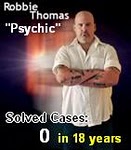
Robbie Thomas, The Angler Fish of Psychics (A Repost)

The following is a repost of a piece originally written for and published on the website www.stoprobbie.com, which is the newest effort in bringing fraudster psychic Robbie Thomas (Poulton) to justice.

As the opening of a previous article on this very subject goes: JoJo’s Psychic Alliance called, they want their frauds back…

It’s not entirely clear really, who’s at fault here, charlatans such as Mr. Robbie Thomas or the ever eager clientele of these predators.  Does Robbie Thomas, the Robbie Thomas who actively misrepresents his involvement in these various cases of missing and murdered persons across Ontario and into the US, exist out of his own design?  Is he the mastermind of a malicious plot to defraud millions of people out of their hard earned money?  Is he an evil genius, undertaking to consume the world in a psychic rage?

Hardly…

There is a notion among Evolutionists, that the prey of certain fish, namely the Angler fish, is actually the selecting factor in the natural evolution of that particular species (Richard Dawkins – The Greatest Show on Earth).  Angler fish are amazing creatures, living and thriving in the inhospitable depths of the ocean, where sunlight scarcely penetrates.  These gruesome Angler fish have adapted to their environment with a surprising and apparently efficient mechanism for attracting the smaller fish they prey on.  Anglers of different varieties have long “rods” protruding from their heads (presumably resembling fishing rods, and hence their apt name); on the ends of these rods are lures – small pieces of flesh resembling worms or deep sea insects.  Some species of Angler fish actually use bioluminescent bacteria to light up their “lure”, all in an effort to make this little death trap as attractive as possible for their prey.  They lurk in the dark depths of this unseen world, dangling their “lure”, aglow and wriggling, waiting for prey of a suitable size to take the bait, and with the horrific power of a Hollywood monster, the Angler opens its gaping maw of a mouth, sucking water into its body and swallowing whole anything unfortunate enough to have fallen for its trick.

It is said by these Evolutionists, that it is the prey who selects the most attractive and most effective individuals of this species (otherwise known as the fittest) for evolutionary advancement, by “taking their bait”, therefore allowing that individual a greater chance to survive and in-turn pass on their genetic material to future generations.

Is it the same with Robbie Thomas?  Is he the ugly Angler fish of the psychic ocean? Spreading his lies and half-truths as a lure to potential victims, all the while refining his methods, evolving his modus operandi into an ever more efficient means of separating fools from their money?  Is he the product of his own misguided sense of moral obligation, or is he the inevitable result of a society that is entirely too gullible?  This may be a variation of the chicken vs. the egg argument, but it does illustrate a point nicely.  Robbie is the product of his environment, that environment thus far rewarding him for behaving as he does.  It’s time for that environment to change, for the betterment of society at large, and as well for the betterment of this community of morally responsible psychics and paranormal enthusiast that he attempts to hide amongst.

A good deal of time and effort has been spent to determine and document the misdoings of Mr. Thomas, never failing to miss the sad fact that his misdeeds are many and far reaching.  This website [www.stoprobbie.com] is now dedicated to highlighting these egregious acts of fraud and misrepresentation, and in that vein it’s important to understand the legal nature of the situation at hand.

The Canadian Criminal Code provides us with definitions for fraud and false pretences (below), and as one would think that it should be enough to simply catch Robbie Thomas in a lie, the law, however, requires much more than that for prosecution.

False pretence (Definition)

s.361 (1) A false pretence is a representation of a matter of fact either present or past, made by words or otherwise, that is known by the person who makes it to be false and that is made with a fraudulent intent to induce the person to whom it is made to act on it.

Whether a seasoned veteran of the Canadian Justice System or a layman who’s never seen the inside of a court room, it’s relatively easy to see that Robbie Thomas is guilty of offering false pretence under this definition.  He actively misrepresents his involvement with various levels of law enforcement, as a key investigator or consultant in the investigation of missing persons, and in the recovery of remains in homicide investigations, even though in each case we can show that he either was not involved at all, or that his involvement was akin to an anonymous tipster.  Furthermore, he uses this false representation, deliberately and with full intent, as a lure to potential clientele for his fortune telling business.  As if it weren’t painfully obvious already, the key point here is simply that Robbie Thomas uses these various lies as advertising testimonials, in a vain attempt to add undue credibility to his services.

Unfortunately, finding similarities between the above definition and the actions of Mr. Thomas is not the same as finding his behaviour to be in contravention of law.  This definition is laid out by the Canadian Criminal Code for the sole purpose of defining the nature of false pretence, as it pertains to the offence of False Pretence (below).

False pretence or false statement (Offence)

s.362 (1) Everyone commits an offence who

(a) by a false pretence, whether directly or through the medium of a contract obtained by a false pretence, obtains anything in respect of which the offence of theft may be committed or causes it to be delivered to another person;

(b) obtains credit by a false pretence or by fraud;

(c) knowingly makes or causes to be made, directly or indirectly, a false statement in writing with intent that it should be relied on, with respect to the financial condition or means or ability to pay of himself or any person, firm or corporation that he is interested in or that he acts for, for the purpose of procuring, in any form whatever, whether for his benefit or the benefit of that person, firm or corporation,

(i) the delivery of personal property,

(ii) the payment of money,

(iii) the making of a loan,

(iv) the grant or extension of credit,

(v) the discount of an account receivable, or

(vi) the making, accepting, discounting or endorsing of a bill of exchange, cheque, draft or promissory note; or

(d) knowing that a false statement in writing has been made with respect to the financial condition or means or ability to pay of himself or another person, firm or corporation that he is interested in or that he acts for, procures on the faith of that statement, whether for his benefit or for the benefit of that person, firm or corporation, anything mentioned in subparagraphs (c)(i) to (vi).

As can be plainly seen, assigning any level of guilt to Thomas under this section –unfortunately the only section that could possibly apply to his circumstance– requires a bit more work.  In layman’s terms, the crime detailed above is simply: anyone who knowingly lies –whether in writing, verbally, or even through the symbolism of implied right– for the purpose of causing someone else to act, by way of handing over property (real or intellectual) or money (actual funds, credit, or even discounts) is guilty of an offence under this section.  This, as any reasonable person would agree, is illegal, and rightfully so.  It should follow that the same reasonable person would find the above description to be fundamentally congruent with the behaviour of Mr. Robbie Thomas.

It has been suggested that another section of the Canadian Criminal Code might be more appropriate, given the profession Mr. Thomas engages in.  The Criminal Code, through a section whose vintage is somewhat aligned with the 17th century witch hunts of early American and western European history (though is somewhat more restrained in its nature) provides the means to prosecute (as opposed to persecute) persons who offer so-called psychic or occult services in a fraudulent manner.  Unfortunately, and for many wide-ranging reasons, this section (shown below) is not applicable in this circumstance, and while it might have been an easier thing to simply call Mr. Thomas a psychic fraud and be done with it, the fact that he claims to be psychic has little to do with the current distain for his behaviour.  His actions would be viewed as morally reprehensible no matter his occupation, from psychic to refrigerator salesman.

Pretending to practise witchcraft, etc.

s.365. Every one who fraudulently;

(a) pretends to exercise or to use any kind of witchcraft, sorcery, enchantment or conjuration,

(b) undertakes, for a consideration, to tell fortunes, or

(c) pretends from his skill in or knowledge of an occult or crafty science to discover where or in what manner anything that is supposed to have been stolen or lost may be found, is guilty of an offence punishable on summary conviction. R.S., c. C-34, s. 323.

The reason for the discrepancy, or misunderstanding if you will, is simply that Robbie Thomas’ claim to being psychic is not necessarily in question.  Quite frankly, few people care if Mr. Thomas has any real ability as a psychic or not (personal opinions and anecdote aside), the fact that he fraudulently represents himself as being affiliated with both law enforcement and with the grieving families of the missing/deceased persons in these cases is more than fair reason to justify a public outcry, and we needn’t enter into an argument of semantics over his self-proclaimed abilities. He may proclaim any manner of silly and entirely ridiculous personal powers, for doing so only makes the case for rational thought all the more potent; what we, the supporters of this website and this movement, assert, is that he may not use the names of innocent and grieving people (often children) in his pursuit of notoriety and fame.

As illustrated by the Angler fish analogy though, is the simple and underlying notion that Robbie Thomas is not to blame, and in this regard we must be careful.  Robbie Thomas has wilfully and knowingly offered false pretence by way of his website and through various advertising mediums in conjunction with his website, time and again, and culpability for those actions is his and his alone.  Where the rest of us come into this bizarre and twisted picture, is in allowing the Robbie Thomas-es of this world to exist in the first place.  Like the prey of the Angler fish, we haplessly select these people for success by accepting their stories and lies without question, teaching them to be better flimflam artists along the way.  We allow Robbie Thomas to behave the way he does, and ultimately we, as a society, must be held accountable for this serious and potentially harmful oversight.  There is no time left for mulling and deliberation, Robbie Thomas and those like him must be made to atone for their transgressions, by way of law and by way of publicly exposing them for the charlatans that they truly are.

So why, you may ask, has he been allowed to continue?  And this is indeed the million dollar question.  Why have authorities failed to take notice?  Why have the families of the deceased stood by while this cretin usurps their charity?  Why has the paranormal community at large not shunned his likeness from their various institutions and halls?  These are difficult questions to answer, except with a loud and deliberate call to arms in the name of morality.  We cannot confidently solve these puzzles here, but we can take ownership of the situation going forward, and demand a higher standard of justice for the victims of these brutal crimes and for their surviving families, and somewhere well down the list of priorities, we can demand a higher standard for the administration and self-policing of the paranormal community.

It is sincerely hoped that these words will be taken with the gravity and forthrightness with which they were offered.  This is a subject that demands and deserves our due attention and respect.

PSI…Where Does It All Come From?

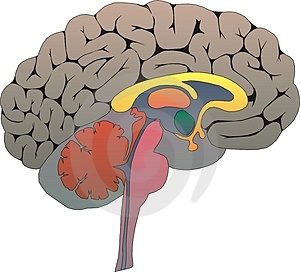
If psychic ability is not rooted in the relatively new (in evolutionary terms) prefrontal cortex of modern man, then it must be housed in some older part of the brain.  If this is the case, then would psychic abilities have been available to prehistoric man?

dorsolateral-prefrontal-cortex3As we’ve come to find, through the many various studies of prehistoric hominid fossils such as Australopithecus Aferensis (‘Lucy’) and Ardipithecus Ramidus (‘Ardi’) [and others], bipedalism, which developed somewhere around 4.5-5 million years ago in hominids, was the catalyst for what may have been the most essential evolutionary divergence ever experienced by a large mammal.[1] This development meant many things for hominids, and by all indications, the most significant aspect of that development was the beginnings of our long evolutionary journey to abstract cognition, brought about through a highly developed prefrontal cortex.

To modern man, the prefrontal cortex is the most important part of what makes him (or her) human.  It offers us the ability to reason (whether we use that ability individually or not), or in the words of Jeremy Lent:

“The prefrontal cortex (or “pfc�?) is that part of our brain that’s primarily responsible for our thinking and acting in ways that differentiate us from all other animals.  It mediates our ability to plan, conceptualize, symbolize, make rules, abstract ideas, and impose meaning on things.  It controls our physiological drives and turns our basic feelings into complex emotions.  It enables us to be aware of ourselves and others as separately existing, and to turn the past and the future into one flowing narrative.�?[2]

The prefrontal cortex may be the root of our famed sense of self, our individualised self-importance and, to the traditionally metaphysical/spiritual, the soul.  Though there has been an enormous amount of scientific, neurological, biological, anthropological, psychological and sociological study conducted with the intended purpose of defining exactly what it is that the prefrontal cortex does for us, as a species, and there are some who seem to take an ego-centric approach to the cannon of information available on this subject.

Among such theories as neurological harmony[3], collective consciousness, and various perversions of Unified Field Theory, there is a large (and growing) group of people who hold to a belief that the pfc is responsible for all things natural and supernatural (and even supernormal) that make humanity stand out against the crowd of biological diversity we share this spinning blue ball with.  And among that crowd, the metaphysical authorities have laid claim to the prefrontal cortex as the home of all psiability.

Before moving on though, we should probably define this term “psi�?.  Within the realm of parapsychology, psi is a catch-all term used to describe all of those strange and wonderful abilities certain people seem to possess, which are traditionally thought to be “psychic�?.  Moreover, it provides a non-theoretical reference to extra-sensory perception and psychokinesis (as an alternative to those terms and thus avoiding their inherent bias).  It is derived directly from the Greek alphabet and literally means ‘mind’ or ‘soul’.  It is in this definition that I wish to work today, and thus provide an alternative way of looking at what psi is and where it might come from.

Eminent French biologist Rene Peoc’h conducted an ingenious experiment in 1985, testing the ability of animals, specifically chicks (baby chickens), to display psi abilities, and ultimately to demonstrate psychokinetic ability.  His experiment was largely successful, though he, like any scientist, has his detractors.  The following is an abstract from Peoc’h’s findings from that experiment:

Peoc'h's famed "tychoscope"

Peoc’h’s famed “tychoscope”

“80 groups of 7 chicks were used to test their ability to influence the trajectory of a robot bearing a candle as the unique source of light in the room. The robot is driven, via telephone line, by a random generator located 23 kilometres away. When chicks are present, the robot moves preferentially into their direction (66.25% out of 80 trials). This is significantly different from the non specific displacement of the machine in the absence of chicks and observer (p<0.00001). The random generator being the source of movements, this result suggests that chicks are able to influence it over a long distance.�?[4]

The outcome of this experiment, which seems to have been conducted fairly cleanly, is such that there is statistical evidence suggesting that these chicks did indeed possess the ability to affect the ‘tychoscope’ through some form of psi.  Peoc’h went on to claim that this was achieved over a great distance of more than 23 kilometres, though this is where his detractors come in; but this issue is not relevant to my purposes here.[5]

Fight-ChicksDirectRobot-SheldrakeThis experiment, which has been repeated with similar success[6], doesn’t speak to defining what psi is, in any of its various forms, but it does seem to present a few things that may eventually become theoretical fact (with a caveat):

1)   Chicks have the ability to affect non-related entities without physical contact.

2)   Chicks require either an emotional/instinctual connection to the entity in question, or must perceive a survival advantage intrinsic to the entity, thus assigning importance to it.[7]

3)   Distance and locality is irrelevant to the effect.

This research is supremely interesting in-and-of-itself, and many have endeavoured to duplicate the effect with other animals, with varying degrees of success.  But there is an underlying significance to this research that may not be readily apparent.

If you were to compare the brain of a chicken (whether full grown or as a chick) to that of a human, there would be some glaring differences, not the least of which is the difference in size.  Though anatomically, there isn’t a whole lot separating these two brains; that is except for the presence of a prefrontal cortex in the human and none in the chicken (which likely comes as no surprise).  Though does this present a slight problem for the earlier idea that psi ability originates in the pfc?

BrainAnatomy

Brain_lateral_view

If the above is true, in either regard, then these ideologies cannot be reconciled, which means that one of the two must be false.  Since the results of Peoc’h’s experiment seem to be supported by statistical data, can we throw out the notion that psi originates in the prefrontal cortex?

I believe we can.  However, this presents new problems, specifically, if psi doesn’t originate in the pfc, then where does it come from?  I believe some light is shed on this issue by understanding the second point presented through Peoc’h’s experiment.

In later experiments from the same sequence, Peoc’h changed the tychoscop and included a lit candle on its surface.  Upon darkening the experiment environment, the chicks were drawn to the light of the candle (as all chickens naturally fear the dark).  You’ll note that in the initial experiment Peoc’h had to take care to imprint the chicks on the tychoscope, and in every case where he didn’t there was no effect between the chicks and the robot, except when he introduced the candle.

What this seems to show is, beyond merely attracting the attention and focus of the chicks, it is an emotional attachment or perceived importance that was most significant to the chick’s ability to influence the robot.  I believe this is our first indicator for tracking down where psi abilities originate in the brain.  Through neurological studies of epilepsy, as well as other such neurological disorders, science has come to understand that emotion is the product of the limbic lobe of the brain (the limbic system), which includes the hypothalamus.

The hypothalamus is a particularly powerful and central component of the brains of pretty much every animal on earth, it acts like a control module for the two parts of the autonomic system of the brain and is believed to be the source of instinct.[8]

So what does this mean?

There seems to be a suggestion hiding in all of this exploratory conjecture, that psi ability, along side emotion and instinct are generated or controlled by the autonomic systems of the brain, and moreover that psi ability is not a cognitive process.  It seems to be much more closely linked to instinct and baser emotions, in both chicks and humans, which in and of itself is quite an interesting conclusion, though I think there may be more to this idea than just an interesting point of conversation.

As mentioned earlier, it isn’t entirely known when our evolutionary development began working on a prefrontal cortex, but one thing is clear, the hypothalamus (which is literally one developmental step above the hindbrain) is much older in evolutionary terms.  Does that mean that psi ability is as old and physiologically intrinsic as say…fight or flight?

Whether psi, or its more popularly termed components -ESP and/or psychokinesis, are founded in a rational process of thought and desire, or that of a much more basic instinctual process is highly intriguing, and this brings me to one final suppositional question…is psi the remnant of a prehistoric ability intrinsic to all mammalian (or even all biological) life, that has, as a result of pfc development, become redundant and ultimately been replaced with human imagination and by extension, technology?

(As a side to the above, I want to point out the irony that such a supposition holds, not only in the fact that I would not be able to participate in this logic, had I not been afforded the benefit of a prefrontal cortex, but also as a challenge to the idea that many metaphysical enthusiast believe mankind is on the brink of some kind of spiritual/psychical awakening, otherwise known as transcendence; though if we’ve shown that psi ability is a discarded piece of old brain semantics, have we not shown that such an awakening would be a serious evolutionary step backward?)


[1] For a definition of bipedalism, see: http://en.wikipedia.org/wiki/Bipedalism; also see Paranormal People’s article regarding ‘Ardi’ here: [2] As found on Mr. Lent’s blog here: http://jeremylent.wordpress.com/2009/10/16/the-tyranny-of-the-prefrontal-cortex/

[3] See: http://www.astrology.com/livereadings/faq.php?id=4

[4] A narrative of the entire experiment can be found here (translated from French): http://gerp.free.fr/rpeoch-chicks.htm

[5] See the Wikipedia entry on the “tychoscope�? for more information (translated from French via Google Translate): http://translate.google.ca/translate?hl=en&sl=fr&u=http://fr.wikipedia.org/wiki/Tychoscope&ei=RdQWS8_CBcuglAf0gtnEBQ&sa=X&oi=translate&ct=result&resnum=3&ved=0CBQQ7gEwAg&prev=/search%3Fq%3DRene%2BPeoc%25E2%2580%2599h%26hl%3Den%26sa%3DG

[6] See the work done by Rupert Sheldrake as presented by John “Birdman�? Bryant: http://www.thebirdman.org/Index/Fight/Fight-SheldrakeOnPresentiment&Psychokinesis.html

[7] See also Imprinting (psychology): http://www.newworldencyclopedia.org/entry/Imprinting_%28psychology%29

[8] For an excellent and understandable breakdown of the importance of the hypothalamus, see: http://www.becomehealthynow.com/article/bodynervousadvanced/825

Encounters With the 5th Dimension; A Theorum

6a00d8341bf7f753ef00e54f09770b8833-800wiIf you navigate your way to the Wikipedia entry regarding the Many-Worlds Interpretation, upon opening the page in your browser you’ll be assaulted with words and terms you may never have believed exist.  You’ll be faced with ideas and theorems so complex, it often takes our greatest minds to understand what they mean, let alone work with them in relation to other equally complex ideas.[1]

Is it all a bunch of scientific mumbo-jumbo, or is there something worth sifting through the jargon for?  Indeed, I would say there is, something that could impact the paranormal research field in such a way as to change our thinking entirely.

This is the weird science of Quantum Theory, named so by none other than Einstein himself.  It’s an extension of String Theory, and a perversion of the Theory of Relativity, and it’s a mathematic enigma so complex it has baffled even the most learned men and women ever produced by our most prestigious scientific colleges the world over.

Many-Worlds, or MWI, aside from being a difficult concept to quantify, is something science fiction writers have been theorising about themselves for decades. Alternate dimensional realities, quantum realities, inter-dimensional beings, star gates; this is the stuff of television shows, of big budget feature movies and of the most fantastic science fiction novels of our time, right?

Not necessarily so.

In scientific terms, Many-Worlds Interpretation -called so as it is an interpretive theory of a paper written by Hugh Everett III (November 11, 1930 – July 19 1982) in 1957 titled �?Relative-State Formulation of Quantum Mechanics’- is an attempt to provide a “simple, natural and realist understanding of unitary quantum theory without invoking wave function collapse or any special role for measurement”.[2]  And while that explanation remains inscrutable, one need not hold a degree in the mathematics of physics to benefit from the work that has been done on the shoulders of men like Everett.

One of the simplest ways to wrap your head around the Many-World Interpretation is offered in the form of Schròdinger’s Cat, which is a well known and often misunderstood mental exercise in visualisation, pertaining to the weirdness of quantum theory, or more specifically, Quantum Entanglement.

Erwin Schròdinger (August 12, 1887 – January 4, 1961), a German born physicist of Einstein calibre, once postulated a paradoxical thought experiment to quantify the problem, as he saw it, with quantum entanglement.  Schròdinger proposed to think of a cat, entrapped in a solid cage, with a flask of poison.  A measurement device, such as a Geiger counter would accompany the cat and thus identify when the flask had released its poison, in turn either killing the cat or not.

The thought experiment then takes a twist, Schròdinger suggested that, prior to a person inspecting the inside of the box, the cat, after having been exposed to the poison would actually exist as a mixed form of both dead and alive cat; essentially holding its quantum potential for both outcomes simultaneously, and only choosing the correct state for this reality upon the cage being open and the conscious mind of the observer influencing the outcome.  He suggested that our perception of reality is what separated the dead cat from the living cat; as until the influence of our perception, the cat exists as both at the same time.[3]  His seemingly morbid and strange assertions were in fact, at least partially supported by a great deal of complex mathematics, and this particular thought experiment became a rather large thorn in the side of theoretical physicists the world over, and still to this day.

Through the extrapolation of this idea and its application to the world, galaxy and universe on the whole, you can see how the poor cat in the cage, carries big ramifications for the furtherance of quantum physics, not the least of which is how to reconcile the idea that all possibilities exist, simultaneously (four simple words with such enormous meaning).

By now you’re asking exactly what this has to do with ghost hunting, and I’m getting to that, I promise.

ghost7Essentially the concept being illustrated by Erwin Schròdinger was that, the way in which we humans perceive our reality (a 3-dimensional reality) is influenced by our perception.  The very particles that make up our reality are actually collapsed manifestations of our own perception from waves of future probability (the reality of the cat, dead or alive, is collapsed from the multiple possibilities inherent to the situation before perceptions influence).  That is to say that space-time is playing a trick on us, as we hurtle through time -time as perceived by our 3-dimensional consciousness- we are collectively presented with every literal possibility of reality in front of us, and it is our observance of that wave of possibility (which isn’t really a wave, but more like a stream) that causes what we see as reality to manifest for our perception.[4]

What if, though, we considered the idea that there are countless other dimensions of reality that we simply are not capable of perceiving?

This is exactly what the science of Quantum Physics is considering now, and has been for several years. Some have mathematically calculated that there are anywhere between 10500 and 10 to the power of 1010,000,000(which is 10 raised to a number ending with ten million zeros) separate universal realities or dimensions.[5]  A value few can even fathom is used to represent the possible number of alternate dimensions to our reality, yet, our brain is incapable of perceiving even a fourth dimension in an accurate way (time is considered the fourth dimension, but it is not linear, our brains simply perceive it that way).

So, to relate the above science to a subject that requires a great deal of illumination, ghosts, can we consider the idea that ghosts are simply an infringement or intrusion of a fifth or sixth (likely fifth) dimension of perception on our reality?  The separation between the fourth dimension (time) and an unknown fifth dimension could be as simple as the difference between the second and third dimensions of our known reality (�?up’ being that difference, or depth for the technically minded)

Electromagnetic radiation, as detectable by simple instruments, and even by the eyes of most living creatures on earth, may in fact be the one element of the multi-verse (if you will indulge) that permeates all of the countless dimensions that could possibly exist.  Light (though much more than the small swath of EM radiation spectrum than we can see), might actually be the unifying principal of existence.

EM radiation, as all you ghost hunters are wondering, is precisely what your trusty EMF meter is detecting, albeit at much lower frequencies than even the eye can pick up; and though there are still literally hundreds of other possible explanations for what causes the EMF readings that most ghost hunters claim to gather as evidence of ghosts, this one should remain intriguing.

A deeper understanding of EM radiation and its effects on both our perceptions and our reality (if there is any difference between the two) is absolutely required before anyone can claim the effectiveness of EMF detection equipment in ghost hunting or paranormal research.  However, it is conceivable that a fourth dimension of reality, one which we are incapable of perceiving, is being revealed to us through EM radiation and the 5th dimension could be manifesting (due to our inability to perceive the fourth dimension) as ghostly visions and/or environmental anomalies of a paranormal nature.

farada4Though the above could be tested, in-so-far as identifying a catalyst which becomes excited when introduced to EM radiation or which excited the radiation itself, such as ionised potassium, and subsequently creating a controlled or EM shielded environment (a la Faraday shielding), and injecting the catalyst into the midst of an EM field of specific frequencies.[6]

If conducted cleanly (i.e. shielded from the interference of outside EM radiation from man-made sources), this experiment could show if there is a relationship between spontaneous EM spikes and an unseen entity, whether ghostly or inter-dimensional. If the catalyst excites the EM field the in the same manner with each successive experiment, then there would seem to be no relationship between EM radiation and either a 5th dimension or the perceptions of the observer; if there is a fluctuating and non-random pattern to the excitation reaction, then it is fair to say that there is an outside influence at play in either the methodology or the perceptions of the observer (by way of an incursion of 5th dimension elements?).   I would predict a non-random reaction from such an EM field in response to the introduction to the catalyst.  However, such an experiment would be dependent on the experimenter’s observance of the interactions between the catalyst and the radiation, thus skewing any results by interpretation.

Human cognitive development is an amazing process; the human brain goes through surprising and fundamental changes throughout its development in the skull of a child and eventually an adult.  Is it conceivable that children, and the lesser developed brains of certain other higher mammals are capable of perceiving EM radiation to a greater extent than fully developed adult humans? And would such a predilection for EM wave energy account for the popular notion that children and animals have the capacity to see ghosts where others can’t?  I admit that to answer in the affirmative to these questions is a stretch, but these are the questions so many seek to answer, and I would suggest that the better vehicle for providing an answer to these, and to the single most important question to the paranormal researcher -what are ghosts?- might be controlled experimentation rather than the collection of biased data in methodologically filthy conditions, by persons with less than even curious regard for the truth.

This is unstable ground to be treading on, but nonetheless I invite anyone and everyone to both try this and any other such experiment, and to post comments, ideas and criticisms of the above theorising.


[1] See: http://en.wikipedia.org/wiki/Many-worlds_interpretation

[2] Quoted from the Perimeter Institute for Theoretical Physics website editorial of the recent 50th anniversary conference on Everett’s paper and theory: http://www.perimeterinstitute.ca/manyworlds/

[3] This is, of course, a very crude layman explanation of �?Schròdinger’s Cat’ thought experiment, for a much more detailed explanation see: http://en.wikipedia.org/wiki/Schr%C3%B6dinger%27s_cat

[4] An excellent resource for understanding the complexities of this concept can be found here: http://www.tenthdimension.com/medialinks.php

[5] Source: http://www.newscientist.com/article/mg20427323.700-multiplying-universes-how-many-is-the-multiverse.html?DCMP=OTC-rss&nsref=online-news

[6] This experiment was first developed by Dale Ave-Lallemant (A.K.Ahttp://twitter.com/OhioGrassman/)

Demons – From Hell and Beyond


The Demon known as Azazel

Devil spawn, stinking and festering creatures of brimstone origin, held at bay by the rules of faith and spirituality.  God toes the line, face-to-face with evil incarnate and all the while we sit in blissful ignorance, right smack in the middle of the ethereal battlefield.

The world behind the world, a thin veil of perception keeps the horrible visions of demonic torture and angelic war, rules of engagement drawn out by the words of the prophets and laid before us, the innocent bystanders, in the form of the holy bible.

Seems a little dramatic, and while I don’t agree with the Heaven and Hell mythology, many, if not most, people do.  The vast majority of public opinion holds that demons are the minions of Satan, and that we are the prize in an ongoing battle between good and evil.  Popular culture has painted a picture on the silver screen and in books that is contrary to the written history of the world.

Films like Constantine, Stigmata and End of Days have all glorified the notion that evil is an entity, hiding in shadow and smoke, waiting for an opportunity to exploit in the absence of the good shepherd.  Relatively modern literature has done the same; it has taken the religiously biased mindset of the public and manipulated consensus to make their story more appealing to those who seek excitement and trills in tempting danger.

I wish to present a new theory, a new consensus, to be taken up by the public and held in the light of reason to explain the entities we commonly refer to as the biblical dogs of hell…the Demon.


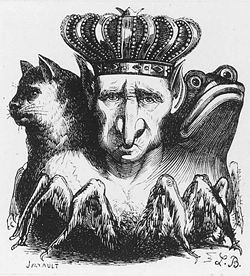
The Demon known s Bael

The idea of demons is not a new one, not by a long shot.  From the time of the great Philosopher ‘Homer’, the term was used to describe superhuman non-god entities that, until the biblical condemnation of the term, were considered to be benevolent. Interstitial and unrelated to our reality, they were believed to be a lower ranking of the beings known to them as The Gods.

It’s interesting to note that all major cultures on earth have, deep in the folk lore of their history, an entity or several entities that are represented by the Demon.  From each culture, there is now a direct link between demons, which are not reducible to humanity, and at least a part of human suffering on earth.

Before we get to what they are, lets examine who they are.  While technically, the term relates to beings or entities that are believed to enter into relations with humans, through a number of various means at their disposal.  This list would include angels, the souls of the passed (including ghosts, genii, familiars and revenants), as well as mythical creatures such as vampires, Incubi, Succubi and many, many more.  There is nearly as much misinformation on Demonic lore as there are Demons to classify.

For a reasonably comprehensive listing of theological Demons, Visit this Wikipedia page.

One thing is becoming relatively clear however, and that is that demonic interaction with humans is increasing in frequency, duration, intensity and effect.  Some see this as the result of our modern culture’s overall rejection of religious dogma and faith.  Other’s are beginning to see connections between humanity and the demonic shadows we encounter that go well beyond the boundaries of religion.


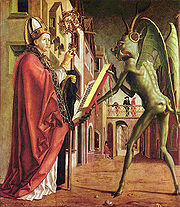
Saint Wolfgang & The Devil

It has been suggested that demonic relations cannot be initiated by the demonic unless a ‘door’ is opened for contact between our realities.  In some areas of the world it seems that not only was a door opened, but it was propped open and forgotten.

The new theory I wish to present is related to the connection between Demons and humanity, and the specifically non-religious nature of Demonology.

In spite of the glamour of Hollywood, the reality of demons is widespread, dangerous and overwrought with amateur paranormalists undertaking to rid their “clients” of demonic activity.  But what if the agenda of the demon is not what you think, what if their motives and reasoning are not rooted in a perpetual battle of good and evil for humanity?

I suggest that very idea, that demons (fitting into that definition only insofar as they are not of human origin) are an invading force of intelligent and malevolent entities from an alternate reality, possibly an alternate dimension of reality.  The torment suffered by those who encounter demons first hand, resembles the suffering often inflicted on insects and small animals by emotionally disturbed children, it resembles a preoccupation with amusement, control and anger, and often has only the single purpose of causing suffering.

Incubus

Incubus

This all seems less like the collateral damage of a war between Heaven and Hell and far more like the pass-time of overpowered and under-stimulated beings whose connection to this world is fleeting and one dimensional; more like a game or a way to amuse and find shelter from an eternity of boredom.  In short, Demons seem more to me like inter-dimensional bullies with too much time on their hands, and in my experience, the only way to stop a bully, is to stand up and refuse to take their abuse any longer.

In any event, the power a Demon can hold over you, is ultimately in your control. You can choose to accept their dominance and be tortured as long as they find amusement in it, or you can slam that so-called door in their face and refuse to take part in their juvenile fraternity games.

I don’t have all the answers, I hope I never do.  What I do have is the curiosity and reason to see things for what they are, and not for what I’m told to believe.

Tricks of the Mind; Sorting Out the Truth

Figure 1.

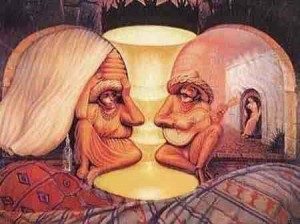
Here are a few demonstrations of just how easy it is to fool the sophisticated perception devices that our so-called big brains use to interpret and reconcile the enormous amounts of conceptual data we experience every day of our lives.  Both figures one and two are common and well known optical illusions, though are they really optical?  And are they really illusions?

Few would doubt that either is just a simple confusing of spatial geometry and/or language norms, but is this really the fault of our optic systems, or is it more indicative of a problem seated deeper inside our minds?

Figure 3.

FINISHED FILES ARE THE RE
SULT OF YEARS OF SCIENTI
FIC STUDY COMBINED WITH
THE EXPERIENCE OF YEARS…

In the above passage, the letter “f” is used a specific number of times, though almost without fail, when one tries to count them out, the outcome is wrong.[1]  Even when the reader is familiar with the word play, they will still end up with the wrong number more often then not.  Is this because people are inherently dim?  Is it because they lack a certain level of attention to detail?  Or is it simply another trick of perception brought on by our brain’s ability to filter information?

Figure 4.

Aoccdrnig to a rscheearch at Cmabrigde Uinervtisy, it deosn’t mttaer in waht oredr the ltteers in a wrod are, the olny iprmoetnt tihng is taht the frist and lsat ltteer be at the rghit pclae. The rset can be a toatl mses and you can sitll raed it wouthit porbelm. Tihs is bcuseae the huamn mnid deos not raed ervey lteter by istlef, but the wrod as a wlohe.

The above jumbled paragraph (figure 4.) is actually a part of a Doctoral Thesis from Nottingham University in 1976, by Graham Rawlinson Ph.D.[2]  Dr. Rawlinson found, through a series of cognitive experiments intended to shed some light on the process by which we, as a species, learn to read, that letter placement within a word is largely irrelevant to both the word’s meaning, and to our ability to quickly decipher the word against the backdrop of a complete sentence.

If a word is jumbled on its own, that is without the context of supporting words in a sentence or paragraph, then our ability to discern its meaning is drastically reduced or completely eliminated, but within the context of a sentence, our ability to understand the sentiment of the language is completely unaffected by the placement of the letters.

Figure 2.

Contrary to what some may be thinking, this does not mean that we are all linguistically psychic, what it means is that our brains rely more on context than on detail.  We derive meaning from patterns, such as language, by interrelating common characteristics and applying them to previous experience, resulting in unique interpretation of characteristics that may be historically similar, but are contextually independent.  But in the case of language, we have cause to find meaningful patterns in what may sometimes seem like complete chaos.  Language is, by definition a static pattern of visual, auditory and (most importantly) conceptual characters.

What this demonstrates, though somewhat clumsily, is that our cognitive powerhouse brains are specifically evolved to do exactly what many in the paranormal research field claim will be our downfall (myself included).  Quite often we use large, generalising terms to describe what is ultimately, a biological necessity for our existence; confirmation bias, belief building, tunnel vision, autosubscription and even to some extent autodebunking.[3]

There are two specific psychological processes that are normally to blame for a great deal of both the autodebunking and autosubscription going on within the paranormal community; Apophenia and Pareidolia.  Either idea, while seemingly similar in definition, is responsible (at least in some part) for a large percentage of paranormal phenomena; from hauntings, to poltergeist, to EVP and to orb photography, and to religious and pseudoscientific ideologies.

Apophenia is often considered a symptom of schizophrenia and autistic spectrum disorders, though we all suffer from apophenic influences on a much more regular basis than a great many people would be comfortable with.[4]  Pareidolia on the other hand, is probably the most underrated and oft lamented ability our brains hold.[5]  Together, these ideas are the foundation of the cognitive interpretation of what you and I might call…reality.  Without these two concepts, or moreover, the processes underlying these concepts, we would not be able to perceive our world.

Here though is the important idea to consider; the underlying processes, of Apophenia and/or Pareidolia are really just symptoms of a larger condition.  A condition, as I call it for lack of a better term, whose main function is to make sense of this strange thing called life.  The mind is continually bombarded with information throughout the day and night, no matter our state of consciousness, no matter our level of attention and no matter our personal propensity for intellectualism or ignorance.  We are bound to a life of sensory overload, or at least we would be had we not developed the ability to make sense of the things we see, hear, feel and well…sense, in a much more efficient way.

While you sit, reading this paper, wherever you might be and in whatever environment you find yourself, there is an almost unfathomable amount of sensory information being presented to you, millisecond by millisecond.  Somehow, through the miracle of cognitive interpretation, you are able to make sense out of that macrocosm, by way of consciously selecting what information is important and what is irrelevant.  At least, you may think it’s a conscious process.

The human mind, as a computational device, has been studied by many in terms of its memory capacity, in comparison to the basic software requirements for cognition.  Some early studies have given us numbers correlated to computer bytes, suggesting that the human brain is capable of retaining up to 1020 bytes of information, though later estimates have reduced that number to a range between 109 and 1013 bytes, which is little more than a few hundred megabytes.[6]  If you can quell that rising sense of righteous indignation for a moment, you can see how poignant that earlier idea of prioritising the perceptual information we’re inundated with really is.

So, this perceptual trickery is really a symptom, or rather a feature, of the efficient nature of our brains.  Subconsciously, our cerebral cortex processes all of the countless bytes of information we encounter over the course of a day.  But our reality is finite, we haven’t the time or the ability to consider, consciously, every piece of sensory information we perceive. We must, in as efficient a manner as possible, discover what is important and what is not, and consequently, we must subconsciously consider the context of all that data in order to determine what is important.

If we cannot consider all of the information we perceive, but we must discern what is relevant, then we must develop a process, a set of rules about what information to consider and what to disregard.

Herein lies the problem however; during that process of enacting, applying and adapting perceptual rules, our environment changes.  It changes drastically, requiring that we adapt and change and understand those changes, and it is this process of adaptation that gives us this unendingly unique ability to see pattern, where pattern doesn’t necessarily exist.

From a survivalist’s perspective, in a world filled with threats to that survival, it will always be a better thing to err on the side of caution.  To see threat where it may or may not exists, rather than to not see threat where it surely does exist.  For this reason, our brains are hardwired (so to speak) to scan the information we perceive quickly, applying it to the various sorting rules we’ve evolved, and whenever a set of environmental conditions fits, even remotely, to any previously experienced situation, we automatically accept it as a fact of reality, whether it truly is or not.

And it is the above idea that brings this discussion full circle and applies it to the world of paranormal research.  The processes or concepts involved in Apophenia and Pareidolia are often blamed for the misidentification and misinterpretation of some of the strangest phenomenon we can encounter in our world, but really, these ideas are just a symptom of a larger perceptual problem.  What we see, hear and feel, are not always to be trusted.  What we know to be true through deduction and reason can, more often than not, trump what we think we see and hear.

Everywhere in our world, our eyes and ears are tricking us, and more so when we delve deep into the mysterious things of our world; we cannot trust the things we know by sight and sound alone, we must quantify and verify the ideas we come to accept and know for certain; we must ensure that those ideas have not been corrupted by perception.  Those common ideas of paranormal pseudo-fact (EVP, apparitions, ghost photography just to name a few) remain unquantifiable and completely unverified, and in so much as they may be caused by unseen and unknown energies, until such time as human fallibility of perception can be eliminated as a cause, caution should be used wherever possible, in the labelling, interpretation and dissemination of these ideas.

In short, beware what your eyes and ears tell you, for they are known to be liars.


[1] Believe it or not, there are six F’s in the passage

[2] See Dr. Rawlinson’s Thesis here: http://opentype.info/static/Letter-Position-in-Word-Recognition.html

[3] Autodebunking is a term coined by Matthew Didier of the Paranormal Studies and Investigations Canada group to describe those who dismiss out-of-hand any evidence to support new and untested theories regarding typically paranormal topics without due attention, and simply based on prejudices of belief alone. In the case of autosubscription, I have simply expanded the above idea to include what might be considered the antithesis of Mr. Didier’s term.

[4] For an easy to understand explanation of Apophenia, see the Wikipedia entry: http://en.wikipedia.org/wiki/Apophenia

[5] A simple explanation of Pareidolia can also be found via Wikipedia: http://en.wikipedia.org/wiki/Pareidolia

[6] One of many studies completed on this issue is nicely summated by Ralph C. Merkle: http://www.merkle.com/humanMemory.html

The History of Demonology – Not All That Growls Is A Monster

“All gods are homemade, and it is we who pull their strings, and so, give them the power to pull ours.” – Aldous Huxley

Once considered to be the leader of modern thought, and widely regarded as an intellectual of the highest calibre, Aldous Huxley gave us a glimpse of his theistic genius in the above quote, but the one flaw in that statement, to my mind, is the omission of an entire class of deistic entities, a corpus of religious manipulation that may hold the power to destroy mankind. [1] That omission may have been innocent, it may have been deliberate, or more likely it was the same simple oversight that the majority of those who think about such ideas commits in their earnest attempt to decipher the riddles of human theistic invention.

Why does God command such attention, when there are much more dangerous ideas lain beside him?

Perhaps he said it better here:

“Most human beings have an absolute and infinite capacity for taking things for granted” –Aldous Huxley

He was not talking about stopping to smell the roses; he was not talking about spending more time with family, and in point of fact, what he was talking about is almost irrelevant.  Those words are more poignant in religious discussion than under any other principle.  What we take for granted are simple facts, simple ideas and simple connections.  We collectively gravitate toward the complex, fanciful and altogether ridiculous ideas of dogma, and only when convenient or trendy do we consider other ideas.

As the title suggests, this is set to be a discussion of the History of Demonology, and it is my research in this regard that brings me to offer such an aggressive opening to the subject.

Demonology is, as defined by the Encarta (North American) Dictionary: (noun) the study of demons, especially those that are frequent in the folklore of some societies.  This definition, however, is an injustice to the trade of Demonology, it speaks only of the common misconception that demons are an external force, to be sought out, vanquished, exorcised and banished from the eyes of all mankind.  But we forget all too easily, either that or we accept pabulum much too willingly.

“All religions are founded on the fear of the many and the cleverness of the few.” –Stendhal [2]

With any capable research into the topic, one can find, with some effort, that the origins of Demonology are rooted in the labelling of humanistic traits of real people, as deemed evil by the early church, though much later than most would have you think.  In approximately the year 590AD, give or take a decade, the church (meaning the very early Catholic hierarchy) began to compile an anthology of demon characteristics and in a painstaking process that is reminiscent of choosing baby names for imaginary children, proceeded to assign ranks and names to various “classes” of demons.[3]

Some of you may find that assertion to be a bit confusing, as did I when I went looking for answers.  But the more I read, the more I’ve come to understand the problem with all this information available about demons.

The history of Demonology, as the concept is known today, is born entirely out of Christian religious doctrine that has been developed and adapted over the last 2000 years or so.  Talmudic teachings speak of demons and of a Jewish classification of demons in various post-exilic concepts that seem to have been influenced by Zoroastrianism, but it should be understood that the Talmudic definition of the term Demon encompasses everything from Spirits to Vampires to certain living people who were, for lack of a better term, disliked.  So, in any literal sense, since Christian demonology is derived from the Jewish theology of demons, the history of Demonology is essentially a blacklisting of people, ideas and things that were out of favour with rabbinic traditions.
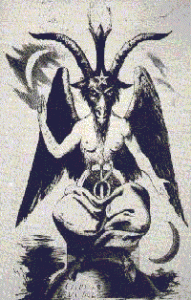
I suspect that this will be less than satisfying to those looking for a real answer though.  So, an examination of the vehicle that brought demonology to its current state is called for.

The idea that Demons are a tangible, malevolent force in some unseen landscape of satanic despotism is, as was stated earlier, an entirely Christian institution, Catholic to be precise.  It is founded on the adversarial nature of Christian theology; the good vs. evil notion.  As mentioned, around the turn of the 5th century AD, Papal officials began to take an accounting of the evil forces at work in their world; a great deal of what they classified as evil and thusly gave demonic identity to, were simple concepts, ten commandment sorts of things.  But in the grand tradition of the Papacy, there were more voices to be heard than there were books to be written, so a great many people -priests, bishops, etc. – were allowed to impart their own versions of various evils.

It’s important to remember what was happening at this time in our history; throughout Europe Christianisation was taking place at an incredible rate, but much of that religious conversion was not voluntary, nor was it particularly effective.  To those tasked with converting old world pagans to the new faith, the obstacles were many, including shamanistic and completely incompatible belief systems.  So, the logical course of action was to demonize those elements of the pagan cultures that were posing the most significant threat to continued Christianisation, and with a little religious slight of hand, the few managed to fool the many into believing that those things they had previously worshiped were evil.

This of course is not to say that all demonic iconography is misidentified pagan ritual, just a large part of it.  There is however that small percentage of demonic lore that was passed along through Old Testament books, many of which are not included in the New Testament Bible, that is based on something entirely more sinister.

But a cold and hard fact remains, there are few who understand the true nature of that small percentage, and even fewer who understand its reach.  As with any cultural meme, there is a grain of truth to all theology; in every group of outlaws, there are those who live the life and those who are just along for the ride, and in any thorough study of Demonology one eventually finds a few tried and true outlaws.  The problem comes from a mixing of so much misinformation passed on through the many years since the inception of Demonology, with what may actually be something beyond our reality.
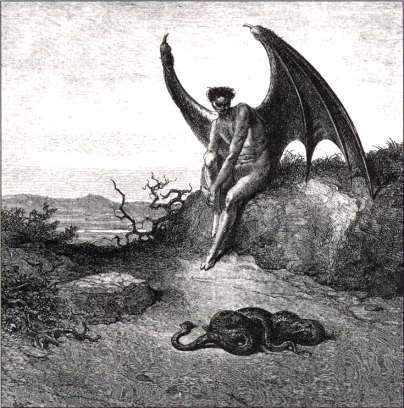
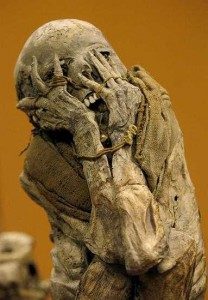
It makes a certain amount of sense, in anthropological terms, for a predevelopment culture to vilify encounters with powers or entities that are not readily explained, and ultimately for a theology to be built around that villainy.  This doesn’t necessarily mean that Demons aren’t dangerous, or even evil as defined by our current cultural standards.  It does seem to mean however, that Demonology is much more of an academic pursuit of the truth in our own history, than a superhero’s quest to save the world from evil.

In the end, we are faced with two truths about the History of Demonology: 1) Not all demons are real, and 2) Not all fairytales are harmless.

I would endeavour to propose here that Demons do not exist, but that would be an erroneous statement.  Demons do exist, in-so-far as the definition for the word and the study of the subject provides examples of people, ideas and things that are deemed to be Demons, though according only to the Catholic Church and to Hermetic writings, but these are not the same idea the masses speak of when they whisper the word demon in the face of unexplained events.  What I can say with unerring impunity is that the Hollywood demon, the Paranormal State demon and the oft lamented torturous and petty demon of modern pop-culture does not exist.

Snarling fangs, supernatural powers, common possession and the pure evil of the devil incarnate are nothing more than the fantastic product of some powerful imaginations.

To close, I’ll offer you an incredulous rant if I may; I find it to be somewhat hypocritical, in this society of ours where every man and woman takes it upon his or herself to define what it is that God and spirituality means to them.  The masses tend to take bits and pieces of various religious theologies, personal experiences, cultural prejudices, and fashionable ideas, and they construct a personal theology that fits with their own belief system.  At the same time, they most often take for granted the dogmatic ideas of demons, evil and the darker side of reality, with little more than a whimper and a secret fear of the unknown.  The assertion that one believes in God, tends to automatically imply that they also believe in Demons, at least in-so-far as their religious leadership warns of demonic influence, but the assertion that one does not believe in God doesn’t come with the same automatic disclaimer.

The popularity of Demonology of late seems to be the product of our Hollywood culture and nothing more, as big budget films and documentary style television strives to tear demonic lore from the hallowed pages of the Good Book, and parade them around as a pet on a leash, but let there be no mistake, Demonology is a religious pursuit, one that should be revered for its discipline and its hold on the past.  We may not agree with the ideas held therein, but we should, as a species doomed to repeat terrible mistakes, at least take an interest in the truth, for truths sake, and not for the sake of a passing fancy.


[1] Aldous Huxley (26 July, 1894 – 22 November, 1963) Author of Brave New World

[2] Stendhal (The pen name of Marie-Henri Beyle 1783-1842) was a renowned French author and is considered to be one of the earliest known and foremost practitioners of realism in his writings.

[3] Source: David G. Scott, Religious Demonologist http://www.nademonicparanormal.com/history.html

Demonology – A Who’s Who of the Demon World

There has been a bit of Demonic sensationalising going on in popular culture of late, ghost hunting television shows have exposed some so-called instances of demonic possession and influence. Some have even named the beastly entities in question, and drawn correlation between various cases to single entities across great distances.

Demonology is a well known discipline of parapsychology and theology, though few people have really done their homework.  The true nature of demons, their purpose and their origin eludes us as a species, and even our own academic ranks are divided among various schools of thought on the very existence of demons. Amid all this scepticism, conjecture and misinformation, the demonic are left to amuse themselves at the expense of the weaker minded.

What follows is a look at the most dangerous demons known to the realm of Demonology (though is not to be taken as a literal listing of real entities, each description is meant as a theological metaphor intended to vilify a certain idea, tradition or prejudice…demons do not exist).

Top 10 Most Dangerous Demons (in alphabetical order):

Amy – The Presiding Demon of Hell

Despite a rather benign name, Amy is an extremely high ranking Demon in Christian theology; he is considered to be the ruling President of Hell. It is said that he appears in flame, but upon taking human form he used his demonic wiles to entrap familiars, to master human sciences and to manipulate the politics of the church. He is bent on taking the thrown of Hell and we are warned that he will use whatever means are possible to do so. Amy may be preoccupied with the political structure of various planes of existence, but he remains capable of commanding legions and waging war on humanity.

Asmodeus – (aka Abaddon) is “The Destroyer”

Mentioned in the Book of Tobias (Deuteronomy), Asmodeus is not your typical all around demon, he is considered to be one of the Princes of Hell, though other sources cite him as one of the King’s of Hell, a distinction that may not be all that important. Among other things, Asmodeus is responsible for the lust component of the famed Seven Deadly Sins, and it is said that those who submit to his sexual manipulation will be doomed to an eternity in the second level of Hell.

Astaroth – one of the Chief Devils

Astaroth is a powerful demon indeed, one of the original 72 to be named in The Lesser Key of Solomon, and this is one to watch out for.  He will use temptation to lure and guide humans to their unending torture; he again, takes a role in the list of the Seven Deadly Sins.

Azazel

Holds the distinction of being the most mysterious extrahuman character in Jewish sacred literature, his presence has been felt throughout the ages, but little is known about his origin or even his affiliation. He is a peddler of influence and knowledge, and popular culture has exploited his reputation and possibly given rise to his recent popularity.

Baal – The Christian King of Hell (also given as Baalim and Bael)

Baal may be the worst demon there is, he is said to be the ruling King of hell. His role as that of the right hand of Satan, and as the leader of sixty-six legions of lesser demons, makes him possibly the most dangerous entity ever conceived. His high rank and responsibility may make him less of a threat to the average living human, though ruthlessness and an all out passion for satanic power make him humanity’s worst nightmare.

Beelzebub – One of the Kings of Hell

Beelzebub may actually be the incarnate identity of Satan himself, though there is doubt in demonology circles. He may be an alternate incarnation of Baal or Bael, or he may be the original fallen angel (with the distinction that Satan was not the original). In any event, Beelzebub is largely regarded as the most powerful and dangerous demon there is. Of the available demons, Baal Zebub (as he is also known), is attributed to not one but two deadly sins, pride and gluttony, though there is some argument about this point.

One point that is seldom argued is Beezebub’s role as one of the three most prominent fallen angels, in the company of Lucifer and Leviathan. He is a force among the ruling echelon of Hell and aside his kin, is a plague on humanity and the heavens.

Byleth – one of the Kings of Hell.

Beleth (one of the many spelling variations is yet another King of Hell, some believe he is a separate incarnation of either Baal or Beelzebub, and as is the case with the demonic, deception and disguise are par for the course. Regardless of his connection to the other Kings of Hell, he is one of the most powerful there is, commanding eighty-eight legions of lesser demons, he is said to be one to offer prize and assistance to those who request it, but usually has an alterior motive.The story of Beleth may be responsible for the “selling your soul to the devil” idiom.

Leviathan

Leviathan, uncommonly not known by any other name, is said to be Satan himself, though argument exists. Typically represented as an enormous sea monster or serpent, it is believed that Leviathan was the serpent to have corrupted Adam and Eve. He stands next to Beelzebub and the famed Lucifer, and rules Hell as one third the almighty triad of Kings.

Lucifer – “Light-bearer”

Lucifer, once translated from the term meaning ‘Morning Star’, is the fallen archangel. He is the ambitious and power hungry Satan and was the subject of God’s wrath as he was cast out of heaven with his band of angels in tow. Some believe that Satan is in fact a representation of Lucifer, Leviathan and Beezebub, and that Hell hath only one King, and his name is Satan. He commands all in the realm of Hell and is the one demon all humanity agrees is most powerful and most dangerous.

Mephistopheles, the original Faustian

Mephisto is commonly held as the originator of the Legend of Faust, wherein the scholar wagers his soul against the devil being able to make Faust wish to live, even for a moment; using circular logic to trick Mephistopheles. He is often portrayed as Satan, though is it likely just his image that has been confused among the theology. He is known as a prince of Hell, and therefore may be considered one of the many hands of Satan

H.P. Lovecraft, the Necronomicon and Ancient Egyptian Mummies

We’re all familiar with the popular Hollywood stories of the dashing American hero, run amuck of the French Foreign Legion in Egypt, and faced with a mercenary charter from a beautiful British woman.  The two narrowly escape capture, only to find themselves swept up in an adventure to save the world from the evil agenda of a mummy and its followers.
As is typically the case in Hollywood, facts sometimes get muddled in the creative process, and what we’ve come to know of the legend of the Book of the Dead, may be less accurate than you think.

It is true that ancient Egyptians made use of a document, now known as ‘The Book of the Dead’, though it is far less dubious than the name suggests.  The name of the book, coined by German Egyptologist Karl Richard Lepsius, was an unfortunate failure of translation from ancient Egyptian, to Arabic, to German and then to English.  Something was definitely lost in that translation.

What archaeology knows as the Book of the Dead was long believed to be the Egyptian Bible, though that belief was replaced with the understanding that the text contains more ritualistic hymns, prayers and incantations, than it does religious doctrine, and was intended to aid the deceased in passing through obstructions in the afterlife (basically a how-to manual for surviving in the hereafter).  It was commonly placed inside the inside the coffin or burial chamber, along with the many other items of spiritual power and wealth.

So, if the Book of the Dead was simply a set of post funeral instructions, where did the mummy legend come from?  This point is up for debate, though some theories have been postulated.

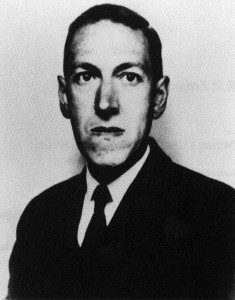
The famed American horror author H.P. Lovecraft (August 20, 1890 – March 15, 1937) may be to blame for more that just a few nightmares.
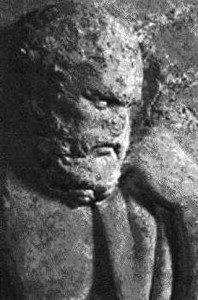
Lovecraft was, in his own time, a little known and under appreciated author of cult stories and strange horror fiction.  His tastes were not aligned with the temperament of his audience at the time, though his work has gained world renown since his death.  Author/Film Maker Stephen King attributes his own sick sense of gore and suspense to Lovecraft (among others).

There is a wide belief that Lovecraft’s most famous work, ‘Cthulhu Mythos’, which has garnered the most attention and influenced more writers worldwide than any other, may actually be a partial plagiarism from the infamous Arabic tome, the Necronomicon.

According to some experts in the study of ancient texts, namely Justin Geoffry in his book ‘The Book of the Arab’, The Necronomicon is shrouded in its own mysteries and misunderstandings.  History had largely accounted the Necronomicon as a collection of evil, as a grimoire or sorcerers handbook, but as is often the case with such fantastic claims, scholars have discovered something very different.

Study of the ancient languages has lead scholars to the correct translation of the books title: ‘Book of Dead Names’.  The Necronomicon was originally written in Damascus in 730ad, by a man who is described by some as a wandering mad poet, Abdul Alhazred.  Little is known about Alhazred, but much speculation has taken place and many believe that he was a well read nomad born of the Yemen province of Sanaa.

What is known is that the Necronomicon was an incoherent literary rambling of a man who has been compared to Madam Blavatsky, famed author of ‘The Secret Doctrine’.  It is believed that the actual purpose of the book was an historical accounting of traditions, languages and important people who had passed on, though Alhazred was less talented as a writer, than he was as a historian.

As a result of his tendency to spin in tangent mid sentence and to marry odd concepts together with little logic or meaning, superstitious readers of the book became convinced that the book itself held supernatural powers, bestowed upon it by the raving madman.

So where does Lovecraft fit into all this?

Well, poet and magician Aleister Crowley is known to have studied various copies of the actual Necronomicon texts (of which there are variations due to banning, destruction and selective editing) as a part of research for his own ‘Book of the Law’, and as it turns out, Crowley’s love interest and later wife, Sonia Greene, was an influential acquaintance of Lovecraft, and had both opportunity and cause to share her suitors work and ideas with the weirdly charismatic horror author.

This is all well and good, and provides some food for thought, but there’s still no connection between the modern mummy legends and Lovecraft, let alone the Necronomicon.

The leap from Lovecraft to modern Hollywood is no real stretch; after all, so many writers and directors are vociferous in their love of Lovecraft.  It’s not hard to see how the fundamentals of the ‘Cthulhu Mythos’ leeched its way into popular culture.  The one piece of evidence that is compelling in all this is the fact that no other book or script in the history of mankind has been so vehemently regarded as an ancient grimoire for raising and controlling the dead.  The Necronomicon is such a book, and the superstition surrounding this script is virtually identical in foundation to the very adventures our hero and his heroine face on the silver screen.

Believe what you may, but know that behind every great adventure story is a grain of truth, though that truth may come from somewhere completely surprising.

Vive La Révolution

In living rooms, basements, offices and bedrooms the world over; on desktops, laptops, PC’s and Mac’s; people across the globe are drawing battle lines, making plans for a veritable war, a war whose casualties will be words and ideas and traditions.  Sides must be chosen, alliances must be formed and enemies must be scouted, for we are on the eve of a revolution of thought.

In reality, this is a silent war that’s been waging for decades, between believers and doubters, between sceptics and followers, between those who choose to shout from their roof top “they are here, and I believe!” and those who respond with gruff sarcasm “and I believe I’ll wait for proof.”

This conflict between those of hard faith and those of hard fact is actually an ancient tradition; whole hierarchical systems of authority have been built on the idea that those who think they know what’s what, want to be sure those who might think otherwise are silent on the subject.  This is an old problem, one for which the pendulum of favour swings far in the direction of either side.  The issue rarely matters: religion, politics, science, art…no matter the subject, as long as there is a public discourse on the topic, there will be a delineation of sides, and more often than not, those sides will be entirely unbalanced.

In the 6th century BCE, our greatest scholars knew, as sure as they knew their own names, that the Earth was a flat disk, floating on a great sea at the center of the universe.  It was the truth, it was undoubtedly certain and indisputable; until the sceptical voice of dissent began to criticise the so-called facts.  They began to analyse and evaluate what was known, comparing the facts to other known facts, and low and behold, they found some incredible discrepancies.

As we all know, by the 3rd century BCE, and with the establishment of Hellenistic Astronomy, the questions became too much for the antiquated facts to bear, and our collective understanding shifted in favour of the Spherical Earth concept.  Whole reputations were smashed, belief systems toppled, faith in deistic traditions was shaken, but, and this is the important part, the truth was found.

The battle between truth and convenient assumption is an ongoing theatre of logical manoeuvres, and it revolves around public debate of the issues faced by any one era of social development.  The importance of that debate has never been so severe as today, and as was outlined by American Politician Al Gore in his book The Assault on Reason, the public conversation is currently in jeopardy of being lost to the one sided, biased and entirely ill-equipped monologue of television, and by proxy, the big money businesses that support television programming.

There are few sectors of modern society that are freely debated and examined by the public at large, for the most part, popular views on the topics with which we, as the people, are concerned, are force fed to us by news anchors and correspondents.  Rarely are we given opportunity to respond, to criticise, or even to agree with the status quo, as manufactured by network news; but one subject is now, as it has been for the last three decades at least, a shining example of the public conversation at it’s most diverse.

That subject is the paranormal, and all that fits under that broadly defined term.

It has long been fascinating to me, the amount of information, educated opinion and free flowing conversation that takes place under the auspices of paranormal research.  In no other arena of academia, spirituality and entertainment has there been such an outpouring of social connection between people in all walks of life, in all economic circumstances and at nearly all levels of formal education.  To some, the community representing paranormal interests is unorganised, unfocused and unmotivated, but to others, it is a vast sea of debate, exploration, investigation and, ultimately, one of the largest unstructured information sharing projects the world has ever known.

Though the paranormal community discussion has its share of problems too; as with any social debate, the various camps of belief involved have their zealots, their fundamentalists, their moderates, their academics, their thrill seekers and their dogmatists, each struggling in their own way to be heard, to be validated and in some cases to be praised.  Each has their own points to make, and each believes their position to be more or less justified than the next.

In the subculture of paranormal research, which is an enormous venue to be sure, we are faced with a changing of the guard, if you will.  What was once the refuge of quackery and hocus-pocus, is quickly becoming a stage for sceptical inquiry, for rational discussion and a transparency in research like never seen before.  Every splintered genre of paranormality is represented in growing numbers by pioneering scholars and passionate researchers, and while there remains a grandfathered theology to much of what is being discussed, no stone is being left unturned in this steady march toward the truth.

In amongst this vast public conversation, fuelled by the internet, powered by curiosity and funded by enthusiasm, there is a social revolution brewing.  Much like the decidedly one dimensional thinking of the ruling social class of the 6th through 3rd centuries BCE, some old notions about what is real and what is truth are about to be tipped on their head.  It may not come as a brain splitting epiphany, and it may not be completely obvious to the masses at first, but this revolution of thinking is underway, and there are three concepts which give it speed; critical examination, passionate exploration and unquenchable curiosity.

Of course, this is not a road paved with gold and shouldered with roses; there are barriers and detours ahead.  Those of us with an eye toward the future can see where our path may diverge from that of our less committed brethren.  We can see where old thinking and ignorant perspectives are going to get in the way, and some of those barriers will come from places least expected.  Authority arguments based on intangible and incredible sources, uncritical collection of data, inter-political posturing, and worst of all, a propensity to throw common sense out the window.

At the end of the day, when all the ghost hunting gear is put away, all the UFO reports have been filed and the Bigfoot photos have been scanned, each and every one of us is human; we are prone to pangs of ego, influenced by greed, affected by ridicule and ultimately, are in imminent danger of complete and total failure.  There are great things ahead for those who are willing to endure and to participate in the debate with honesty and integrity.  For those who are looking to exploit the vast mysteries in this particular debate to selfish and unscrupulous ends, I’m sorry to say, you will be left in the cold by those of us with enough sense to see past your flim-flam show, and to move beyond it in search of the truth.

This need not be a campfire song cliché, we needn’t hold hands and commune in order to reap the benefits of this transformation…all we need do is open our eyes and keep doing what we’ve been doing.  The discussion will get louder, more voices will be heard, and in the end, we will all be richer for the experience.